


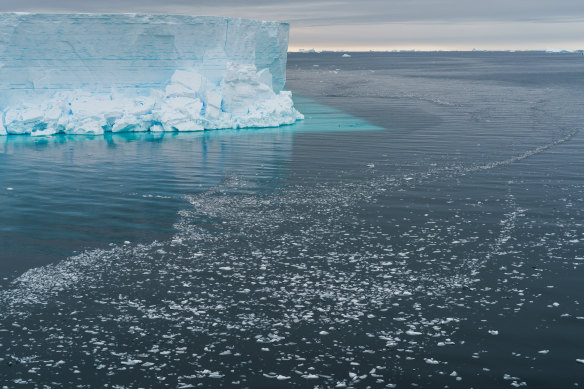
A gigantic iceberg about 30 kilometres long cracked off the ice sheet on January 13, revealing a swath of ocean that had not seen daylight in decades.
A gigantic iceberg about 30 kilometres long cracked off the ice sheet on January 13, revealing a swath of ocean that had not seen daylight in decades.
By Dino Grandoni
March 21, 2025 — 5.25am
Researchers were working off the coast of Antarctica when it happened: A gigantic iceberg about 30 kilometres longcracked off the ice sheet on January 13, revealing a swath of ocean that had not seen daylight in decades.
The team aboard a research vessel called the Falkor (too) decided to search the seafloor under the freshly exposed ocean. No human had ever explored the deep sea there before.

“It’s the kind of event that, when it happens, you leave whatever you’re doing,” said Patricia Esquete, the expedition’s chief scientist.
But expectations weren’t high. The scientists didn’t think much life could thrive under such a thick blanket of ice.
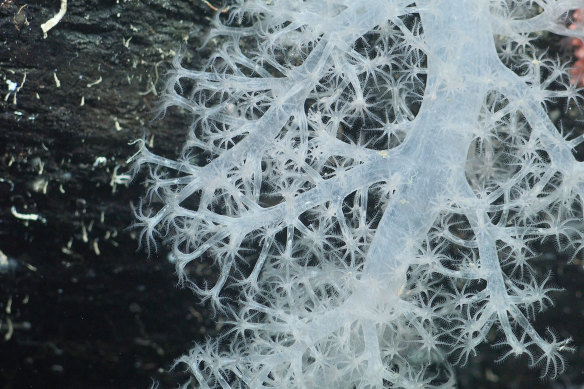
Yet what the team members found under the iceberg surprised them: giant sea spiders, octopuses, ice fish, corals and sponges, including a vase-shaped one that may be hundreds of years old. In total, the researchers believe they will be able to identify dozens of new species from the expedition.
“We were really surprised and amazed by the diverse ecosystems and the rich ecosystems we found down there,” said Esquete, a researcher at the University of Aveiro in Portugal.
The discovery, announced on Thursday, not only shows how life finds a way into nearly every corner of the world – including entombed under floating glaciers – but also provides a crucial baseline for understanding how deep-sea life may change on a warming planet.
“They were really serendipitously in the right place at the right time to be right there and to see an ecosystem,” said Jyotika Virmani, head of the Schmidt Ocean Institute, a nonprofit that facilitated the research.
Advertisement

During the roughly month-long expedition, the researchers piloted a remotely operated vehicle to capture photos and video and collect specimens from some of the deepest reaches off Antarctica. The team also explored areas of the remote Bellingshausen Sea farther from the ice sheet. Among the species potentially new to science are crustaceans, sea snails, worms and fish.
It will take months of lab analysis to confirm the discovery of any new species. “Most of the work starts now,” Esquete said.

After a Schmidt Ocean Institute expedition off the coast of Chile last year, scientists identified more than 70 new species, including squat lobsters and marine snails that were new to science.
Off Antarctica, the biggest mystery isn’t centred on any particular creature but on the entire ecosystem: How exactly does that much life thrive under so much ice?
In other parts of the ocean, photosynthesising organisms rain down nutrients to sustain benthic creatures, which live on, in or near the seafloor. But none do so under the dark Antarctic ice. Instead, ocean currents, glacial meltwater or something else has been helping to nourish the deep-sea creatures.

“This is all very much an area of active scientific research now because of this discovery,” Virmani said.
Esquete hopes to go back to see how life under an area uncovered by ice changes, providing a window into how deep-sea life in polar regions may change as temperatures rise and more icebergs calve in Antarctica and elsewhere.
The George VI Ice Shelf from which the iceberg broke has experienced widespread melting in recent years.

The Washington Post
Start the day with a summary of the day’s most important and interesting stories, analysis and insights. Sign up for our Morning Edition newsletter.
Loading