


Day three of Antoinette Lattouf’s unfair dismissal case continues with ABC managing director David Anderson in the witness box for two hours of cross-examination.
Day three of Antoinette Lattouf’s unfair dismissal case continues with ABC managing director David Anderson in the witness box for two hours of cross-examination.
Good afternoon, I’m Calum Jaspan, and welcome back to our live coverage of Antoinette Lattouf v the ABC in the Federal Court.

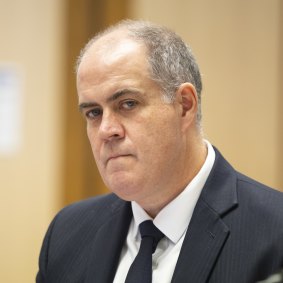
We’re now on day three of freelance journalist Lattouf’s unlawful termination case against the ABC. She initially took the public broadcaster to the Fair Work Commission after she was sacked in late 2023, three days into a five-day contract hosting a local radio show in Sydney. Since then, it has snowballed into a full-blown crisis for the ABC.
She was sacked after reposting a report from Human Rights Watch on her Instagram account and is claiming, in part, this was due to expressing political opinion and racial discrimination.
The ABC has continued to deny she was sacked or that its most senior executives, including then-chair Ita Buttrose and outgoing managing director David Anderson, were influenced by pro-Israel lobbyists in their decision.
Building on Anderson’s comments that a step may have been missing in the process, he says he had “no doubt” Oliver-Taylor’s direction was lawful or reasonable.
Beforehand, Anderson said he was not “entirely sure how adequate” the steps were to seek the right advice from employee relations and the people and culture department when making the decision.
“But otherwise it might not have changed the outcomes,” he said.
Anderson is being quizzed about Chris Oliver-Taylor’s decision to remove Lattouf.
He says: “If Mr Oliver-Taylor had his time over again, he might have sought additional advice from other people before he made his decision, but otherwise, I don’t know. I don’t know that I have an answer for you, that’s useful.”
Asked if he has any regrets over the process, Anderson says he “personally believes there was potentially a step missing, with regard to this issue, but it might have had the same ending”.
“What was the step missing an investigation?” Fagir asks.
Anderson responds: “Hindsight is a wonderful thing. You would like to have seen that there was certainly a discussion with Ms Lattouf to find out the motivation behind what I believed at the time was disobeying a direction, and then tried to ascertain what the resulting risk was.”
Fagir brings up an ABC report published on December 18, 2023, in which the broadcaster reported that Human Rights Watch had accused Israel of using starvation as a weapon of war.
“I look at the headline. The headline doesn’t breach what I would consider to be impartial. Out of the obligations, you’d want to have a look at the entire article, see the context, the analysis, any right of reply, all the things that we would expect to go to the publication,” Anderson says.
This article is important, as it is the same Human Rights Watch report that Lattouf shared on her social media on December 19, 2023. The ABC reported the story the day before Lattouf’s post.
Fagir says he wants to put to one side any suggestion the ABC has a single rule that no employee can express an opinion in which one section of the community may disagree.
“Nor does the ABC have any rule that it will not employ a person who has expressed opinions with which a section of the community disagrees on,” Fagir says.
Anderson agrees on both counts. “There needs to be something more than that,” he says.
When asked if he followed Lattouf’s cross-examination on Monday, Anderson admits he has not followed any of the proceedings so far.
Anderson agrees with the proposition it would be unreasonable to expect that the social media activity of an employee before they join the ABC would comply with the Act.
“We can’t regulate what they do on social media. People will do what they wish on their personal use of social media. We can’t prevent them for it, all we can have is a consequence if they don’t abide by these guidelines,” Anderson says.
“The proposition that I put to you is that there is a delineation between editorial policies and personal conduct policies at the ABC. Do you agree or disagree? I suggest to you as a clear delineation, would you agree with that?” Fagir asks.
“Yes,” says Anderson.
Personal social media usage is not subject to the editorial policies, Anderson then agrees.
“If a complaint is received about content on a personal account, it will not be investigated as an editorial complaint, or assessed against editorial policy,” Fagir quotes from an ABC standards document. Anderson confirms this is correct.
Anderson accepts the ABC’s content will at times cause offence, discomfort or even outrage through its editorial content.
“We do have an editorial policy that does deal with harm and offence,” Anderson said.
“On top of my head, it’s editorial policy number seven […] it doesn’t mean that we shy away from potentially offending people, but we do have editorial circumstances by which that could happen.”
Anderson agrees with the contention that some perspectives do not deserve to be presented as equal, such as those of Australians who are Nazis.
Fagir continues to quiz Anderson about the ABC’s editorial policies, and the role of the editorial director. It is pretty straight forward stuff so far.
“I wouldn’t characterise it like that,” Anderson says, when asked if the editorial director is the most senior subject matter expert on ABC editorial policies.
Lattouf’s barrister Fagir begins by asking Anderson about the ABC’s charter, Act, enterprise agreement and code of conduct.
He asks Anderson if the rules discussed apply to all employees including himself.
“We have expectations that are set across all of our staff from the highest executives to anyone that’s in the lower band. So by definition, that is all staff in the organisation have obligations to the organisation itself,” Anderson says.
When asked by Fagir, Anderson says he understands the difference between a “suggestion” and a “direction”.
Before we get under way, the ABC’s barrister Ian Neil, SC, clarifies a point made by Lattouf’s barrister Oshie Fagir on Monday, that the ABC rejects Lattouf’s claim of racial discrimination, because she has not proven being Lebanese, Middle Eastern or Arab is a race.
“The ABC does not deny the existence of any race. I repeat that the ABC does not deny the existence of any race,” Neil says.
“The point being made there is, that this is an issue in respect of which the applicant has an onus, and that she has not equipped the court with any evidence upon which to resolve that issue, please.”
“There is no evidence consistent with the hypothesis that race or national extraction had anything to do with any matter under consideration in these proceedings,” Neil concludes, before Anderson is called to the stand.