


The Australian sharemarket has slumped in early trade, with particularly deep falls in the shares of miners that rely on China as critical customer.
The Australian sharemarket has slumped in early trade, with particularly deep falls in the shares of miners that rely on China as critical customer.
- Updated
- Business
- Markets
- World markets
By Staff reporters
Updated April 9, 2025 — 10.40amfirst published at 3.15am
The Australian sharemarket has tumbled in early trade, reversing most of Tuesday’s gains, after another wild session on Wall Street as investors brace for the United States to ramp up its trade war with China.
The S&P/ASX200 was 1.9 per cent lower shortly after trading commenced, with all 11 of the ASX sectors in the red. Mining companies that rely on China as a crucial customer fell sharply, with mining giant BHP dropping 4 per cent, Rio Tinto down 4.6 per cent and Fortescue down 5.33 per cent.

Energy companies were also deep in the red, with Woodside slumping by 3.2 per cent and Santos down 3.4 per cent, after the oil price continued to fall amid worries about how the trade war will hit economic growth.
Health care stocks were sharply lower, with CSL – one of the biggest stocks on the index – losing 3.8 per cent. Banks were mixed, with Commonwealth Bank down 0.1 per cent, Westpac down 0.5 per cent, and ANZ Bank down 0.8 per cent, while National Australia Bank rose 0.7 per cent.
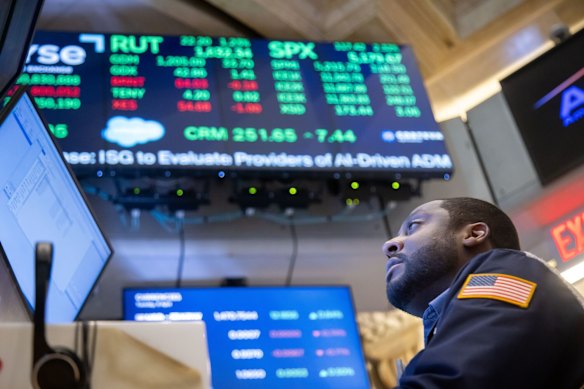
Overnight, US stocks dove following another stunning reversal, with Wall Street veering from a huge gain at the opening of trading to more losses at the close, because investors still have no idea what to make of President Donald Trump’s trade war, which is scheduled to kick into a higher gear at 2pm AEST.
Loading
After blasting to an early gain of 4.1 per cent, which would have marked its best day in years, the S&P 500 quickly lost all of it. It then careened to a loss of 3 per cent before paring its drop to 1.6 per cent. That left the index, which sits at the heart of many investors’ 401(k) accounts, nearly 19 per cent below its record set in February.
The Dow Jones lost 320 points, or 0.8 per cent, after erasing an earlier surge of 1,460 points, while the Nasdaq composite dropped 2.1 per cent.
The Australian dollar lost further ground. It was fetching 59.32 US cents at 10.20am AEST.
Advertisement
The big question remains centred on how long Trump will keep his stiff tariffs on other countries, which would raise prices for US shoppers and slow the economy. If they last a long time, economists and investors expect them to cause a recession. But if Trump lowers them through negotiations relatively quickly, the worst-case scenario can be avoided.
Hope still remains on Wall Street that negotiations may be possible, which helped drive the morning’s rally. Trump said Tuesday that a conversation with South Korea’s acting president helped them reach the “confines and probability of a great DEAL for both countries.”
“Their top TEAM is on a plane heading to the US, and things are looking good,” Trump said on his Truth Social platform. “We are likewise dealing with many other countries, all of whom want to make a deal with the United States.”
Japanese stocks led global markets higher after the country’s prime minister, Shigeru Ishiba, appointed his trade negotiator for talks with the United States. It was based on an agreement between Ishiba and Trump, Japanese officials said.
But investors should still remain cautious, said Sameer Samana, a senior global market strategist for Wells Fargo Investment Institute. He pointed to how “the key countries continue to escalate, rather than de-escalate.”
China said it will “fight to the end” and warned of countermeasures after Trump threatened on Monday to raise his tariffs even further on the world’s second-largest economy.
White House press secretary Karoline Leavitt then said Tuesday that Trump’s threats of even higher tariffs on China will become reality after midnight, when imports from China will be taxed at a stunning 104 per cent rate.
That would coincide with Trump’s latest set of broad tariffs, which are scheduled to kick in at 12:01 a.m. And Trump has made clear that he does not intend to have any exemptions or exclusions in the tariffs, according to the country’s top trade negotiator, Jamieson Greer.
Trump’s trade war is an attack on the globalisation that’s shaped the world’s economy and helped bring down prices for products on store shelves but also caused manufacturing jobs to leave for other countries. Trump has said he wants to narrow trade deficits, which measure how much more the United States imports from other countries than it sends to them as exports.
On Wall Street, companies with vast supply chains around the world helped lead the losses. Ralph Lauren sank 5.6 per cent, for example. It sourced about 15 per cent of its products from China last fiscal year.
Loading
On the winning side of Wall Street were health insurers, which rose after the Centres for Medicare & Medicaid Services announced a stronger-than-expected increase in Medicare Advantage payments for next year. Humana jumped 10.7 per cent, and United Health climbed 5.4 per cent.
In the bond market, longer-term Treasury yields rose for a second straight day to recover more of their sharp losses from prior months. The yield on the 10-year Treasury climbed to 4.27 per cent from 4.15 per cent late Monday and from just 4.01 per cent late Friday.
Yields tend to rise with expectations for the US economy’s strength and for inflation.
with AP
The Market Recap newsletter is a wrap of the day’s trading. Get it each weekday afternoon.
Loading