


Back down goes Wall Street, and its former superstars are once again leading the way.
Back down goes Wall Street, and its former superstars are once again leading the way.
By Stan Choe
March 19, 2025 — 4.12am
Back down goes Wall Street, and its former superstars are once again leading the way on Tuesday.
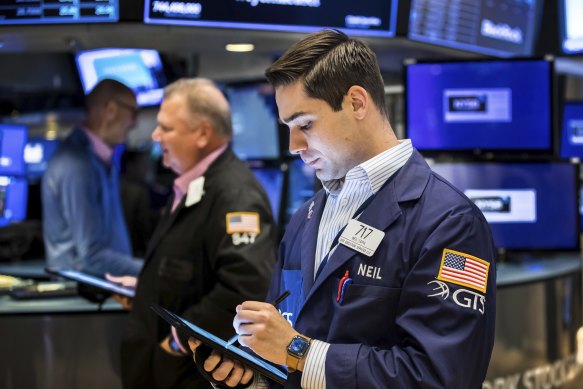
The S&P 500 is down 1 per cent in afternoon trading. It’s the latest swerve in a scary ride where it tumbled by 10 per cent from its record and then rallied for two straight days. The Dow Jones was down 245 points, or 0.6 per cent, in mid-afternoon trade and the Nasdaq composite was 1.5 per cent lower.

The Australian sharemarket is set to retreat, with futures at 4.54am AEDT pointing to a fall of 44 points, or 0.6 per cent, at the open. The ASX edged up by 0.1 per cent on Tuesday. The Australian dollar slid. It was 0.4 per cent lower at 63.59 US cents at 5.11am AEDT.
Tesla was one of the heaviest weights on the market after falling 4.6 per cent. The electric-vehicle maker’s stock has been struggling on worries that it will lose sales because of anger at its CEO, Elon Musk, who has been leading efforts to cut spending by the US government. EV rivals, meanwhile, continue to chip away at its business. China’s BYD on Monday announced an ultra-fast charging system that it says is nearly as quick as a gasoline fill-up.
Alphabet sank 2.5 per cent after the owner of Google said it would buy cybersecurity firm Wiz for $US32 billion ($50 billion). It would be the company’s most expensive purchase in its 26-year history, and it could boost the tech giant’s in-house cloud computing amid burgeoning artificial-intelligence growth.
The drop for Big Tech continues a trend that’s taken hold in the market’s recent sell-off: Stocks whose momentum had earlier seemed unstoppable have since dropped sharply following criticism that they had simply grown too expensive.
Loading
Chief among them have been stocks that zoomed higher in the frenzy around AI technology. Nvidia fell 2 per cent. Super Micro Computer, which makes servers, lost 3.9 per cent. Palantir Technologies, which offers an AI platform for customers, sank 2.8 per cent.
These stocks have been among the biggest losers as Wall Street retrenches amid uncertainty about what President Donald Trump’s trade war will do to the economy. Trump’s announcements on tariffs and other policies have created worries that US households and businesses could hold back on their spending, which would hurt the economy.
Advertisement
It all makes the calculus different for the Federal Reserve, which is beginning its latest meeting on interest-rate policy and will make its announcement on Wednesday.
The Fed could lower its main interest rate, which would make it easier for US businesses and households to borrow. That in turn could boost the economy. But lower interest rates can also push inflation upward, and US consumers have already begun bracing for higher inflation because of tariffs.
Virtually everyone on Wall Street expects the Fed to hold its main interest rate steady on Wednesday, as it waits for clues about how the uncertainty will play out. The job market, for the moment at least, appears relatively stable after the economy closed last year running at a solid rate.
More attention will be on the forecasts the Fed will publish after the meeting, showing where officials expect interest rates, inflation and the economy to head in upcoming years. For now, traders on Wall Street are largely expecting the Fed to deliver two or three cuts to rates through the end of this year.
One of the reasons the US stock market’s sell-off in recent weeks has “so far been orderly,” with the epicentre remaining within tech, may be because of faith that the Fed can protect Wall Street, according to strategists at Barclays. If conditions were to deteriorate quickly, the Fed could cut rates to support the economy.
Such faith “crucially could be put to test this week” if the Fed appears to be more concerned about inflation than a weakening economy, at least relative to the market’s expectations, according to the Barclays strategists led by Venu Krishna.
Loading
In stock markets abroad, indexes rose across much of Europe and Asia. They have broadly been doing better than the US stock market this year, flipping a years-long trend and forcing questions about whether the end has arrived for what was called “US exceptionalism.”
Japan’s Nikkei 225 rose 1.2 per cent. Investors expect the Bank of Japan to keep its benchmark interest rate unchanged at a monetary policy board meeting due to wrap up Wednesday.
Trading on Indonesia’s stock exchange was suspended temporarily as the benchmark JSX tumbled as much as 6 per cent. But it later pared the loss to 3.8 per cent.
Investors have been sending shares of state-owned banks lower after the government launched a sovereign wealth fund, called Danantara, that so far has not proven popular. Worries over US tariffs and other risks have also shaken confidence in the economy of the world’s fourth-most populous nation, said Budi Frensidy, a professor at the University of Indonesia.
In the bond market, the yield on the 10-year US Treasury note edged down to 4.28 per cent from 4.31 per cent late on Monday.
AP
The Market Recap newsletter is a wrap of the day’s trading. Get it each weekday afternoon.
Loading