


Wall Street is falling again as US households get more pessimistic about the economy because of inflation, tariffs and other policies coming from Washington.
Wall Street is falling again as US households get more pessimistic about the economy because of inflation, tariffs and other policies coming from Washington.
By Stan Choe
February 26, 2025 — 4.17am
Wall Street is falling again as US households get more pessimistic about the economy because of inflation, tariffs and other policies coming from Washington.
The S&P 500 was down 0.4 per cent in afternoon trading. It’s coming off a three-day losing streak after setting an all-time high last week. The Nasdaq composite was 1 per cent lower in early afternoon trade, while the Dow Jones was an outlier and up 157 points, or 0.3 per cent. The Australian sharemarket is set to decline, with futures at 4.54am AEDT pointing to a loss of 32 points, or 0.4 per cent, at the open. The ASX lost 0.7 per cent on Tuesday.

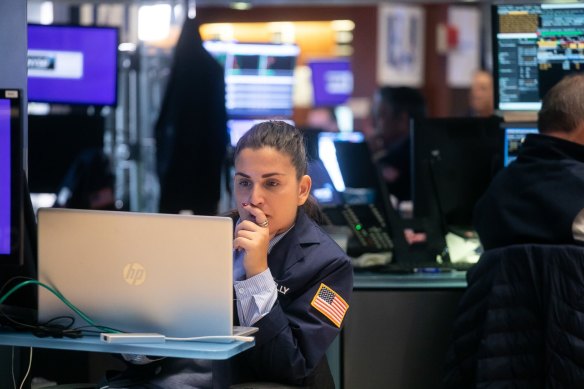
The US stock market has been sinking since the middle of last week after several weaker-than-expected reports on the economy thudded onto Wall Street. On Tuesday, the latest update said confidence among US consumers is falling by more than economists expected.
To be sure, the US economy still appears to be in solid shape, with growth continuing at the moment. But for the first time since June, a measure of consumers’ expectations for the economy in the short term fell below a threshold that usually signals a recession ahead, according to The Conference Board. The increase in pessimism was broad-based and carried across both higher- and lower-income households, as well as older and younger ones.
“There was a sharp increase in the mentions of trade and tariffs, back to a level unseen since 2019,” according to Stephanie Guichard, senior economist, global indicators at The Conference Board. “Most notably, comments on the current administration and its policies dominated the responses.”
Loading
The White House has the position that the lower consumer confidence reflects the overhang of the Biden administration and that the recent announcements by Apple and measures of CEO confidence reflect growth ahead.
Wall Street closely tracks such data because spending by US households is the biggest engine driving the US economy. And Tuesday’s report echoed what an earlier report from the University of Michigan suggested: Consumers see the current situation as OK, but they’re worried about the future.
Within the S&P 500, the heaviest weights included high-momentum stocks that had been among Wall Street’s biggest stars in recent years. Nvidia fell 1 per cent, for example, while Tesla tumbled 8.1 per cent.
Advertisement
Bitcoin sank more than 8 per cent, falling back below $US88,000 ($138,830), which dragged down stocks of companies in the crypto industry. MicroStrategy, the company that’s raised money with the express purpose of buying bitcoin and now goes by the name Strategy, fell 11.6 per cent
Zoom Communications dropped 8.6 per cent even though it reported stronger results for the latest quarter than expected. Analysts at UBS pointed to the company’s forecast for revenue growth in the upcoming year, which fell a bit short of their own estimate.
They helped offset a 4.8 per cent rise for Home Depot, which delivered a stronger profit for the latest quarter than analysts expected. CEO Ted Decker, though, said the retailer is still contending with an uncertain economy and higher interest rates, which hems in customers’ ability to spend on home improvements.
Home Depot was the biggest reason the Dow Jones, which includes only 30 stocks, was doing so much better than the S&P 500 and other broader measures of the market.
Slightly more stocks rose on Wall Street than fell, though many of the gainers were smaller in size. That means they have less of an impact on the S&P 500 and other indexes than Nvidia and Big Tech stocks, which are massive in size.
Keurig Dr Pepper rose 3.2 per cent after the company behind Snapple, Canada Dry and K-cup coffees reported better results for the end of 2024 than analysts expected. Growth was stronger for its US operations than for its international business, which contended with a heavy drag caused by shifting foreign-currency values.
The pace of profit reports is slowing, but what’s perhaps the most anticipated report is still to come on Wednesday. That’s Nvidia, which has grown to become one of Wall Street’s most influential stocks because of nearly insatiable demand for its chips.
Loading
Wednesday will provide the first earnings report for the chip company and its CEO, Jensen Huang, since a Chinese upstart, DeepSeek, upended the artificial-intelligence industry by saying it developed a large language model that can compete with big US rivals without having to use the top-flight, most expensive chips.
That called into question all the spending Wall Street had assumed would go into not only Nvidia’s chips but also the ecosystem that’s built around the AI boom, including electricity to power large data centres.
In the bond market, Treasury yields pulled back as investors herded into investments generally seen as safer when US economy’s prospects look rockier. Yields have been swinging sharply since President Donald Trump’s election, amid uncertainties about how his policies on tariffs, immigration and taxes could affect the global economy.
Dramatically altering relations under Trump, the United States split with its European allies by refusing to blame Russia for its invasion of Ukraine in votes on three U.N. resolutions Monday seeking an end to the three-year war.
Additionally, Trump has antagonised US trading partners recently, threatening to raise tariffs and inviting them to retaliate with import taxes of their own. Trump said Monday that tariff hikes on imports from Canada and Mexico will move ahead after a one-month delay.
The yield on the 10-year Treasury fell to 4.30 per cent from 4.40 per cent late Monday, which is a notable-sized move for the bond market.
In stock markets abroad, indexes were mixed in Europe after falling across much of Asia. Tokyo’s Nikkei 225 lost 1.4 per cent after markets in Japan reopened from a holiday on Monday.
AP
The Market Recap newsletter is a wrap of the day’s trading. Get it each weekday afternoon.
Loading