


The local sharemarket’s losing streak continues after US President Donald Trump ruled out an exemption for Australia from his 25 per cent tariffs on aluminium and steel, hitting almost $1 billion worth of exports.
The local sharemarket’s losing streak continues after US President Donald Trump ruled out an exemption for Australia from his 25 per cent tariffs on aluminium and steel, hitting almost $1 billion worth of exports.
- Updated
- Business
- Markets
- World markets
By Staff writers
Updated March 12, 2025 — 12.45pmfirst published at 4.18am
The Australian sharemarket has extended its losing streak on Wednesday, with losses accelerating during the morning, after US President Donald Trump ruled out exempting Australia from America’s 25 per cent tariffs on aluminium and steel, hitting almost $1 billion worth of the nation’s exports.
The S&P/ASX 200 slumped 1.6 per cent by midday, but pared some of those losses after lunchtime. It was still down 94.70 points, or 1.2 per cent, at 7795.40 as of 1.09pm AEDT, wiping out more than $28 billion, with all 11 industry sectors bar the defensive utilities in the red.

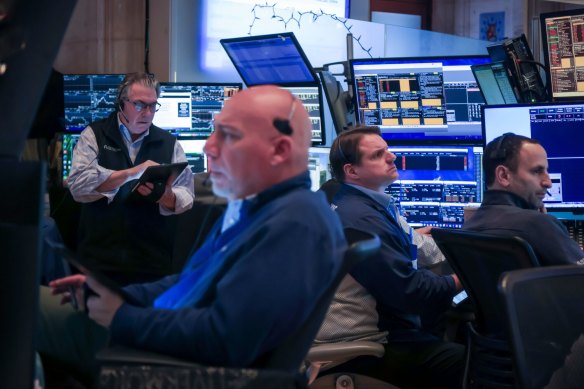
The broad losses come after another wild day on the US market, where Trump’s latest escalation in his trade war briefly pulled Wall Street 10 per cent below its record set last month, which is deemed correction territory. Stocks began tumbling in the morning in New York after Trump said he would double planned tariff increases on steel and aluminium coming from Canada. They recovered before sliding again into the close.
The ASX lost 0.9 per cent on Tuesday. The Australian dollar traded at 62.96 US cents as of 12.32pm.
Australia, along with other major steel and aluminium exporters, have spent the past month pressing Trump to grant them an exemption on the tariffs that are due to start mid-afternoon Australian time today. Asked why he had decided against the carve-out, White House press secretary Karoline Leavitt indicated there would be no exemptions across the board.
Materials stocks including the mining heavyweights that are selling iron ore – the raw ingredient for steel – declined. BHP, the world’s largest miner, shed 1.4 per cent, while its rival Rio Tinto lost 1.9 per cent and Fortescue Metals Group fell 1.1 per cent. Home sidings maker James Hardie, which makes most of its profits in the US, lost 2.1 per cent. Mining explosives maker Orica shed 1.8 per cent even as the company said it will buy back up to $400 million of its shares to boost investor returns.
Loading
Industrial stocks also fell, led lower by a 2.6 per cent fall in pallet maker Brambles, whose shares traded for the first time without the right to its latest dividend. Other shares trading ex-dividend during this session include Westpac and Breville.
Financial stocks, which together with the materials account for more than half of the ASX, also fell amid concerns how the tariffs will weigh on the Australian economy. The big four banks were all down by more than 2 per cent. Commonwealth Bank, the nation’s biggest lender and the biggest stock on the ASX, fell 1.8 per cent. Westpac shed 2.4 per cent, National Australia Bank slumped 2.6 per cent and ANZ lost 2.3 per cent.
Advertisement
Stocks dependent on discretionary consumer spending were also hit hard, with Bunnings, Officeworks and Kmart owner Wesfarmers down 3.4 per cent, electronics retailer JB Hi-Fi losing 1.7 per cent and furniture and white goods seller Harvey Norman 1.8 per cent weaker.
On Wall Street overnight, the market’s slide was erratic and dizzying. The S&P 500 fell 0.8 per cent, but only after careening between a modest gain and a tumble of 1.5 per cent. At its bottom for the day, the index was more than 10 per cent below its all-time high and on track for what Wall Street calls a “correction.”
Other indexes likewise swung sharply through the day. The Dow Jones lost 1.1 per cent, and the Nasdaq composite ended up slipping 0.2 per cent.

Such head-spinning moves are becoming routine in what’s been a scary ride for investors as Trump tries to remake the country and world through tariffs and other policies. Stocks have been heaving mostly lower on uncertainty about how much pain Trump is willing for the economy to endure to get what he wants.
And moves by Trump and comments by his White House on Tuesday didn’t clarify much.
Stocks began tumbling in the morning after Trump’s Canada move. The president said it was a response to moves a Canadian province made after Trump began threatening tariffs on one of the United States’ most important trading partners.
Loading
Trump has acknowledged the world’s largest economy could feel some “disturbance” because of the tariffs he’s pushing. Asked on Tuesday just how much pain Trump would be willing for the economy and stock market to take, right about when the market was nearing its lows for the day, Leavitt declined to give an exact answer. But she said earlier in a press briefing that “the president will look out for Wall Street and for Main Street.”
For his part, Trump said earlier on social media, “The only thing that makes sense is for Canada to become our cherished Fifty First State. This would make all Tariffs, and everything else, totally disappear.”
Stocks pared their losses later in the day, even eliminating them all briefly, after Ontario’s premier said he had agreed to remove the surcharge on electricity that had enraged Trump so much. He said he was confident that the US president would also stand down on his own plans for 50 per cent tariffs on Canadian steel and aluminum.
After that perk higher, though, stocks would go on to slide again into the end of trading.
Tuesday’s swings followed more warning signals flashing about the economy as Trump’s on-and-off-again rollout of tariffs creates confusion and pessimism for US households and businesses.
Such tariffs can hurt the US economy directly by raising prices for consumers and gumming up global trade. But even if they end up being milder than feared, all the whipsaw moves could create so much uncertainty that US companies and consumers freeze, which would sap energy from the economy.
Helping to keep the market in check despite all the worries were several Big Tech stocks, which steadied a bit after getting walloped in recent months. Elon Musk’s Tesla rose 3.8 per cent, for example, after Trump said he would buy a Tesla in a show of support for “Elon’s baby.”
Tesla’s sales and brand have been under pressure as Musk has led efforts in Washington to cut spending by the federal government. Tesla’s stock is down 42.9 per cent for the young year so far.
Loading
Other Big Tech superstars, which had led the market to record after record in recent years, also held a bit firmer. Nvidia added 1.7 per cent to trim its loss for the year so far to 19 per cent. It’s struggled as the market’s sell-off has particularly hit stocks seen as getting too expensive in Wall Street’s frenzy around artificial-intelligence technology.
Because Nvidia, Tesla and other Big Tech stocks have grown so massive in size, their movements carry much more weight on the S&P 500 and other indexes than any other company.
with AP
The Market Recap newsletter is a wrap of the day’s trading. Get it each weekday afternoon.
Loading