


Britain and France will propose a one-month truce in Ukraine “in the air, at sea”, as part of a so-called European coalition of the willing.
Britain and France will propose a one-month truce in Ukraine “in the air, at sea”, as part of a so-called European coalition of the willing.
- Updated
- World
- Europe
- Russia-Ukraine war
By Rob Harris
Updated March 3, 2025 — 10.45amfirst published at 4.54am
London: Britain and France will propose a one-month truce in Ukraine “in the air, at sea” as part of a so-called European coalition of the willing’s security guarantee to help end the years-long conflict with Russia.
French President Emmanuel Macron told Le Figaro that peacekeeping troops would only be deployed on the ground in the second phase of any peace deal, as European leaders scrambled to broker an agreement that can appease both Kyiv and Washington after talks between leaders descended into a shouting match in front of cameras in the White House on Friday.

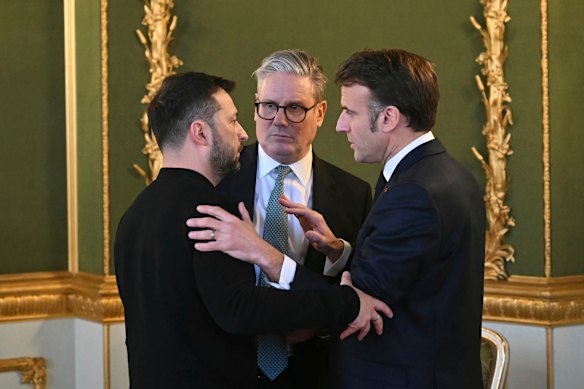
After the meeting, Ukrainian President Volodymyr Zelensky acknowledged the scenes inside the Oval Office had not been helpful but said he was hopeful of constructive talks with the US in the future.
British Prime Minister Keir Starmer said it was clear that Europe would need to do “the heavy lifting” in the face of a more isolationist America following a summit with leaders at Lancaster House in central London, but added that securing backing from US President Donald Trump would be needed.
“We need to deliver together,” Starmer said after the meeting. “We are at a crossroads in history today … the UK is prepared to back this with boots on the ground and planes in the air together with others.”
He said that progress had been made in building a coalition which would commit military assets, including troops on the ground, if Europe was to build a force to deter Russian aggression in Ukraine.
Starmer pushed for a greater contribution from European allies to continent-wide security and announced a new £1.6 billion ($3.42 billion) deal that would allow Ukraine to purchase 5000 air-defence missiles using export finance. Macron later suggested that European countries should raise their defence spending to between 3 and 3.5 per cent of GDP to respond to Trump’s demands.
“There will be no European troops on Ukrainian soil in the coming weeks,” Macron told the newspaper. “The question is how we use this time to try to obtain an accessible truce, with negotiations that will take several weeks and then, once peace is signed, a deployment.
“We want peace. We don’t want it at any price, without guarantees.”
Advertisement
Zelensky, who later met King Charles for almost an hour, has been sceptical of Europe’s ability to act alone to defend Ukraine. Again wearing a military-style black sweatshirt adorned with the Ukrainian trident, which attracted scorn from his US critics in the Oval Office on Friday, the pair were served tea in Sandringham’s Saloon room, at the royal residence in Norfolk.


Asked for his thoughts on the summit, Zelensky told the BBC he believed Ukraine’s best security guarantee “is a strong Ukrainian army”.
He said it was “important” that European allies were not reconsidering Russia’s role as the aggressor, adding he’d again raised the issue of using frozen Russian assets to help rebuild his country.
He said Ukraine’s relationship with the US would continue despite Friday’s White House having not “brought something positive or additional to us as partners”.
He said he was “sure that this situation will pass by” and that if future talks are “constructive, a positive result will come”.
Loading
Locals, some holding Ukraine flags, gathered outside the estate to witness his entrance by helicopter. The BBC reported Zelensky requested the meeting and it was approved by the UK government, in line with protocol.
The Ukrainian president has consistently said the US would be needed to deter the Kremlin from attacking his country again if there were a ceasefire deal.
The US has sent nearly $70 billion in military aid – dwarfing contributions from any of Kyiv’s other allies – since the start of the war. But European nations have steadily stepped up their support, with the EU, Britain and Norway combined giving Ukraine about $25 billion in military aid last year – more than the US.
Starmer said “a number” of European countries had indicated at the summit they would be willing to join a “coalition of the willing” to support Ukraine, but said it would be up to them to outline their contributions in the future.
He said the key to any deal would be to keep military aid flowing into Ukraine and, while the war was ongoing, increase economic pressure on Russia and ensure Ukraine was at the table for any peace talks.

Starmer was cautious not to call out Trump’s berating of Zelensky but said, “nobody wants to see that”. He added that Zelensky was “rightly concerned” that any proposed peace deal “has to hold”.
“I do not accept that the US is an unreliable ally, there are no two countries as closely aligned as our two countries,” he said, adding that he wanted to achieve a “lasting peace” in Ukraine, based on its military being fortified, a European peace-keeping force on the ground and US security guarantees to deter Russia from trying to invade again.
Macron, however, said he was sceptical about a ceasefire deal signed between the US and Russia, adding that it would leave Ukraine vulnerable.
Starmer could not say Trump had agreed to US security guarantees for any peace deal, but said discussions were ongoing. Leaders from Germany, Denmark, Italy, the Netherlands, Norway, Poland, Spain, Finland, Sweden, the Czech Republic and Romania were at the summit. The discussion also included Canadian Prime Minister Justin Trudeau and Turkish Foreign Minister Hakan Fidan.
Trudeau, who will step down in coming weeks, said all countries had an important role to play, adding that Canada has been a steadfast supporter of Ukraine for more than a decade, particularly in training defence forces.
When asked about Canada’s contribution to the so-called “coalition of the willing”, Trudeau reaffirmed Canada’s commitment.
Loading
“We’re going to continue to be there to support Ukraine as necessary with whatever it takes for as long as it takes,” he said, highlighting that Ukraine’s fight is not only for its territories but for the “very principles and values” that sustain democracies worldwide.
European Commission President Ursula von der Leyen said Europe had to turn Ukraine into a “steel porcupine” that was “indigestible” to invaders.
“We all have understood that after a long time of under-investment, it is now of utmost importance to step up the defence investment for a prolonged period of time,” she said.
Loading
“We need in the geostrategic environment in which we live to prepare for the worst.”
In the US, National Security Adviser Mike Waltz said Russia would have to make concessions on Ukraine’s security in exchange for compromises on territory in any deal to end its war with Ukraine.
“This war needs to end, and that’s going to take concessions on territory. That’s going to take Russian concessions on security guarantees,” Waltz told CNN.
Olaf Scholz, who attended the summit as caretaker chancellor after losing elections last month, has repeatedly voiced his opposition to peacekeeping troops. He reiterated this stance on February 17 after the Munich Security Conference, telling Macron the question was “completely premature”.
Get a note directly from our foreign correspondents on what s making headlines around the world. Sign up for the weekly What in the World newsletter here.
Rob Harris is Europe correspondent for The Sydney Morning Herald and The Age.Connect via email.
Loading