


Joel Cauchi was severely mentally ill but “effectively unmedicated” and unmonitored for about five years before his death, an inquest has heard.
Joel Cauchi was severely mentally ill but “effectively unmedicated” and unmonitored for about five years before his death, an inquest has heard.
By Michaela Whitbourn
April 28, 2025 — 3.50pm
The man behind the deadly Westfield Bondi Junction stabbing attack consumed cannabis and searched online for articles about serial killers and mass stabbings shortly before he killed six people and injured 10 more while his severe mental illness was untreated, a court has heard.
Joel Cauchi had also attempted to access guns in 2021, counsel assisting the Bondi Junction inquest, Peggy Dwyer, SC, said in her opening address in Sydney on Monday.

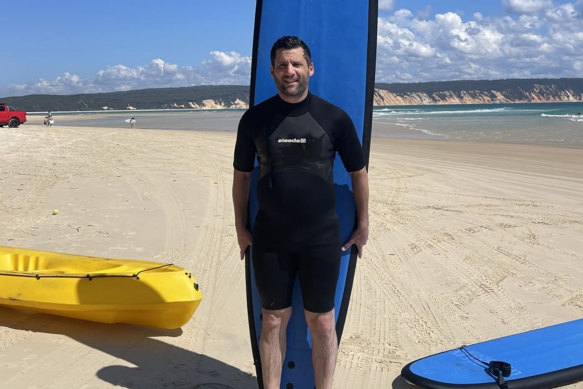
Cauchi, 40, was diagnosed with schizophrenia as a teenager but was “effectively unmedicated” and unmonitored for about five years before his death, Dwyer said on the first day of the five-week inquest.
Ashlee Good, 38, Dawn Singleton, 25, Jade Young, 47, Yixuan Cheng, 27, Faraz Tahir, 30, and Pikria Darchia, 55, were killed during Cauchi’s three-minute knife attack before he was shot dead by NSW Police Inspector Amy Scott. Scott is slated to give evidence on Tuesday.
State Coroner Teresa O’Sullivan told the families of victims that, while the inquest was a formal process, “we’re all human, and we all have hearts, and our hearts go out to you”.
The inquest is examining the circumstances surrounding all seven deaths. Dwyer said the court would consider “apparent gaps” in the mental health system that Cauchi “fell through”.

Police had reviewed voluminous records from Cauchi’s phones, she said, including his web browsing and messages. The “distressing” records showed he was “extremely unwell” and was “preoccupied with weapons, with violence, and with mass killing” from at least 2022.
At the time of the killings, Cauchi was homeless and had moved from Queensland to Sydney. He had been treated in both the public and private health systems in Queensland. His medication had been reduced before being stopped entirely in 2019.
Advertisement
Dwyer said there was evidence Cauchi’s actions followed “rudimentary planning”, but no motive was apparent. In the years before 2024, Cauchi had bought several knives. He bought the knife ultimately used in the attack in south-west Sydney on February 24.
On January 25, he made a note on his phone: “Call knife sharpener and confirm it doesn’t need sharpening for mall use.” Less than a month later, he made a note to “check out malls and also where to run”.

Dwyer said other notes in January and February “all suggest that he was planning a strike or attack”.
This was “very different to how Mr Cauchi presented or behaved or appeared to think when he was medicated”, Dwyer said.
The browsing history on his phone from about late 2022 “suggested a preoccupation with death and murder”, she said.
Loading
“There are bookmarked pages [and searches] on serial killers, searches containing mass stabbing incidents in Australia … that’s all in the days leading up to the attack. Mr Cauchi also searched for information on the Columbine [high school] shooters on the 13th of April.”
Dwyer said that “apart from this insight into Mr Cauchi’s inner turmoil, there is no direct evidence indicating any motive associated with his plans”.
Those records unequivocally showed a man who was “seriously unwell”, “far from home and far from the watchful eye of his parents” who had previously kept him connected with health services, she said.
“The expert psychiatric evidence is clear and unanimous that Mr Joel Cauchi was floridly psychotic on the 13th of April,” Dwyer said.
“Expert toxicology evidence suggests that Mr Cauchi had been using cannabis … in the days preceding his death. The use of marijuana also preceded Mr Cauchi’s initial diagnosis of schizophrenia in 2001.

“I expect the court will hear expert psychiatric evidence that use of cannabis would likely have exacerbated the psychotic symptoms that Mr Cauchi was experiencing around the 13th of April, but, conversely, expert evidence is also likely to shed light on the fact that use of cannabis may be a symptom of schizophrenia or psychosis.”
Dwyer said Cauchi had displayed an interest in guns in 2021, and a psychiatrist provided a report to the “Queensland Police Service weapons licensing branch … in which he confirmed that Mr Cauchi was at that stage, in his view, a fit and proper person to be issued with a weapons licence”.
“The available evidence suggests that Mr Cauchi did not follow through with a gun licence and that is very, very fortunate.”
He was reported to Crime Stoppers in 2022 after attempting to watch a school swimming carnival in Toowoomba, Dwyer said.
“The school took swift action, and he was not permitted to attend,” she said.
The court was not seeking to stigmatise those living with complex and chronic mental illness, Dwyer said, and most people living with schizophrenia will never commit any form of violent attack.
Cauchi’s parents loved and cared for him all his life, and they were shocked he had committed these terrible acts of violence, she said.
Start the day with a summary of the day’s most important and interesting stories, analysis and insights. Sign up for our Morning Edition newsletter.
Michaela Whitbourn is a legal affairs reporter at The Sydney Morning Herald.Connect via Twitter.
Loading