


Should you tape your windows? Move larger pot plants? Open leeward windows to relieve pressure? We asked an expert. Here’s what they said.
Should you tape your windows? Move larger pot plants? Open leeward windows to relieve pressure? We asked an expert. Here’s what they said.
By Matt Shea
March 7, 2025 — 4.04pm
Follow our live coverage of Cyclone Alfred here.
For many people, Tropical Cyclone Alfred will be their first encounter with a storm of this scale and intensity.
Which can make preparation intimidating. Where should you shelter if confronted with destructive winds? Should you open a window on the leeward side of your house? Do you really need to move your larger pot plants?
Dr David Henderson, director of James Cook University’s cyclone testing station, is well-placed to answer these questions. When this masthead contacted Henderson on Friday morning, the first thing he said he wanted Brisbane residents to know was that this a broad, slow-moving system that would affect different areas in different ways.
“One answer is not going to suit everyone,” he says. “There’s going to be so many different types of effects right across the region.”
Still, he took time to address some common questions and, in some cases, misconceptions.
Loading
Where should you shelter in your house?
Henderson says the advice for areas experiencing severe winds is to typically shelter in a small room with no windows or at least small windows.
Advertisement
“That could be a corridor,” he says. ” Or it could be a bathroom, which are typically small and have no or small windows.
“Plus you have access to water [in a bathroom].”
Should you tape your windows?
Henderson stresses that taping your windows won’t make them any stronger. This is an older storm-prevention technique aimed at keeping fragile glass together after it is broken due to wind pressure or debris.

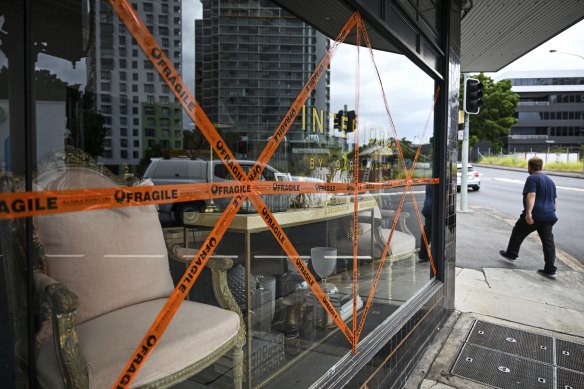
“The tape was there to help in the clean-up, which it didn’t really do anyway,” he says.
Modern glass is much stronger but is still in danger of being damaged by flying debris.
If you insist on taping your glass, Henderson recommends applying it in a “cheeseboard” pattern.
Should you open leeward windows?
A classic piece of cyclone advice, the idea being that it will relieve some of the intense positive pressure the storm applies to the windward side of the house. Henderson, though, says it’s not so simple.
“I don’t want to dismiss it out of hand because … if you imagine your house is a shoebox and the wind is hitting along the wall of that shoebox, it’s putting positive pressure on the windward wall as it goes up over the roof and around the house.
“[And] it’s got negative pressure on your roof — trying to lift the whole house up by its roof — and suck out on the side walls and also on that leeward wall.

Opening one window (and “only one,” Henderson says) on the back wall can let a slight negative pressure enter the building and slightly resist some of the wind on the roof.
“But it adds to the windward wall pressure,” he says, “and it’s going to draw more rain into your building, which you may or may not be concerned about.
Loading
“But if one of those [windward] windows breaks or a door blows inwards … that pressure that’s on the windward wall instantly enters the building, almost doubling the load on the roof structure because now you’re pushing from underneath as well as pulling from up top.”
The other problem with having a back window open is the wind direction can shift. And, of course, a house’s aspect isn’t necessarily going to perfectly fit with the oncoming storm.
Should you close the internal doors in your house?
The short answer is yes.
“There’s some research that shows that if you close all your internal doors, it [helps] limit the spread of pressure, as well as some of the wind-driven rain getting into other places.”

Should you fill your bath and other receptacles?
This should be part of your normal storm preparation with the potential loss of power, Henderson says, along with charging batteries and so on.

Just beware that a full bathtub can be a potential drowning risk for younger children, and is prone to contamination if you have any four-legged housemates.
Do you need to worry about moving larger pot plants?
The rule of thumb here is if you can move it, a cyclone can well and truly move it. So, anything you can shift, get it inside.

How else should you prepare?
Henderson wouldn’t be drawn on whether you should disconnect your solar-power system, deferring instead to the Get Ready Queensland disaster planning website.
Loading
Also, this masthead didn’t get the opportunity to ask Henderson whether you should drain your swimming pool, although the general consensus is that you don’t need to, and a drained above-ground swimming pool has the potential to become a hazard in destructive cyclonic winds (Get Ready Queensland simply says to make sure your pool is well maintained).
“Just keep an eye on the messaging coming from emergency services and the [Bureau of Meteorology],” Henderson says.
“This is going to be a long thing. Just be confident in your preparations, and if you’re not one of the ones impacted, be grateful that you did the prep and you’re ready for it next time.”
Get alerts on significant breaking news as happens. Sign up for our Breaking News Alert.
Matt Shea is Food and Culture Editor at Brisbane Times. He is a former editor and editor-at-large at Broadsheet Brisbane, and has written for Escape, Qantas Magazine, the Guardian, Jetstar Magazine and SilverKris, among many others.
Loading