


Analysts believe a deal between the world’s two biggest economies is now unlikely in the short term because it would require major concessions.
Analysts believe a deal between the world’s two biggest economies is now unlikely in the short term because it would require major concessions.
- Updated
- World
- Asia
- Trade wars
By Lisa Visentin
Updated April 9, 2025 — 6.08pmfirst published at 2.27pm
Singapore: China did not immediately retaliate after a crippling tariff of 104 per cent on its US-bound goods came into effect on Wednesday, alongside sweeping import duties on dozens of other countries, as US President Donald Trump’s campaign to upend global trade systems entered its next phase.
Trump and Chinese President Xi Jinping are locked in an escalating feud of tariff brinkmanship that is hammering global markets, upending trade norms and intensifying fears of a worldwide recession. Many China analysts believe that a trade deal between the two sides is now unlikely in the short term, as it would require either Xi or Trump to make major concessions.

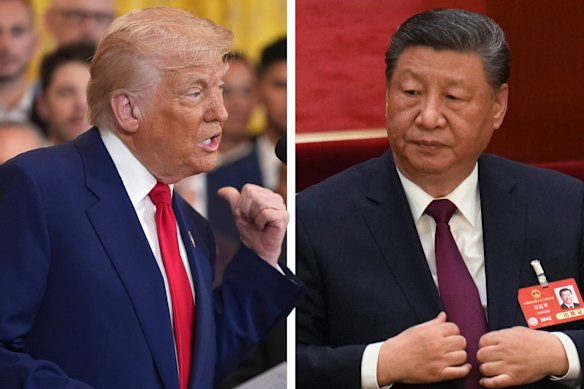
Beijing has vowed to “fight to the end” and “resolutely take countermeasures” in response to Trump’s trade warfare, but did not counterstrike with a package of its own tariffs and sanctions, as it has done in response to previous rounds of US tariffs.
However, in a post on his social media platform Truth Social, Trump said he was waiting for Beijing’s call to kickstart deal negotiations.
“China also wants to make a deal, badly, but they don’t know how to get it started,” Trump wrote. “We are waiting for their call. It will happen!”
Foreign Ministry spokesman Guo Jiakun did not directly address questions about what measures China was contemplating or whether Trump’s claims that Beijing was seeking a deal were correct.
“If the US overlooks the interests of the two countries in the international community, and is determined to fight a tariff and a trade war, China’s response will continue to the end,” he said at a press conference in Beijing.
At the same time, China has kept open the door to negotiation. Late on Wednesday, state media was reporting Beijing had released a White Paper on its trade and economic ties with the US, which said that friction in the relationship was normal and could be resolved through dialogue.
Trump’s barrage of tariffs on about 60 of America’s trading partners, which he has dubbed the “worst offenders” for running trade surpluses with the US, kicked in at 2.01pm AEST on Wednesday.
Advertisement
Asian stock markets took another battering as the tariffs took effect, with Japan’s Nikkei 225 slipping by about 5 per cent, while in South Korea and Hong Kong stocks had tumbled by around 2 per cent by mid-afternoon. The S&P/ASX 200 in Australia declined 1.8 per cent.
In addition to China, a string of Asian countries are bearing the brunt of Trump’s barrage of tariffs, first announced on April 2. Cambodia and Vietnam, which are hubs for Chinese-owned manufacturing operations, are facing 49 per cent and 46 per cent charges.
Loading
Imports from South Korea and Japan, which include cars and electronics, will be taxed at 26 and 24 per cent, respectively, while goods from the European Union will face 20 per cent levies.
As the April 9 midnight deadline approached in America, Trump rebuffed the mounting criticism directed at him on US soil and from abroad, boasting that more than 70 countries were seeking deals to escape the tariffs.
“I’m telling you, these countries are calling us up, kissing my ass. They are. They’re dying to make a deal,” he told a Republican Party black-tie dinner in Washington.
China was whacked with the latest duties after Trump added an extra 50 per cent to the country’s tariff scorecard – taking the cumulatively total to at least 104 per cent on all imports – as a punishment for Beijing’s refusal to withdraw its latest counter-tariff of 34 per cent on American goods.
The Chinese government has been eager to signal that its export-driven economy can endure the trade pain longer than the US, with Premier Li Qiang saying on Tuesday that Beijing had ample policy tools up its sleeve to “completely offset adverse external impacts”.
“China is full of confidence in maintaining its own sustained and healthy economic development,” Li, the second highest-ranked official in China, said during a phone call with EU Commission President Ursula von der Leyen, according to Beijing’s transcript of the call.
Get a note directly from our foreign correspondents on what’s making headlines around the world. Sign up for our weekly What in the World newsletter.
Lisa Visentin is the North Asia correspondent for The Sydney Morning Herald and The Age. She was previously a federal political reporter based in Canberra.Connect via Twitter.
Loading