


Prime Minister Anthony Albanese and Opposition Leader Peter Dutton are into the second week of their campaigns. Follow our rolling coverage here.
Prime Minister Anthony Albanese and Opposition Leader Peter Dutton are into the second week of their campaigns. Follow our rolling coverage here.
As sharemarkets around the region plummet today, Perpetual’s head of investment strategy Matt Sherwood says there is likely to be more volatility ahead.
The ASX 200 was down 4.4 per cent at 1.41 pm, after China retaliated to Trump’s tariffs with its own tariffs on US exports.
Markets across Asia fell sharply, with Japan’s Nikkei index falling 6.5 per cent and Hong Kong’s Hang Seng index down 9.1 per cent.
Sherwood said investors were fearful of the economic damage caused by retaliation to Trump, and there was no obvious “off ramp” or circuit breaker.
He said it was hard for Trump to back down from the tariffs he had announced, and he believed it was also unlikely the US Federal Reserve would cut interest rates soon.
“The investors are not wanting to catch the falling knife,” Sherwood said. “It’s hard to see things stabilising, at least in the near term.”
Permanently lower. They are the key words in a short analysis by the federal Treasury into the impact of Donald Trump’s tariff war.
According to Treasury, Trump’s plan to take America’s average tariff levels to their highest point since Alfred Deakin was Australia’s prime minister will devastate the US and Chinese economies and make the rest of the world poorer.
The American economy alone is expected to be around 0.8 percentage points smaller than if Trump had said nothing in the White House Rose Garden last week. That’s about $US300 billion.
Meanwhile, US inflation is expected to lift by 1.4 percentage points.
In other words, less economic activity and higher consumer prices for American consumers. That’s the price of Trump’s “Liberation Day” for everyday Americans.
China, Australia’s export cash cow, is facing a 0.6 percentage point hit to its economy as it deals with effective tariff rates close to 70 per cent.
And that’s where Australia feels Trump’s plans. We and our Heard and McDonald Island penguins escaped with a 10 per cent tariff hit, which Treasury says will reduce economic output by 0.1 per cent this year and lift inflation by 0.2 per cent.
While inflation will come back down here, the economic damage caused by the tariffs will forever linger.
“Over the medium term, Australia’s GDP is permanently lower,” it notes.
Forget the turmoil on the sharemarket, on the value of the dollar, on the price of key commodities. The real story is the permanent economic carnage being wrought on the entire globe by Donald Trump.
Thanks for joining us so far today. Sophie Aubrey is now steering you through this afternoon’s headlines. In case you need a refresher, here’s what has happened earlier today:
- Treasurer Jim Chalmers has declared US tariffs will be “manageable” and flagged further interest rate cuts were expected. This came as Treasury released new analysis showing tariffs would dent the country’s GDP by 0.1 per cent and inflation would be 0.2 percentage points higher.
- More than $85 billion has been wiped off the value of Australian shares in a dramatic market plunge, with share prices of corporate giants collapsing in response to the escalating trade war between the US and China.
- Majority government could be within reach for Anthony Albanese as Labor opens up its lead over the Coalition after week one of the federal election campaign, polls show.
- Pauline Hanson has backed her daughter, Lee Hanson, who is competing for a Senate seat in Tasmania under One Nation.
- Albanese and Victorian Premier Jacinta Allan held their first campaign media event together in Melbourne, ducking questions about whether Allan’s flagging popularity would be a drag on federal Labor.
- Albanese hit out at Dutton for his “extraordinary position” on working from home and claimed he was pretending the program would not proceed.
- Dutton said sorry for the now-dumped Coalition public service policy. “We’ve made a mistake in relation to the policy. We apologise for that,” he said.
Chalmers says Australia is better placed than other countries to tackle the economic fallout of Donald Trump’s tariffs, but admits there is more uncertainty and volatility than usual.
The treasurer told reporters that Australia was well-positioned but warned against electing a Coalition government.

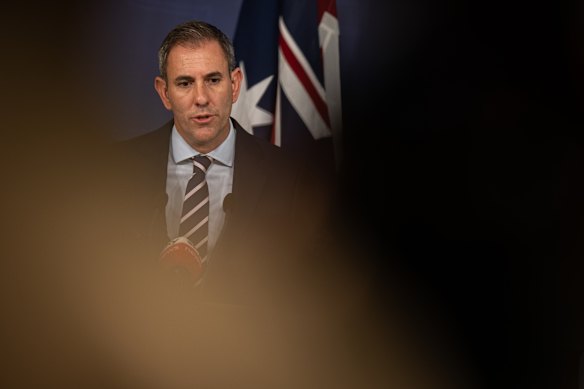
“Australia is better placed and better prepared than our peers,” he said. “This would be the worst time to risk a change of government, to a Coalition government, which would make wages lower, taxes higher, and who has secret cuts to pay for nuclear reactors.”
Releasing Treasury’s third updated forecasts on the impacts of the tariffs, Chalmers acknowledged there was “more than the usual amount of uncertainty and volatility when it comes to forecasting economic outcomes.”
Treasurer Jim Chalmers says he has spoken to Reserve Bank governor Michele Bullock and UK Chancellor of the Exchequer Rachel Reeves about developments in the global economy as a result of Donald Trump’s tariffs.
“I was able to brief [Reeves] on our expectations here in Australia, and the response that Prime Minister Albanese announced in the immediate aftermath of the American decision being made public last week,” he said.

“I also spoke this morning, before the market opened, with Governor Michele Bullock to compare notes on their expectations, on what happens now in our economy.”
Chalmers said he compared notes with Bullock on the impact of the tariffs on the real economy.
“Obviously, both of us, in her independent way and the government, are working out how to ensure that we are best calibrated for this economic uncertainty that we are all anticipating ahead,” he said.
“As I said before, Australia is really well-placed and we are well-prepared to deal with this global economic uncertainty.”
Treasurer Jim Chalmers has said the impact of Donald Trump’s tariffs on the Australian economy should be “manageable” but noted markets were now expecting an interest rate cut of as much as 0.5 percentage points at the next Reserve Bank meeting.
“I don’t predict or pre-empt those decisions, but the market is certainly now expecting multiple interest rate cuts over the course of the year, beginning in May,” Chalmers said in a press conference in Sydney, after Treasury released new analysis about the tariffs’ impacts.

The Australian sharemarket has shed nearly 4 per cent of its value today.
Chalmers said investors were flocking to safe assets such as gold as oil prices tumbled and that the Australian dollar was hovering around US60¢.
“That is largely a reflection of people’s concerns about the Chinese economy, but it also reflects the fact that markets are now expecting around four interest rate cuts in Australia this calendar year,” he said.
While the election campaign continues apace, it would be easy to forget to enrol to vote, or update your enrolment – including changes of address, which can affect who you’re voting for.
The deadline for enrolling, or making changes, is 8pm tonight (your local time).
It’s a fairly simple process, you just need to go to the Australian Electoral Commission website – aec.gov.au.
Treasurer Jim Chalmers and Finance Minister Katy Gallagher are holding a press conference in Sydney.
Watch below.
US tariffs announced by US President Donald Trump will permanently dent Australia’s economic output and push up prices in the short term, according to fresh Treasury analysis released today.
Australia’s gross domestic product (GDP), adjusted for inflation, will be 0.1 per cent lower compared to if tariffs had not been imposed, while inflation will be 0.2 percentage points higher.
Sectors such as agriculture, energy, mining and durable manufacturing will be the hardest hit.
Most of the impact from US tariffs for Australia will come from weaker demand for Australian exports from major trading partners such as China, Japan and South Korea.
Treasury’s modelling does not account for any additional trade disruptions.
We’ll soon be hearing from Treasurer Jim Chalmers in a press conference.
More than $85 billion has been wiped off the value of Australian shares in a dramatic market plunge, with share prices of corporate giants collapsing in response to the escalating trade war between the United States and China.
The ASX 200 was 3.8 per cent lower at 12.08 pm, after being down more than 6 per cent in early trade after a dramatic plunge on Wall Street over the weekend. All sectors of the market are deep in the red, and the Australian dollar fell under US 60¢.
Banks, miners and energy companies were hit the hardest, with the biggest stock on the ASX, Commonwealth Bank, tanking 5 per cent. Other banks also plunged, with ANZ 5.1 per cent lower, Westpac shedding 4 per cent and NAB down 3.8 per cent.
Mining giants BHP plunged 5.8 per cent and Rio Tinto dropped 4.2 per cent, while oil and gas giants Woodside fell 7.3 per cent after more declines in the global oil price. Santos lost 9.6 per cent.