


Authorities will bring sand to tourist hotspots, but the affected stretches will take months to recover. Environmental experts are more worried about damage to dunes.
Authorities will bring sand to tourist hotspots, but the affected stretches will take months to recover. Environmental experts are more worried about damage to dunes.
The ex-tropical cyclone that pummelled the NSW and Queensland coastlines with dangerous winds, heavy rain and high seas has washed away most of the sand at famous beaches such as Byron Bay and Surfers Paradise.
The coastal erosion, which extends at least as far south as Coffs Harbour and as far north as Noosa, has exposed a shipwreck at Ballina, while turtle hatchlings were washed ashore in heavy swell near Byron Bay.
Such erosion occurs naturally with a low-pressure system and beaches build back up with calm weather. Authorities will speed the recovery process by bringing in sand to restore beaches in tourist hotspots. Gold Coast Mayor Tom Tate has promised “ample golden sand” for Easter.
Experts say a more serious matter is damage to sand dunes, which could take years to recover, if at all. While beaches are rebuilt by waves, dunes are reformed by wind – a slower process.

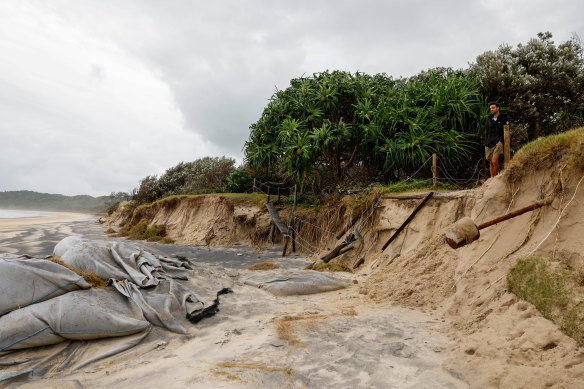
Javier Leon, associate professor in physical geography at the University of the Sunshine Coast, said beach recovery usually took weeks, but with a stronger event such as Alfred, it would probably take months, depending on weather in the aftermath.
Advertisement
“The problem with the changing climate is that, in the next few decades, we will be seeing … stronger events, [though] not necessarily more frequently,” Leon said.

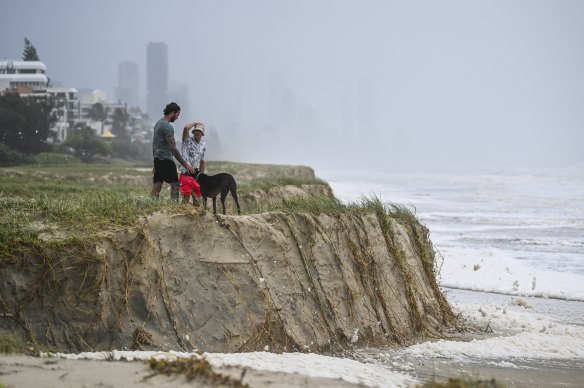
“If you combine that with incremental [changes] like sea levels rising and more people living on the coast, the risk is just higher, so the next time it comes, it’s going to be as bad or even worse.”
Leon spoke on Monday morning while he took measurements on Peregian Beach, just south of Noosa Heads. He was measuring “scarping”, the process of cutting or eroding a slope or hillside so it becomes steeper.

“There’s been significant erosion, some of the dunes have scarped maybe two metres, some of them three, and there’s the odd four metres scarped down the beach – it’s highly variable,” Leon said. “The beach itself has potentially retreated horizontally, between 20 and 30 metres.”
Advertisement
Tate told ABC TV that scarping on Gold Coast beaches was up to eight metres high and warned people not to go to the edge because it would subside under the added weight.

Robert Leach, animal rescue officer at the International Fund for Animal Welfare, an agency coordinating various wildlife rescue groups, said a number of sea turtle hatchlings had been washed ashore in northern NSW and were being treated for injuries at places such as the Byron Bay Wildlife Hospital.

Queensland Minister for the Environment, Tourism, Science and Innovation Andrew Powell said the Crisafulli government was working with councils of affected areas to help with beach restoration, including upgrading rather than just replacing infrastructure.
“Beaches are an important part of our tourism offering, and we want our tourism operators to be able to return quickly to business as usual,” Powell said.

Advertisement
Tate said the recovery phase would start on Tuesday, first by removing debris, then restoring services such as pathways, and finally the long-term rejuvenation of sand and dune systems. The mayor said the council would “get the job done and work out how to fund it after”.
“We’ve done it before and I’m confident we will return the 52 kilometres of ocean beaches to their former glory,” Tate said.
“The final phase may take a while, but we will have Gold Coasters back on some of their beaches within a week. I make this commitment: there will be ample golden sand ready for the April school holidays and Easter.”

A spokesperson for the NSW Department of Climate Change, Energy, the Environment and Water said environmental impact assessments and a plan for the next steps could occur only once storm and flood risks had abated.
The coastal storm exposed part of a shipwreck on Shelly Beach in Ballina. Ron Creber, curator and manager of the Ballina Naval and Maritime Museum, said there were 64 shipwrecks from the 1860s to 1906, including paddle steamer The Comet, wrecked in 1890.

Advertisement
The NSW environment department spokesperson said there were penalties of up to $1 million for illegally damaging or disturbing a shipwreck.
“Shipwrecks are fragile and their preservation allows future generations to learn about their history,” the spokesperson said.
A European research paper published in Nature Climate Change in 2020 predicted that half the world’s beaches would disappear by 2100 because of rising sea levels, including 40 per cent of Australia’s 12,000 beaches.
An international team, including researchers from the University of Sydney and the University of Wollongong, published a rebuttal paper saying beaches with natural dunes would be able to retreat inland, retaining their general shapes.
Loading
However, the paper said beaches backed by hard coastal cliffs or seawalls would have nowhere to go, so the expanse of sand would shrink and eventually drown.
Get to the heart of what’s happening with climate change and the environment. Sign up for our fortnightly Environment newsletter.