


Vast quantities of costly school stationery goes to waste each year.
Vast quantities of costly school stationery goes to waste each year.
By Noel Towell
January 27, 2025 — 8.00am
They are the two words prompting dismay among parents of Victorian children returning to school in the coming days: stationery pack.
The cost of the standard piece of the annual back-to-school kit can be up to $200 each, and included in the price is often the nagging sense that much of this stuff is bound for landfill.
But a pioneering project in Melbourne’s north aims to put the vast quantities of stationary consumed by Victorian schools each year on a sustainable basis.

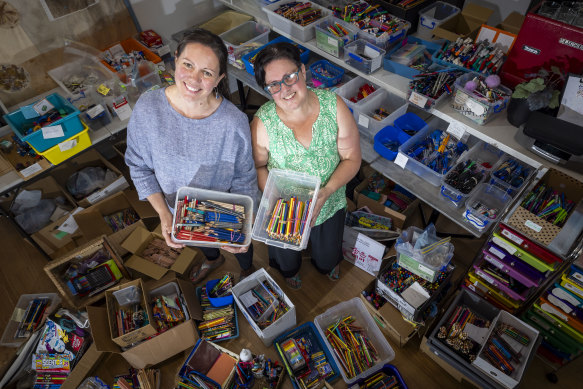
Project Stationery, driven by Fairfield Primary School worker Amelia Trompf and her friend Bridgitte Belleville– working with just 13 local schools – have collected and re-homed vast quantities of back-to-school supplies that might have otherwise ended up at the tip.
“Most state schools have a system where the stationery is ordered by the parents, it then goes home at the end of the year, and the next year new stationery is ordered, so you might end up with seven different pencil cases,” Trompf said.
“We have children in schools getting this new turnover of stuff every single year, and even when it’s old stuff, it’s totally fine.”
The stationery drive began in late 2023, with about 100 schools contacted and volunteers recruited.
In just three months, tens of thousands of stationery items had been donated, often delivered, Trompf said, by teachers frustrated with the waste and grateful to divert the supplies from landfill.
Teachers even reported rummaging through school skips to salvage supplies that other staff had discarded.
Advertisement
For a small enterprise, Project Stationery racked up some big numbers in its first few months: nearly 8000 exercise books, more than 21,000 textas and erasers, more than 22,000 coloured pencils, 614 sharpeners, 570 pairs of scissors, 1500 glue sticks and much more.
Loading
The repackaged supplies were gratefully received by kindergartens, childcare centres, primary schools, community houses, not-for-profits and charitable organisations, which is nice, says Trompf, but for her, sustainability is the main game.
“We’re passing this on to people who can actually use it,” she said.
“But our main thing, our main interest, is waste minimisation, and this year, which is different to last year when trying to work with schools to change systems.
“We’re trying to put it back on schools to make systemic changes.”
Efforts are underway to get buy-in from the state government, but significant changes can be made around the kitchen table at back-to-school time, too.
“We get a lot of exercise books that are brand-new, but they’ve all got names on them,” Trompf said.
“So a simple thing like not naming books before they get used, that makes a world of difference to being able to re-home them or reuse them within the school. Little things like that, they really add up.”
The Morning Edition newsletter is our guide to the day’s most important and interesting stories, analysis and insights. Sign up here.