


Trump’s personal attack on Volodymyr Zelensky and his adoption of Putin’s talking points raise the question of who will stand up for truth and decency.
Trump’s personal attack on Volodymyr Zelensky and his adoption of Putin’s talking points raise the question of who will stand up for truth and decency.
Opinion
Michael Koziol
North America correspondent
Updated February 20, 2025 — 1.33pmfirst published at 10.51am
Updated February 20, 2025 — 1.33pmfirst published at 10.51am
Washington: Donald Trump’s vindictive and personal attack on Ukrainian President Volodymyr Zelensky shows the US president has fully adopted the propaganda of Russian autocrat Vladimir Putin – a significant and scary moment in world affairs.
Trump’s dismissal of Zelensky as a “modestly successful comedian” and a “dictator without elections” comes straight from Kremlin talking points. His claim Zelensky is supported by just 4 per cent of Ukrainians is either of similar origin or fabricated.

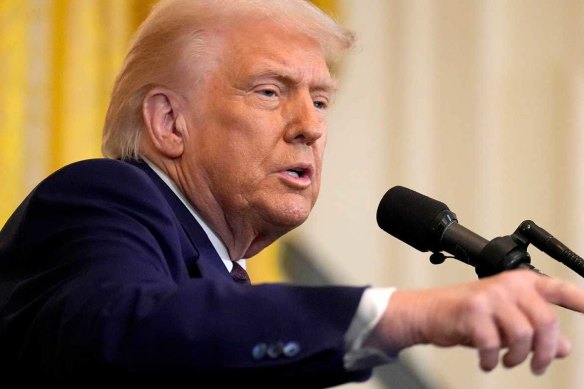
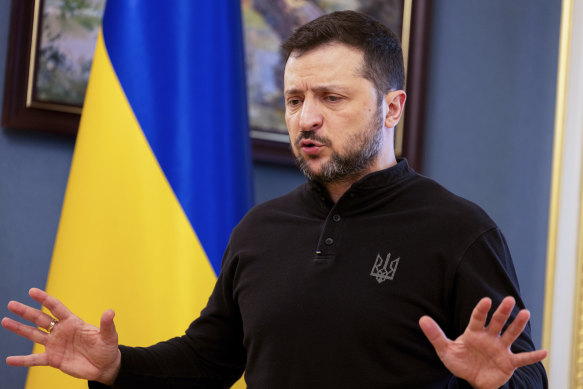
The tirade also suggests Trump has picked a side, and it has not, seemingly, taken much for him to do so. There was his phone call with Putin last week, resulting in US-Russia talks in Saudi Arabia that cut out Ukraine and Europe, and Zelensky’s understandably irked – but understated – response to being excluded.
The Ukrainian’s subsequent remarks – that Trump lived in a world of disinformation and was wrongly painting Russia as the victim – appear to have provoked the president’s latest outburst.
Of course, we don’t know the full extent of Trump and Putin’s communications. Nearly two weeks ago, he told The New York Post’s Miranda Devine he had already spoken with the Russian president, and when asked how many times, reportedly responded: “I’d better not say.”

So, we now have a US president in open courtship with a Russian autocrat, in whom he seems to see much of himself, and the sudden upending of the US position as a friend of Europe, Western allies and democracies.
At the time of writing, Zelensky appears to have decided on a diplomatic and deliberate response. He has not taken the bait. Rather, he began by posting a simple message: “Thank you for your support”, followed by an emoji of the Ukrainian flag.
He then set about relaying a series of phone calls with other world leaders and key figures, including British Prime Minister Keir Starmer, French President Emmanuel Macron and Republican senator Lindsey Graham, chairman of the US Senate Budget Committee.
Advertisement
Graham said on Wednesday: “When it comes to blame for the Russian invasion of Ukraine, I blame Putin above all others.” But among American leaders, he added, Democrats Joe Biden and Barack Obama “were pathetically weak in handling Putin and failed to protect Ukraine from invasion”.
Graham stood by Trump as “Ukraine’s best hope to end this war honourably and justly”, adding that he would “achieve this goal in the Trump way”.
The familiar defence of Trump’s indulgences – “that’s just how he rolls” – is doing a lot of work these days. Can there be a master strategy at play where cosying up to Putin yields a better, or even just, outcome for Ukraine?
Or is it more likely Trump’s departure from the liberal democratic order – his endorsement of an autocratic and aggressive regime – will embolden despots everywhere and make the world less safe, peaceful and prosperous? And what must Beijing make of all this?
On Wednesday, as Trump announced he would rescind federal approval for New York City’s new congestion pricing scheme, the White House posted from its official accounts: “CONGESTION PRICING IS DEAD. Manhattan, and all of New York, is SAVED. LONG LIVE THE KING!”


It accompanied the post with an image of Trump wearing a crown against a backdrop of New York’s skyline.
These are frightening times. The president linking arms with foreign autocrats and portraying himself as a sovereign king warrants strong resistance both at home and abroad. But who will provide the leadership to match the moment?
Not the Democrats, who are still reeling from November’s election defeat and unsure of how to tackle Trump’s second coming. Republicans are mostly in thrall to their president, despite their reluctance to entertain Putin. Roger Wicker, chair of the Senate Armed Services Committee that oversees the Pentagon, said on Thursday the Russian leader should be in jail or executed.
Globally, it’s difficult to picture Britain’s Starmer, a rookie prime minister already floundering at home, rising to the occasion – though he has shown a willingness to put British troops on the ground in Ukraine.

Among European leaders, it’s surely Macron, the relatively long-serving French president, who must step up – and he did so on Friday (AEDT), with a strong message that he and his counterparts would take responsibility.
“I have had once again a long conversation with several colleagues from the European Union, as well as from Canada, Iceland, and Norway. France and its partners have a clear and united position,” he said.
“We seek a long-lasting and solid peace in Ukraine. We stand with Ukraine and will take full responsibility to ensure peace and security in Europe. This is the fundamental interest of France, and I am its guarantor.”
Loading
Get a note directly from our foreign correspondents on what s making headlines around the world. Sign up for the weekly What in the World newsletter here.
Michael Koziol is the North America correspondent for The Age and Sydney Morning Herald. He is a former Sydney editor, Sun-Herald deputy editor and a federal political reporter in Canberra.Connect via Twitter.
Loading