


A new study finds cochlear implants can slow cognitive decline in older adults, improving memory and brain function. Researchers hope it will lead to big changes.
A new study finds cochlear implants can slow cognitive decline in older adults, improving memory and brain function. Researchers hope it will lead to big changes.
By Broede Carmody
March 5, 2025 — 2.03pm
Surgically implanted hearing devices can significantly improve the memory and brain function of senior Australians, according to a groundbreaking study that researchers hope will overhaul the way cognitive decline is treated.
It’s estimated that just 10 per cent of older Australians with severe-to-profound hearing loss ever receive a cochlear implant, despite the relatively straightforward procedure and zero cost in the public health system.

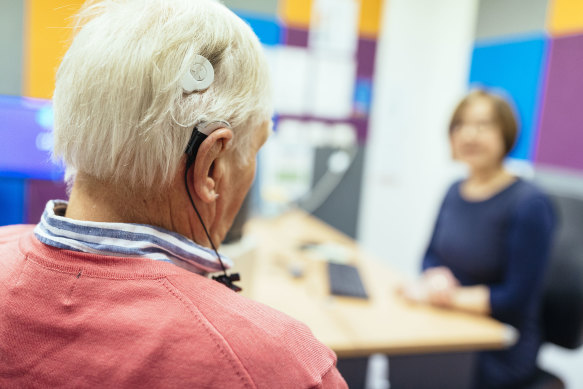
Melbourne University professor Julia Sarant, who recently published her findings in the peer-reviewed journal Brain Sciences, studied older Australians receiving an implant – as well as a non-intervention group – with check-ins at 18, 36 and 54-month intervals. In total, 101 adults were assessed with a median age of 74.
In her first interview about the paper, Sarant said the cochlear implant group had seen “a continued trend of significant improvement through to 54 months in two cognitive functions that are supposed to be most impacted by having hearing loss – those are executive function and working memory”.
“The other three tests we did [attention, psychomotor function and visual learning] showed stability.”
The professor said she was “staggered” by the results.
“Normally, what happens with ageing is we have a process of cognitive ageing. You slow down. You expect to see even a group of people with normal hearing to decline over their lifetime. Not only did we not see a cognitive decline, they didn’t get any worse. And in terms of two of their functions, they actually significantly improved.”
Brighton resident John Fisher, 83, swims every morning at a local beach and credits his active lifestyle to getting a cochlear implant.

Advertisement
“If you can’t hear, then you can’t [easily] be part of society,” he told The Age. “Once you’re interacting with people, and doing things and out and about, then you’re staying more active, more fit, more everything.”
Fisher’s general practitioner recommended surgery in August 2016 because he had no hearing in his right ear at the time and only about 15 per cent capacity in his left. He had, as his GP put it, become “a nuisance” to his loved ones – even with hearing aids.
“Everybody had to repeat themselves. I couldn’t participate in family life.”
Fisher says his circumstances could not be any different nine years after receiving his implant. He can participate in group conversations with family members and even swims with a group of friends who meet every day at 6am, no matter the weather.
“It’s had an enormous impact. I’m not fearful of group situations. I would think that the majority of my week is spent with a lot of people who are much younger than me,” he said.
Fisher says he is not surprised by the study’s findings.
“I’m more able to keep more balls in the air than I was six or seven years ago. I can go to the supermarket now without a list. I remember to go to the supermarket and I remember what I need to buy there.”

The head of cochlear implants at The Royal Victorian Eye and Ear Hospital, Professor Robert Briggs, said the hospital oversees close to 300 adult implants each year.
“We could be doing nearly 10 times that if everybody that could benefit came along,” he said.
“It’s normal to be apprehensive about surgery. But it’s a relatively straightforward procedure with a patient having a one-night stay in hospital and it’s relatively pain free.”
Loading
Sarant worked in collaboration with The Royal Victorian Eye and Ear Hospital and the Florey Institute of Neuroscience and Mental Health for her paper. Only four similar studies worldwide have extended beyond the two-year follow-up date.
She says she is continuing to recruit research participants and hopes to do a review in another three years.
“The prevalence of hearing loss with our ageing population and the prevalence of dementia are both rising rapidly,” she said. “We don’t know what causes dementia. But it’s well known that the majority of people with hearing loss don’t do anything about it.”
Start the day with a summary of the day’s most important and interesting stories, analysis and insights. Sign up for our Morning Edition newsletter.
Broede Carmody is a state political reporter for The Age. Previously, he was the national news blogger for The Age and The Sydney Morning Herald.Connect via Twitter or email.
Loading