


South East Queensland and northern NSW continue to experience rain and flooding in the wake of ex-Tropical Cyclone Alfred. Follow our ongoing coverage.
South East Queensland and northern NSW continue to experience rain and flooding in the wake of ex-Tropical Cyclone Alfred. Follow our ongoing coverage.
Good afternoon, and thank you for reading our live coverage of ex-tropical cyclone Alfred’s path of destruction across South East Queensland and northern NSW. If you are just joining us now, here’s what you need to know.
- Queensland’s Lockyer Valley, which was the scene of a deadly “inland tsunami” that claimed 12 lives in 2011, is facing flash flooding again. The main street of the town of Laidley, about an hour west of Brisbane, is underwater.
- Flash flooding is also hitting Ipswich and was identified by Premier David Crisafulli as another area of “major concern”.
- NSW Premier Chris Minns said the focus in the state today was the risk posed by water levels in the Clarence, Richmond and Tweed rivers. There are dozens of SES warnings in place along the rivers, with the Bureau of Meteorology advising of possible major flooding along all three, with further rainfall forecast for the Northern Rivers today.
- Lismore residents are returning to their homes after evacuation orders were lifted.
- More than 200,000 homes across South East Queensland and northern NSW remain without power.
- In Queensland, major flood warnings remain in place for the Bremer River, Warrill Creek, and the Logan Albert River basin. In NSW, a major flood warning remains for the Clarence River at Grafton. Near major flooding was occurring this morning along the Tweed River at Tumbulgum.
- Hundreds of schools are closed today – head here for a full list of NSW schools, and here for Queensland. Some public transport services are set to resume across flood-affected areas.
- A man who died after being swept into floodwaters in northern NSW on Friday was identified as 61-year-old Tom Cook.
- Thirteen people who were injured in a crash involving two Australian Defence Force vehicles near Lismore are expected to make a full recovery. All but one ADF member has been released from hospital, Deputy Prime Minister and Defence Minister Richard Marles said this morning.
Stay with us for updates throughout the afternoon and evening.
Elective surgeries have resumed in South East Queensland today, with the premier thanking the 2000 doctors, nurses and health workers who slept in hospitals on Thursday, Friday and Saturday nights to keep emergency departments open and patients cared for.
Premier David Crisafulli also confirmed the Pacific Motorway, south of the Queensland-NSW border, is open today, to allow fuel and food supplies into the state.
In other developments:
- Across Brisbane, about one in five traffic lights are out due to flash flooding.
- 198 state schools reopened today and 27,500 children returned to school, but 463 state schools and 259 independent and Catholic schools remain closed.
- Some bus services have resumed in Brisbane, including 19 high-frequency services.
- Public transport services are not operating on the Gold Coast or in Ipswich, Logan, and the Lockyer Valley.
At his press conference earlier, Queensland Premier David Crisafulli said another 100,000 homes and businesses could have been blacked out if a substation at Nudgee on Brisbane’s northside went under in flash flooding.
But the premier said Energex crews, SES volunteers and council crews worked together to protect the substation in the middle of the night, in driving rain.
“The way they protected that valuable asset; that was the difference between another 100,000 people being without power this morning,” Crisafulli said.
To those still without power today, the premier said: “I understand how much this has impacted you and the impacts on food, your family, your mental health, your ability to stay connected.
“I’m mindful of how much the impact of not having electricity means on families, and I’m mindful of how you’re having to go over and above to charge your phone, get food for your family, try to somehow bring some normality in a really difficult time. We assure you that getting power reconnected is at the top of our list right now.”
More than 35 people were rescued from their cars in South East Queensland overnight as the region was lashed with intense rain.
Swift-water rescue crews were still rescuing stranded drivers at 7.30am AEST this morning.
“[I’d] like to highlight the incredible effort our swift-water firefighters did last night,” said Kevin Walsh, acting commissioner for the Queensland Fire Service.
“Our swift-water firefighters undertake the most serious [tasks] in terms of rescuing people. It’s probably one of the most challenging and dangerous things we do as a fire service. Last night presented a number of challenges.”
In Logan, south of Brisbane, eight vehicles were swamped, and one home was inundated.
On the Sunshine Coast, swift-water crews helped evacuate 12 residents from the Yandina caravan park as the water rose. Those residents were taken to the Nambour Showgrounds.
“The rescues were in areas of no electricity, street lighting, housing lightning,” Walsh said.
Swift-water rescue crews had to navigate 300 metres of floodwater to reach two men stranded on top of a four-wheel-drive on Chevallum Road in Palmwoods on the Sunshine Coast about 6.40am.
“To give you an understanding of the ingenuity of the team … they used the drone to check the stability of the water to safely traverse the 300 metres and bring the people to safety,” he said.
The two men were in the hands of paramedics by 7.45am.
Speaking earlier, NSW Premier Chris Minns said the focus in the state today was the risk posed by water levels in the Clarence, Richmond and Tweed rivers.
There are dozens of SES warnings in place along the rivers, with the BoM advising of possible major flooding along all three with further rainfall forecast for the Northern Rivers today.
Since 12pm AEDT, additional watch and act warnings have been issued for Bungawalbin on the Clarence River, and Coraki on the Richmond River, among others.
Having said that, at most locations the rivers are currently falling or steady. The Clarence River saw levels at Grafton more than double in 24 hours from just over 2.3 metres on Saturday to above the major flood level of 5.4 metres on Sunday.
This morning it sat at 5.5 metres, after peaking at 5.7 metres overnight, and is now falling.
The Tweed River, which has seen minor flooding at Murwillumbah and Chindera, is also steady or falling at all of the BoM’s measuring locations. The Richmond River is rising at Kyogle and at Bungawalbin Junction.
In the wake of the ex-tropical cyclone, wildlife rescue groups are seeing an influx of native animals injured by the floods or high winds.
Stephen Van Mil, co-founder of the Byron Bay Wildlife Hospital, said the facility closed from Thursday to Saturday for the safety of staff but reopened on Sunday.

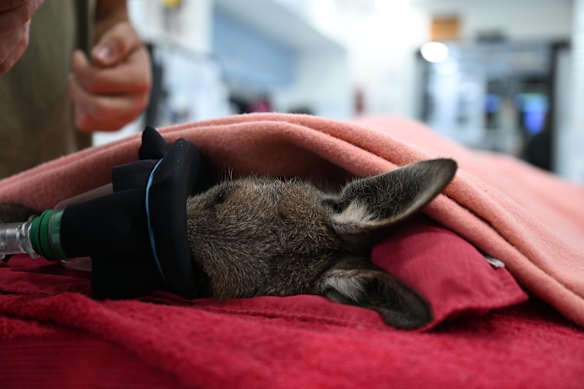
“We were literally inundated with wildlife as we reopened the doors,” Van Mil said.
The hospital is caring for an eastern grey kangaroo that was found caught in a stormwater drain, a bunch of sea turtle hatchlings that were washed ashore, a number of birds that are heavily waterlogged and unable to fly, a flying fox and a huge python.
Sadly, many animals had to be euthanised, including a young female koala that was blown out of her tree and found on the ground near Byron Bay. Van Nil said the animal had chlamydia and was already in a weakened state.
Queensland Premier David Crisafulli says he is prepared to call out insurers who do not pay out claims or hike up premiums in the wake of ex-tropical cyclone Alfred.
The premier said he was concerned about rising insurance premiums for Queenslanders, saying that Australia’s most disaster-prone state had been “pretty good” to the insurance industry.

“I will be prepared to call out insurers who aren’t good partners in the short and long term,” he said.
“If you look over the last decades, there’s been a lot of people who have paid a lot of money to the insurance industry.
“I think they owe it to those clients to be good corporate citizens in someone’s hour of need. And that relates to both ends of the state.”
The first government hardship payments for those affected by ex-tropical cyclone Alfred will be available to Gold Coast, Redlands and Logan residents in South East Queensland.
Premier David Crisafulli said there would be payments of $180 per person and $900 per family available. People in other areas will be able to access those payments in the near future.
Community hubs will also be established.
“They offer face-to-face support, somewhere to go if you’re having strife with your insurance; if you don’t have documentation; if you’re not feeling well and you just need to talk to someone,” Crisafulli said.
“Those community hubs do a power of work, and I saw how effective they were in places like Cardwell, Ingham, and Townsville – just as a single point where people can go and know they’ll be listened to.”
More than 1000 Australian Defence Force personnel are deployed across Queensland and Northern NSW as part of the recovery effort.
Defence Minister Richard Marles said a contingent of 700 personnel was in northern NSW in addition to 500 in South East Queensland.
“Together, these personnel are engaging in supporting recovery centres, engaging in welfare checks, doing route clearances, knocking on doors and providing assistance,” he said.
“We have other assets at hand in terms of high clearance vehicles, potentially [aircraft to provide an] airlift if that is needed in the coming days, those men and women of our defence force are showing their exceptional skill and competence.”
Sole traders and eligible workers who have lost income as a direct result of ex-tropical cyclone Alfred will be able to access up to 13 weeks of income support.
Speaking from Lismore, Prime Minister Anthony Albanese said the payments would be the same amount as JobSeeker for those most affected by the aftermath of Alfred in Queensland and northern NSW.
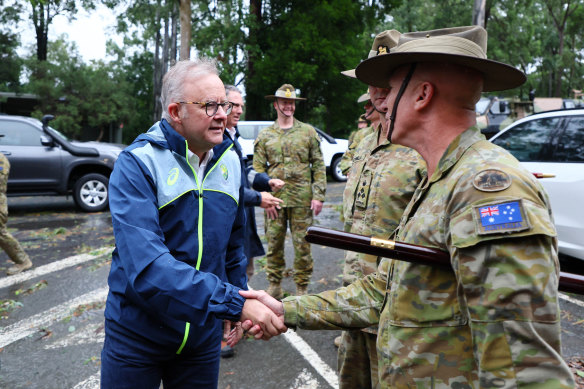
“The disaster recovery allowance is a solely Commonwealth-funded allowance. It provides up to 13 weeks of income support at the JobSeeker level to individuals who work in the local government areas impacted,” Albanese said.
“Further today, along with the Queensland premier, will be making an announcement as well jointly funded Commonwealth state support is kicking in. The personal hardship assistance scheme will be activated for impacted residents in the Logan Gold Coast City and Redlands City Council areas.
“These are grants for eligible impacted residents, they cover emergency costs, replacement of damaged household goods and reconnections of services.”