


In the latest and arguably most significant legal challenge to Trump’s sweeping agenda, his administration has been accused of defying a federal judge.
In the latest and arguably most significant legal challenge to Trump’s sweeping agenda, his administration has been accused of defying a federal judge.
By Michael Koziol
March 18, 2025 — 10.50am
Washington: The Trump administration argued a judge’s verbal orders do not have to be obeyed as it came under intense scrutiny over the deportation of alleged migrant criminals using an 18th century wartime law.
In the latest and arguably most significant legal challenge to President Donald Trump’s sweeping agenda, the administration has been accused of defying court orders to halt the removal of nearly 200 migrants alleged to be members of the Venezuelan Tren de Aragua gang.

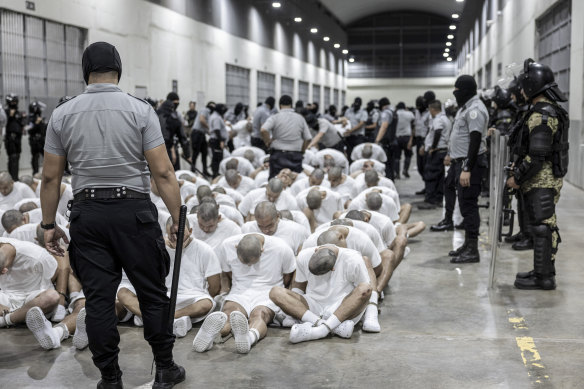
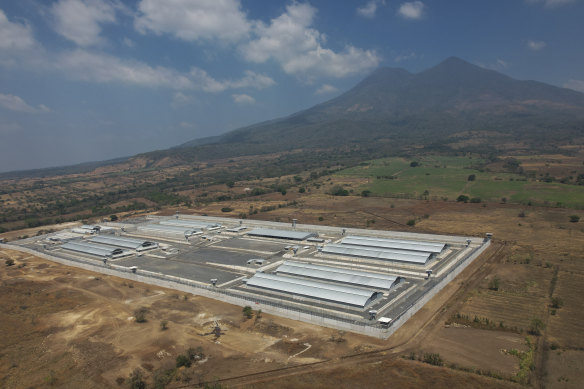
The orders were issued on Saturday as the individuals were already on planes bound for El Salvador from the southern Texas city of Harlingen. Trump used the 1798 Alien Enemies Act, an obscure law not invoked since World War II, to arrest and deport the migrants without the right to plead their case before an immigration court.
The timing of the events has since come under scrutiny because although the White House abhors many of the directives given by US judges, it maintains that it always obeys them.
“All of the planes that were subject to the written order took off before the order was entered in the courtroom on Saturday,” White House press secretary Karoline Leavitt said at a briefing on Tuesday (AEDT).
As to the judge’s earlier, verbal directive to halt the planes – and turn around any that were in the air – Leavitt asserted: “There’s actually questions about whether a verbal order carries the same weight as a written order.”

That argument incensed District Judge James E. Boasberg when put before him in a Washington courtroom by Justice Department lawyers, as did a suggestion the written order was too late because the planes were already airborne.
“That’s one heck of a stretch, I think,” he said, noting the administration knew the hearing was underway. “I’m just asking how you think my equitable powers do not attach to a plane that has departed the US, even if it’s in international airspace.”
Advertisement
Prior to those comments, Trump’s senior policy aide Stephen Miller launched a hyperbolic attack on Boasberg, telling reporters the judge was engaged in the equivalent of trying to direct American troops overseas.
“It is the most outrageous thing I have seen from a District Court judge in my lifetime, but frankly going back multiple lifetimes,” he said. “The judge’s order was patently unlawful. Beyond unlawful, it was an outrageous assault on the Constitution, an outrageous assault on the sovereignty of the nation, and on democracy itself.”

Miller foreshadowed more executive action on deportations in coming days. “You will see the full suite of presidential authorities used to extirpate this gang, this terrorist organisation, from our soil,” he said.
In February, Trump designated the gangs Tren de Aragua and MS-13 as foreign terrorist organisations. However, the law used to deport the alleged terrorists without a hearing has only ever been used in times of war, as declared by Congress.
Lee Gelernt, lead counsel for the American Civil Liberties Union, argued outside court the government had violated due process by not giving people the chance to demonstrate they were not part of the gang.
He said the administration had potentially violated, “perhaps even knowingly violated”, the law by refusing to turn the flights around.
“There’s a lot at stake here,” Gelernt said. “It is also a fundamental question of the separation of powers. The president is simply thumbing his nose at Congress.”
Speaking aboard Air Force One on Sunday, Trump argued the country was effectively at war because criminal migrant gang members were illegally crossing the border.
Loading
“That’s an invasion. They invaded our country. In that sense, this is war,” he said. “In many respects, it’s more dangerous than war because in war they have uniforms.”
More broadly, Trump and his administration are growing frustrated with blockages and delays by US judges, including orders by multiple courts to reinstate thousands of fired federal workers.
“I think it’s absolutely ridiculous,” Trump said. “It’s a judge that’s putting himself in the position of the president of the United States who was elected by close to 80 million votes. You’re having more and more of that, it’s a very dangerous thing for our country.”
Yale University law professor Bruce Ackerman said the designation of Tren de Aragua as a foreign terrorist organisation did not make the invocation of the Alien Enemies Act legal or appropriate.
“We are not at war with Venezuela. Moreover, we have not even deported these people to Venezuela,” he said. “The question of whether they had the constitutional, legal authority to invoke the Alien Enemies Act in this case – the answer is clearly ‘no’.”
with AP
Michael Koziol is the North America correspondent for The Age and Sydney Morning Herald. He is a former Sydney editor, Sun-Herald deputy editor and a federal political reporter in Canberra.Connect via Twitter.
Loading