


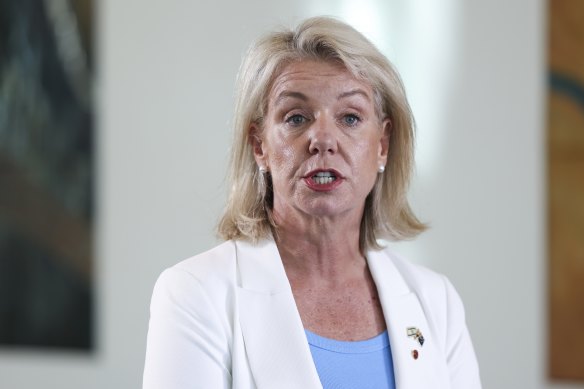
Qantas’ domestic CEO told an inquiry into passenger rights that a compo scheme does “not deliver better outcomes for consumers”, as the Coalition’s Bridget McKenzie cited the airline’s “explicit breach of consumer trust”.
Qantas’ domestic CEO told an inquiry into passenger rights that a compo scheme does “not deliver better outcomes for consumers”, as the Coalition’s Bridget McKenzie cited the airline’s “explicit breach of consumer trust”.
By Chris Zappone
March 17, 2025 — 2.56pm
Qantas and Virgin are unconvinced by a push for a passenger compensation law for delayed and cancelled flights, as consumer advocates say airlines have “zero incentive” to improve customer service.
Qantas domestic CEO Markus Svensson told an inquiry into passenger rights on Monday that a compensation-based scheme does “not deliver better outcomes for consumers” in terms of reduced delays or cancellations. In fact, such a law could drive up ticket prices, he said.

Svensson said that when delays or cancellations were “within our control”, Qantas already provided a refund, rebooking or any other remedies required by law.
The inquiry into the airline passenger protections bill, designed to ensure “concrete protections” for passengers, follows a series of Qantas scandals that have infuriated the travelling public.
In 2024, Qantas was ordered to pay $120 million in fines and compensation for booking customers on already-scrapped services. Qantas also forced passengers to accept flight credits for pandemic disruptions rather than the refunds they were entitled to.
The so-called “pay on delay” legislation, introduced last year by the Coalition and separate from a planned Ombuds Scheme supported by the Albanese government, would establish penalties for Australia’s airlines in the event of flight delays, cancellations or denials of boarding.

Virgin Australia government affairs spokesman Stephen Beckett said his airline supported a “beefed up” complaint handling body with the ability to make binding decisions, as well as “building greater awareness” of consumer law to “make remedies more accessible to the travelling public”.
Nationals senator Bridget McKenzie, sponsor of the “delay or pay” bill, cited Qantas’ sale of tickets for already-cancelled flights – so-called “ghost flights” – as a reason for creating a mandatory compensation system.
Advertisement
“That was an explicit breach of consumer trust,” McKenzie said. “If Qantas was willing to knowingly sell those ‘ghost tickets’, why should passengers trust that the voluntary consumer protections that you offer in your own policies are enough?”
The ability for Australian airlines to cancel flights with little or no penalty has emerged as a feature of the industry, underscoring what’s seen as weak levels of domestic competition among the three major airlines.
Monthly airline statistics showed Qantas cancelling 2.4 per cent of flights in January, compared with 0.9 per cent for Virgin.
Loading
Despite existing laws and regulations, the outlook for improved competition remains far from positive, consumer advocates said.
Consumer advocate Adam Glezer told the inquiry: “We’ve got a duopoly of Qantas and Virgin, and we’ve got no consequences if they delay, cancel flights, whatever it might be.”
A spokesperson for Qantas said it didn’t cancel for commercial reasons at short notice.
Qantas and its budget carrier Jetstar have emerged from the uncertainty of pandemic lockdowns in a stronger financial position, but they are not short of controversies, including former chief executive Alan Joyce’s jumbo payout and the sacking of 1700 ground crew workers that was later ruled illegal by a court.
Even with the prospect of a Virgin-Qatar tie-up increasing long-haul international competition, the domestic market remains a cash cow for airlines.
Qantas notched up $1.39 billion, a rise of 11 per cent, in the half year to December 31, with a 35 per cent surge in Jetstar’s earnings in the period.
The “pay on delay” legislation at the centre of Monday’s inquiry is separate from the 2024 announcement of an Ombuds Scheme, contained in the aviation white paper, designed to give powers of enforcement to regulators to curb airlines’ poor customer service.
The Australian Lawyers Alliance solicitor Victoria Roy, who covers travel law, noted a 2023 submission to the aviation green paper showed that “on a given day, cancellation rates vary significantly between airlines despite flights being subject to the same weather conditions and air traffic control”.
The legal group “is concerned that this suggests that some cancellations are due to operational reasons”, she said.
Loading
Aviation stands with banking and groceries as industries that feature entrenched players with little incentive for robust competition.
Dean Long, of the Australian Travel Industry Association, said reform would require “an economic cost” for the airlines to offset the current incentive to provide poor services.
The opening to a Senate hearing got off to a jarring start with Qantas’ domestic boss coming under fire for not attending in person.
“I thought things were going to be different under the new leadership,” McKenzie said, in a reference to Vanessa Hudson replacing Alan Joyce as chief executive in 2023.
Qantas’ submission to the inquiry wasn’t on time, McKenzie said: a “bit similar to your flight schedule, it seems”.
Svensson said he didn’t travel to Canberra because of a “personal matter”. Other witnesses to the inquiry, including at least one based in Canberra, also provided testimony by video link.
The Market Recap newsletter is a wrap of the day’s trading. Get it each weekday afternoon.
Chris Zappone is Digital Foreign Editor of The Age and Sydney Morning Herald.Connect via Twitter, Facebook or email.
Loading