


Goldfish is an unconventional new production that shows that hope can come in the most unexpected of forms.
Goldfish is an unconventional new production that shows that hope can come in the most unexpected of forms.
By Cher Tan and Andrew Fuhrmann
February 27, 2025 — 1.11pm
THEATRE | ASIA TOPA
Goldfish ★★★★★
Arts House, until March 1
It is a time of crisis, and it has been for some time. The threat of natural disaster looms as global warming increases – reports have estimated that the oldest and thickest ice in the Arctic has declined by 95 per cent over the last 30 years. We see the encroaching danger of climate disaster through strange weather patterns, and as sea levels rise.

The question remains: can art respond to ecological crisis? One answer might come through Terrapin, a Tasmanian puppet company which has been shining a spotlight on significant questions for more than 40 years. Previous shows have explored power and greed, the search for belonging, and environmental conservation.
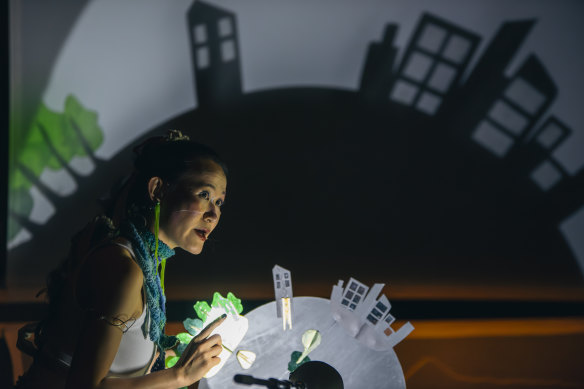
Now, Terrapin returns with Goldfish, an unconventional new show co-created with Japan’s Aichi Prefectural Art Theater. Goldfish opens with shadow puppetry, and performer Mayu Iwasaki begins by telling an energetic story of a mountain town that is soon enveloped by a flood, something which Iwasaki narrates with verve.
Not long after, however, the show is abruptly interrupted by two disaster recovery workers (played by Marcus McKenzie and Rino Daidoji) who insist that there is a real flood happening in the world outside the theatre. As fact and fiction suddenly blur, a new story emerges. This time, as McKenzie and Daidoji busy themselves around her, Iwasaki uses the materials of disaster recovery (a tarpaulin, ladder, rope, emergency food stores) to continue her story.
Often filled with pleasant surprises, the storytelling in Goldfish is multifaceted, blending physical theatre with ingenious puppetry. Iwasaki’s storytelling is particularly noteworthy, her superb narration taking centre stage amidst the minimal set design. The trio’s movements too, are fluid and evocative, creating an immersive experience that pulls in even the most detached sceptic.

While there are many moments of tenderness and playfulness through slapstick humour, there is also a shadow of loss and despair that pervades the show, a delicate balance deployed to great effect. And the puppetry is masterful: simple materials and everyday objects are used to breathe life into the inanimate, and where inventive uses of reflected light and shadow create an awe-inducing atmosphere.
Despite its playfulness however – and this is Terrapin’s unique strength, as a puppet company that is well-known for its intergenerational shows – Goldfish is not just a show for children. It’s a reminder that even in the aftermath of destruction, there’s still hope – and sometimes, it comes in the most unexpected forms.
Reviewed by Cher Tan
Advertisement
PERFORMANCE ART | ASIA TOPA
Unpacked No. 2: Political ★★★
Dancehouse, until February 28
Melati Suryodarmo frames this ruminative performance lecture with a familiar device: the unpacking of bags after a voyage. Surrounded by luggage and apparently wearied by the journey of her life, she hauls forth the paraphernalia of past performances.

Suryodarmo, an Indonesian performance artist who achieved mainstream recognition when a video of her Butter Dance went viral in 2012, traces her path from dreaming child to globe-trotting artist, lingering on the political contexts she encountered along the way.
She was born in 1969 – at the beginning of the Suharto era – in the small central Javanese city of Surakarta. Her parents, she tells us, threw her placenta in the river and this is why she yearned to travel.
In the late 1980s, while attending university, she joined small theatre troupes. Street theatre was at that time a crucial form of dissent in the face of rampant corruption and human rights abuses, as well as tightening controls over the press and freedom of expression.
Loading
Later, Suryodarmo relocated to Braunschweig in Lower Saxony. Here, she explains, she struggled with the tradition of critical analysis that is so integral to art making in Germany, but she found her own way.
While narrating this bildungsroman of a young artist abroad, she demonstrates fragments of a half-dozen or so works. These are sketched performances – travel-sized versions – without the durational intensity of the actual works.
It’s a relaxed performance, full of anecdotal digressions and generalised reflections on happiness, pain and our shared humanity. Things get lost in the clutter created by the unpacking of so many props, but it’s all part of the restrained and somewhat melancholy mood.
Suryodarmo will be performing her famous Exergie – Butter Dance on Friday, but this lecture provides a fuller picture of her career, one that is as introspective as it is retrospective.
Reviewed by Andrew Fuhrmann
The Booklist is a weekly newsletter for book lovers from Jason Steger. Get it delivered every Friday.
Cher Tan is an essayist and critic living and working on unceded Wurundjeri land.
Andrew Fuhrmann is a dance critic for The Age.
Loading