


Jeremy Grantham has earned a reputation as a doom-monger in financial circles for his warnings over stock market bubbles. No one is laughing at him now.
Jeremy Grantham has earned a reputation as a doom-monger in financial circles for his warnings over stock market bubbles. No one is laughing at him now.
By Michael Bow
March 21, 2025 — 5.22am
The city of Doncaster, South Yorkshire, is a long way from the gleaming skyscrapers of Boston, Massachusetts, but they are both places that the billionaire British stock picker Jeremy Grantham calls home.
Grantham, 86, is one Britain’s most successful investors, having made his name on Wall Street in the 1960s at GMO, the Boston-based $US63 billion ($99 billion) money manager, which still bears his name. He represents the G.

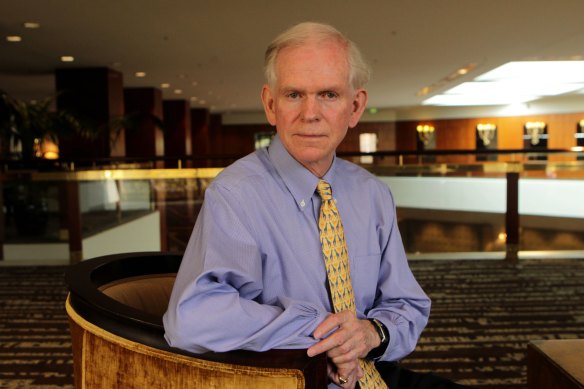
Likened to Warren Buffett, the so-called Oracle of Omaha, the octogenarian has earned a reputation as a doom-monger in financial circles for his warnings over stock market bubbles.
As an investor he predicted the dotcom bust, much to the chagrin of his clients, and has been likened to “the skunk at the garden party” for his grumpy pessimism when the stock markets are riding high.
Loading
But ever since US markets cratered last week, Grantham has been transformed from a doomster into a Cassandra figure whose warnings should have been heeded.
He claims to have studied 300 historical financial bubbles throughout history, including England’s canal building and railway construction busts during the Industrial Revolution, and now his long-standing predictions that the AI bubble will pop appears to be bearing fruit.
The Nasdaq fell an extraordinary 4 per cent last Monday, the largest one day move in three years. The S&P 500 of America’s largest companies is also down 10 per cent from its February 19 peak, wiping $US5.2 trillion off its value.
Like Buffett, who before the crash had amassed a $US344 billion cash pile from selling stocks, Grantham appears to have made the correct call.
Advertisement
For months, Grantham had been raising the alarm over the sky-high share prices of the “magnificent seven” – Google, Meta, Tesla, Nvidia, Apple, Microsoft and Amazon – as well as the overvaluation of US stocks more generally.
“This [US stock market] has moved up the rank of super bubbles. The bigger and the higher it goes, the more exciting and dangerous it will be,” he warned last month.
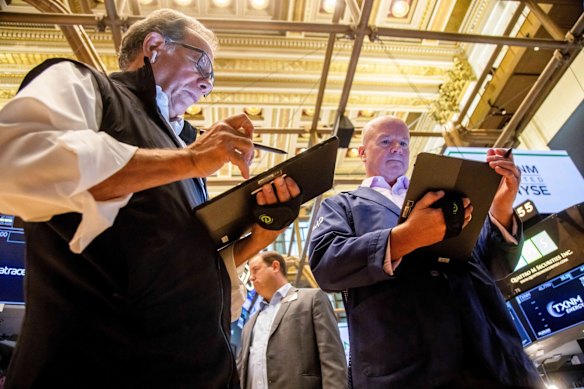
Although he agrees AI will transform society, he has called the US stock market’s reaction a “glorious bubble” similar to the UK railway boom in the 19th century. We still have our railways up and down Britain, he says, but the investors were “washed away”.
During the period when he was calling for restraint, shares in AI-linked companies continued to surge, leaving him an increasingly isolated figure in the financial world.
Since AI fever gripped the market in late 2022 when ChatGPT was released, Nvidia shares rose 900 per cent, while even old-time veterans of the stock market such as Amazon surged 176 per cent.
Loading
Many other pessimists who had warned of a bubble slowly cracked when they saw such monumental increases, but in true Yorkshire fashion, Grantham stuck to his guns.
Despite his bearish stance, one thing Grantham consistently failed to pinpoint was the trigger for the stock market slump.
Improbable though it may seem, that has come in the form of the US president Donald Trump and his aggressive economic policy.
When Trump came to office, it appeared that the chances of Grantham’s bubble theory being proved right were slim.
Deregulation and low taxes triggered a Trump bump, ushering in a wave of euphoria and fresh stock market highs.
Yet in recent weeks, markets have gone into reverse with frothy AI stocks taking the worst hit. Nvidia shares are down 16 per cent over the past month.
With his transatlantic accent, one could be forgiven that Grantham had lost some of his Yorkshire grit.
Yet he says his roots help inform his “value” style of investing, when stock pickers aim to buy stocks on the cheap in the hope they rise in value.
In his young investing days, he made millions of dollars very quickly betting on US stocks in the late 1960s only to lose it in a market crash.
“It did of course teach me a very powerful lesson that even on the frivolous end, speculating in crazy stuff was not a great idea,” he said on a Bloomberg podcast last month. “I reverted to my Yorkshire roots of waste not, want not, and went for value for money big time.”
Grantham was born before the Second World War and grew up in the coal mining community of Doncaster.
After graduating from the University of Sheffield, he joined his stepfather’s firm as a salesman selling hospital supplies – a period he has called “without doubt the worst, ugliest 18 months of my life” – but eventually quit for the business world.
His big break across the Atlantic started when he went to study at Harvard Business School, a move which opened up doors to the world of consultancy and, eventually, money management, then a fledgling industry centred around Boston.
In the late 1970s he set up Grantham, Mayo, Van Otterloo (GMO), a firm he is still attached to today. The company, which adopts many of Grantham’s pessimistic market views, manages about $US63 billion of investments.
With his skill at parsing threats on the horizon, Grantham is now predicting a new danger that he says could crash the financial system, a concept he has labelled “toxicity”.
This is his description of the global health effects of new chemicals invented over the past 60 years.
In a paper published last week, the investment guru claimed these chemicals – which are contained in plastics, pesticides, shampoo and perfume – are “poisoning us more effectively than lead in paint and gasoline once did”.
The most worrying effect of this is the extraordinary decline in testosterone, libido and sperm count, contributing to a significant drop off in the number of people having children, he says.
Loading
Over the past 12 years, global births have slumped from 142 million to 130 million per year and are set to continue to decline, he says, and the most pressing consequence will be a wave of lawsuits against companies producing these chemicals.
Grantham’s warnings have been met with a healthy dose of scepticism, with one academic once saying his encounters with the 86-year-old “whipped him into a state of alarm” because of their apocalyptic nature.
But with the Trump slump still in full effect, perhaps a good dose of Yorkshire realism is what investors really need.
Telegraph, London
The Business Briefing newsletter delivers major stories, exclusive coverage and expert opinion. Sign up to get it every weekday morning.
Loading