


The prime minister is in no hurry to drop billions on the Suburban Rail Loop, an undertaking so gargantuan that most of us will be dead before it’s completed.
The prime minister is in no hurry to drop billions on the Suburban Rail Loop, an undertaking so gargantuan that most of us will be dead before it’s completed.
Opinion
February 12, 2025 — 6.00pm
Oh, to be a young government again.
In June 2015, when Jacinta Allan rose in parliament to spruik the need for a new statutory authority called Infrastructure Victoria, the Labor administration was seven months old. Just a bub, really.
Reading from a speech laced with strong ideals about how government decisions with far-reaching consequences should be made, Victoria’s then public transport minister spoke about the importance of seeking independent, expert advice, of relying on evidence and submitting to robust, transparent analysis before committing large amounts of public money to major projects.

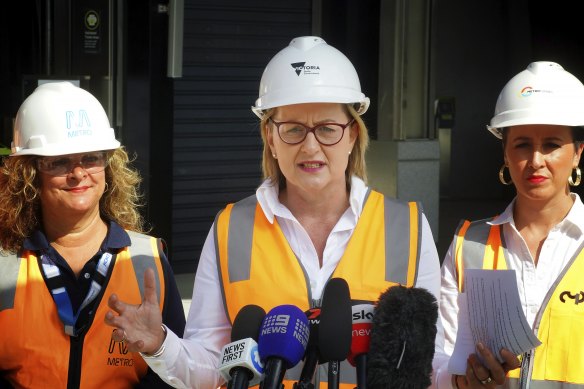
“Victorians know too well that some infrastructure decisions have been rushed, haphazard, and without any ability for the community to scrutinise the often grandiose claims of the governments that make them,” she tut-tutted.
“These are decisions that spend taxpayers money, and which hold the potential to shape our state for decades to come. Planning the future of our state without an enduring, strategic and evidence-based plan is to the detriment of us all.”
Daniel Andrews, the premier who’d come to power promising to tear up a newly inked contract to build a cross-city road project entered into in the dying days of the Napthine government, had the chutzpah to declare: “Infrastructure Victoria will take short-term politics out of infrastructure planning.”
Looking back nearly 10 years later, it is hard to know what is funnier – Andrews and Allan promising to take electoral politics out of major projects or the idea they would ever want to.
The same thing could be said of nearly every state and federal government since Edmund Barton zipped up his first high-viz vest. But this Labor government, with its “Big Build” branding and hard-hatted persona, has raised to an art-form the excavation of infrastructure votes.
Andrews made good on his promise to ditch the East-West Link, at an eventual cost of $1.1 billion to the state. When he next sought re-election, it was off the back of a promise to deliver the Suburban Rail Loop, modestly touted as the “biggest public transport project in history”.
Advertisement
The project was developed in secret by consultants and concealed from senior transport bureaucrats to give Andrews something shiny and new to take to the election.
Loading
We have now arrived at a place where Andrews’ successor, Jacinta Allan, having lambasted with just cause the way Victoria was stiffed for years by the Abbott, Turnbull and Morrison governments in terms of Commonwealth funds for major protects, is locked in bitter dispute with her Labor counterparts in Canberra over what to fund next.
As reported by my colleague Paul Sakkal, a $2 billion impasse has emerged between Allan and her federal counterparts.
The Albanese government wants to add this money to $5 billion it has already committed to building a rail line from the city to Melbourne Airport. The Allan government is refusing to accept the additional $2 billion for the airport rail or any other major infrastructure project until the Commonwealth stumps up more cash for the Suburban Rail Loop.
And it all comes down to politics.
Anthony Albanese is a self-described “infrastructure nerd” who in a previous life served as the nation’s first minister for infrastructure. In 2008, he oversaw the establishment of Infrastructure Australia to assess and prioritise major projects.
If Albanese firmly believed what he told parliament about Infrastructure Australia in 2008 – that it would “drive investment where it is needed most” – he wouldn’t be offering more Commonwealth money for either Melbourne Airport Rail or the SRL.
Melbourne Airport Rail, a project designed to provide mass public transport between the city and the international airport and ease traffic on a freeway forecast to reach capacity within the next 11 years, has been sitting on Infrastructure Australia’s priority list since 2016.
In its most recent published assessment of the project, Infrastructure Australia found that while there are “strong reasons” to keep developing it, its economic benefits do not outweigh its costs. The reasons for this are complex, but Infrastructure Australia’s take-out advice is that, for now, there is no rush to start laying tracks.
Given the state and Commonwealth governments have already committed a combined $10 billion towards an $11.6 billion rail line, there is more work to be done before the project needs a promise of more money.
Loading
Albanese has a different set of concerns. He is not fussed about whether the Tullamarine is chockers by 2036. He is worried about getting run over by Victorian voters at this year’s federal election.
He is willing to cough up $2 billion so that he can fly to Melbourne, pop on a hard hat and announce that if we vote for his government, Melbourne Airport Rail will be fully funded.
But he can’t make the same promise about the SRL, a project so gargantuan in its cost and timeframes that Allan, Albanese, myself and most current subscribers of The Age will be dead by the time at all stages are completed.
Infrastructure Australia is yet to add the SRL to its priority list because the Victorian government only provided in December last year additional information the agency had sought for two years to properly assess the project. This is the same government that in 2015 stressed the importance of robust, transparent advice in infrastructure decisions.
Allan’s considerations, though no less pressing, are different to Albanese’s. After the twin shocks of the Resolve poll showing support for Labor had crashed to 22 per cent and the Werribee byelection shellacking handed to her government, she is clinging to the SRL like Linus to his blanket.
At Monday’s Cabinet meeting she declared to colleagues she wasn’t for turning. She remains convinced the largest public transport project in history can be rebadged as a whopping housing project and is convinced voters still want it.
Whether we do shouldn’t matter. Neither Infrastructure Victoria nor Infrastructure Australia are there to promote projects we want. Their purpose is to prioritise what we need. The stand-off between Allan and Albanese suggests they should read some of their old speeches.
Chip Le Grand is state political editor.
The Opinion newsletter is a weekly wrap of views that will challenge, champion and inform your own. Sign up here.
Chip Le Grand leads our state politics reporting team. He previously served as the paper’s chief reporter and is a journalist of 30 years’ experience.Connect via email.
Loading