


The Wall Street honeymoon Donald Trump experienced in the initial months of his new administration appears to be ending.
The Wall Street honeymoon Donald Trump experienced in the initial months of his new administration appears to be ending.
Opinion
February 26, 2025 — 10.59am
The Wall Street honeymoon Donald Trump experienced in the initial months of his new administration appears to be ending, with the share market sliding, bond yields falling, cryptocurrencies tumbling and consumer confidence evaporating.
Until a week ago, the US sharemarket was up 7.6 per cent from its level immediately before the November election. It has since fallen 3 per cent. The “Magnificent Seven” big technology stocks have fallen more than 6.5 per cent in the past week. Bitcoin, having soared 56 per cent in the post–election period, has lost 11 per cent of its value since last Friday.

The yields on Treasury bonds are also dropped with the yield on the benchmark 10–year bonds down from 4.55 per cent a week ago to 4.32 per cent.
The sudden loss of what had seemed significant momentum within the markets appears tied to the difference between the expectation Wall Street investors and US consumers had of the Trump administration and its reality.
They expected deregulation, tax cuts, and smaller government and were dismissive of the prospect that Trump would follow through with his campaign promise of a universal tariff and a 60 per cent tariff on China’s exports to the US.
Loading
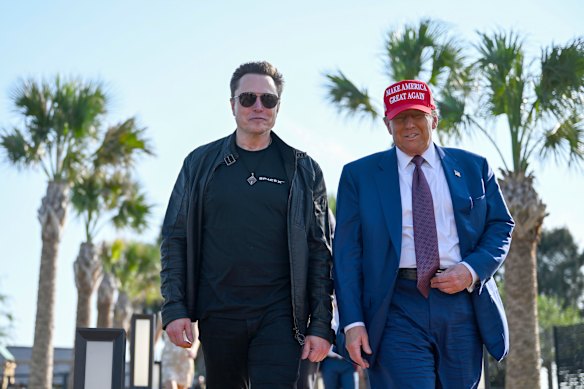
Instead, they have got chaos. Trump announces new and different tariffs almost on a daily basis, while Elon Musk’s rampage through the government’s agencies is running into roadblocks in the courts and pushback from the agencies and even from some of their Trump–appointed leaders.
Trump announced, paused and now says he will proceed with tariffs on imports from America’s two major trading partners, Mexico and Canada.
He has also imposed an extra 10 per cent duty on imports from China, removed (and paused) a tariff on low–value goods, imposed a 25 per cent tariff on imports of steel and aluminium (and says copper is next in line) and foreshadowed “reciprocal” tariffs on all the countries the US trades with, while including non–tariff issues like Europe’s valued–added tax and digital services tax in the calculations.
Advertisement
While Trump is trying to upend global trade and undermine global growth, it’s also becoming apparent that the “savings” Musk is claiming are grossly overstated and, in any event, are inconsequential when set against the scale of government spending.
He and his youthful acolytes are, however, sewing confusion and dysfunction within the agencies even as other Trump appointees, like Defence Secretary Pete Hegseth, or Health Secretary, Robert F. Kennedy Jnr., are only just starting to contribute to the that cause.

It’s little wonder then, that Wall Street is becoming unsettled, or that consumers are becoming fearful.
The Conference Board consumer confidence survey, issued on Tuesday, showed US consumer confidence has fallen more this month than at any time in the past three and a half years. The board’s index fell 7 points in the February survey, the third straight monthly decline.
Consumers are pessimistic about labour market conditions, as well as the outlook for their finances and business conditions. There’s a growing proportion of them who expect a recession within the next year.
It’s the mix of tariffs and the mass firings (or attempted firings) of government employees that appears to be unsettling the consumers. Separate surveys have shown their expectations of inflation are at their highest levels in nearly 30 years.
It’s probably not helping consumer confidence that the House Republicans in Congress are trying to pull together a “big, beautiful bill” (which is how their leaders now describe it) that would slash $US2 trillion ($3.2 trillion) from government spending, including big cuts to social welfare and medicare programs – in order to partly fund Trump’s $US4.5 trillion of tax cuts for the wealthy.
Trump’s Treasury Secretary, Scott Bessent, has said his economic plan is to cut the US budget deficit from 6.4 per cent of GDP to 3 per cent, lift GDP growth (2.8 per cent last year, but fading) to 3 per cent and increase oil and gas production (which is already at record levels) by 3 per cent.
He has also said that the administration’s focus would be on lowering the 10–year bond rate, which influences all interest rates within the US economy, including the cost of government debt.
The US inflation rate has proven stubborn, indeed it rose slightly last month. The Federal Reserve Board is therefore sitting on its hands, not expecting to lower rates again until the second half of the year, if at all.
Trump’s tariffs and his immigration policy – deporting millions of undocumented immigrants – are inherently inflationary.
Despite what he says, and may believe, tariffs are paid on goods once they have landed within the US and by the importer, not the exporter. Most of their cost is then either absorbed by the importing company, lowering profits, or passed onto consumers, increasing prices and inflation.
It’s that growing fear that – rather than the bonanza that investors and the big tech and energy companies that supported Trump had envisaged – the administration might bungle its way into recession, which seems to be unsettling Wall Street.
Fewer of the lowest income workers inevitably means higher labour costs, and more inflation, although Trump’s promise to round up and deport illegal immigrants in their millions appears to be proving easier said than done, despite the massive level of resources the administration has assigned to the effort.
Investors in the US, and consumers, are therefore reacting rationally to the prospect of more inflation and less growth than they foresaw last year in the immediate aftermath of the election.
There is a possibility that, instead of the high–growth, low–inflation, lower interest rate environment Bessent is targeting, the US ends up with a low–growth economy but one with still–high inflation and interest rates – stagflation – because of Trump’s policies.
Loading
It’s that growing fear that – rather than the bonanza that investors and the big tech and energy companies that supported Trump had envisaged – the administration might bungle its way into recession, which seems to be unsettling Wall Street.
The erratic nature of the administration and the eccentric (to be polite) nature of some of those Trump has appointed to lead key agencies is contributing to the sense that America is deliberately destabilising (if not quite destroying) itself, along with much of the rest of the world.
Trump and his advisers believe they are dismantling the “Deep State” and a parasitic world order but, even if they were more effective in executing their plans than they have been to date, America would emerge diminished by the effort, with the geopolitical landscape tilted heavily towards China.
That’s not what Trump intended, or Wall Street expected.
The Business Briefing newsletter delivers major stories, exclusive coverage and expert opinion. Sign up to get it every weekday morning.
Stephen Bartholomeusz is one of Australia’s most respected business journalists. He was most recently co-founder and associate editor of the Business Spectator website and an associate editor and senior columnist at The Australian.Connect via email.
Loading