





Amid fears of destructive winds, flooding and a billion-dollar bill to come, people were trapped in their bedroom after a large tree blew onto their house, while thousands lost power.
Amid fears of destructive winds, flooding and a billion-dollar bill to come, people were trapped in their bedroom after a large tree blew onto their house, while thousands lost power.
- Updated
- National
- Queensland
- Extreme weather
By Cloe Read and Felicity Caldwell
Updated March 7, 2025 — 1.02pmfirst published at 5.00am
Follow our live coverage of Cyclone Alfred here.
Two people have been rescued after a large tree fell on a Gold Coast house and trapped them in a bedroom, as Cyclone Alfred continues to batter South East Queensland.
More than 41,000 properties had lost power by noon on Friday, the day before the cyclone was expected to make landfall and bring the full brunt of its destructive wind gusts of up to 155km/h.
As of 11am, Cyclone Alfred was 150 kilometres offshore of Brisbane, and was expected to cross the coast by Saturday morning.
Parts of the Gold Coast have recorded 24-hour rainfall totals of more than 160 millimetres, and 100km/h winds.
Heavy rainfall of 800 millimetres has been forecast across the disaster period, with a potential damage bill in the billions.
Loading
Acting Police Commissioner Shane Chelepy said emergency crews were starting to get requests for help, particularly on the Gold Coast.
He said there had been 11 search and rescue jobs since Thursday, including for jet ski riders, swimmers and kayakers.
Advertisement
“Now is not the time to be in the surf, and all you’re doing is putting emergency services at risk and yourself at risk,” he said.
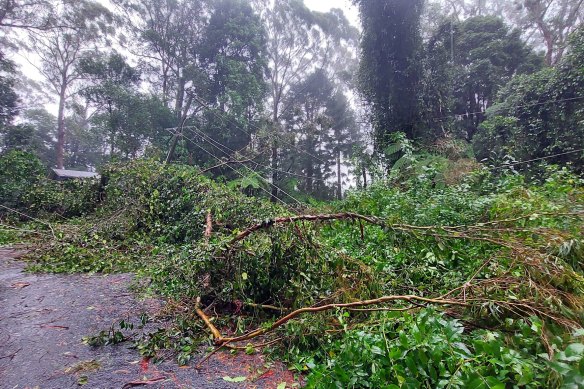
Chelepy said emergency crews also had reports of several large trees down, and beach erosion.
Brisbane City Council has updated its flood mapping, with about 850 homes added to the 20,000 expected to be affected across the city as the water rises.
The category 2 system may weaken as it hits near Brisbane, but the bureau warned Alfred could linger for more than six hours, causing flash flooding and storm surges.
Premier David Crisafulli said authorities expected significant rainfall in the “next 24 to 48 hours right across that system and maybe even beyond.”
“This system remains a very broad one and often when we see tropical cyclones as they approach the coast, that band really does tighten,” he says.
“In this case it is really large and slow-moving, and that does represent the prospect of some significant rainfall over a long period of time. That rainfall does bring the risk of river and creek flooding.”
Loading
People have been warned to stay home, off the city’s roads.
Crisafulli earlier said some roads in Greater Brisbane were owned by the private sector, who would make their own decisions about closures, but the government hoped to keep roads and bridges “open as long as we possibly can”.
“Because we want emergency services and essential personnel to be able to still drive,” he said.
Many essential services such as schools, public transport and supermarkets have stopped operating, and more than 1000 schools in Queensland were closed until further notice.
Translink reported all public transport services were cancelled “until further notice”, while more than 600 Education Queensland schools would reopen “when it is safe for students to attend”.
Electricity provider Energex warned that conditions were becoming dangerous for crews, and power might not be restored to some premises until early next week.
“The last thing we want to be doing is putting a cherry picker up and the wind blowing it over with crews inside,” Energex’s Danny Donald told 4BC.
Brisbane has been forecast to cop 200 millimetres of rain in a 24-hour period.
Loading
Lord Mayor Adrian Schrinner said most of the rain was forecast to come on Saturday, with the tail end of the cyclone.
“The scale of this weather system is incredible … unlike the normal storms that come through Brisbane,” Schrinner said.
As Alfred closes in, residents in the Gold Coast and Redland Bay areas have been warned they could see storm surges up to 1.5 metres if the system crossed at high tide.
The Brisbane Airport cancelled flights from Thursday afternoon, with Qantas and Jetstar international flights suspended until at least noon on Saturday, and domestic operations until at least Sunday morning.
In a bid to protect water supply, more than 30 water treatment plants were put in place across the region, fortified with back-up generators.
Asked on 4BC about releases from Wivenhoe Dam, Seqwater chief executive Emma Thomas said that would begin anywhere from within the next 48 hours to 72 hours.
She said Wivenhoe Dam had a drinking water compartment of 1 million megalitres, which was close to full capacity.
“We have another 2 million megalitres of flood storage compartment in that dam and the idea of that is to manage the storage of water in there in conjunction with the releases and then … with what’s happening downstream in the Lockyer and Bremer rivers.”
There had been confusion from residents living in low-lying areas about whether they could park their cars in shopping centres for free to avoid flooding risks. A Scentre Group spokeswoman said parking was free at Westfield shopping centres in the cyclone warning zone on Thursday, but they could not guarantee safe access or storage of cars during or after cyclone.
Start the day with a summary of the day’s most important and interesting stories, analysis and insights. Sign up for our Morning Edition newsletter.
Discover more from World Byte News
Subscribe to get the latest posts sent to your email.
