





Premier David Crisafulli said the south-east power outages were the most significant in a decade, adding: “The challenges now are flash flooding.”
Premier David Crisafulli said the south-east power outages were the most significant in a decade, adding: “The challenges now are flash flooding.”
By Cloe Read and Cameron Atfield
Updated March 8, 2025 — 10.28amfirst published at 5.50am
- Follow our live coverage for Cyclone Alfred here.
Millions of people have been warned of life-threatening flash flooding in the coming hours as ex-Tropical Cyclone Alfred continues to batter the south Queensland coast, leaving 274,000 people without power.
On Saturday morning, category 1 Cyclone Alfred was downgraded to an ex-tropical system and was north-east of Brisbane.
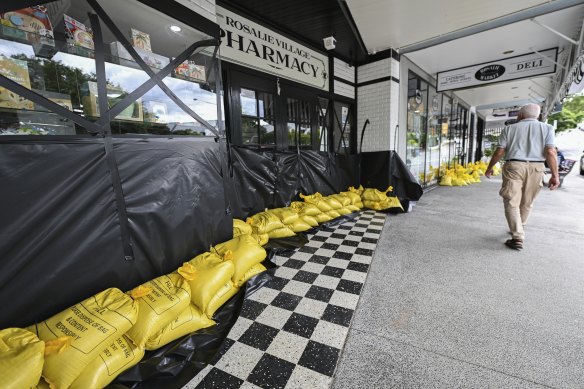
But authorities said millions of people were still at significant risk of flash flooding as the system moved west over land.
Crews were racing against the clock to restore power to Gold Coast University Hospital and Seqwater pumping stations in the Redlands region.
Speaking on Saturday morning, Premier David Crisafulli said “the challenges now are flash flooding”.
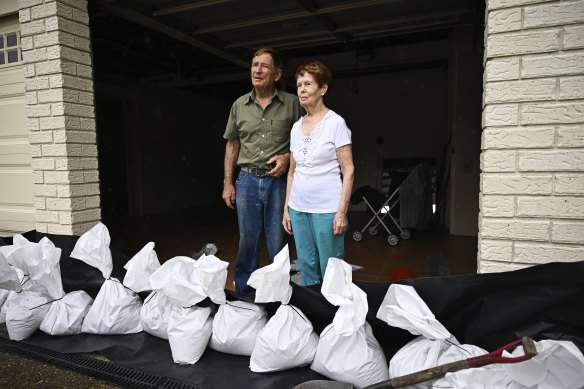
“Just to give you an indication of what occurred in the past 19 hours, we’ve had 240 millimetres recorded at Springbrook, 200 millimetres at Tallebudgera, and 100 millimetres at Mount Cotton,” Crisafulli said.
He said Gold Coast University Hospital was without mains power and had been running on generators.
Advertisement
“The water treatment plants at Mount Cotton and Alexandra Hills are without power. There are generators on site and staff are urgently attempting to reconnect those, and it is a race against the clock to try to do that in the minutes and hours ahead before those reservoirs run out of water.”
Dozens of people needed help on the Gold Coast overnight, including residents of a Labrador apartment block whose roof was blown off.
At the Gold Coast Seaway, 107km/h winds had been reported, and significant coastal erosion.
“We’ve seen the loss of a roof off one of the apartment buildings, one of the older buildings on the Gold Coast. We’ve had quite a few instances of trees falling on homes, cars and powerlines,” Crisafulli said.
He said the power outages across the state’s south-east were the most significant in 10 years.
“We are currently approaching a quarter of a million homes without power,” he said.
Before crashing, the Energex website said more than 250,000 homes were without power in Queensland alone, and nearly 300,000 were without power across the affected areas in NSW and Queensland. That has since been upgraded to 274,000 in Queensland.
“That’s the single biggest loss we have seen in over a decade since [Tropical Cyclone] Oswald,” Crisafulli said earlier this morning.
“The work needed to reconnect that is significant … Queenslanders need to know that right now, there are damage assessments being done, and already crews are being mobilised to get that done.”
Bureau of Meteorology Brisbane manager Matthew Collopy said as the system moved inland, tropical moisture would stream across south-east Queensland.
“We are expecting widespread totals of 300 to 500 millimetres, with localised amounts of 800 millimetres plus, possible in some areas of south-east Queensland, particularly again around the southern part of where ex-Tropical Cyclone Alfred tracks,” he said.
Loading
When asked whether the bureau would still categorise the system that crossed into south-east Queensland as a cyclone, given it had been downgraded, Collopy said it was better to focus on the effects of the weather system.
“It certainly crossed the bay islands as a category 1 system, and then the impacts we saw across the Gold Coast, and indeed in Brisbane, and the flooding we’re expecting over the coming days,” he said.
“The exact coastal crossing times and those features will be analysed in good time, and I would again focus on the impacts, and also focus on the rainfall and flooding we’re still expecting.”
Lord Mayor Adrian Schrinner told ABC Radio Brisbane that while the city had dodged a bullet, residents should prepare for heavy rainfall on Saturday and Sunday.
He said the city’s south-eastern suburbs recorded incredibly strong winds, with heavy rainfall at Burbank and Rochedale, south of Brisbane.
“The Redlands were hit hard as well,” he said.
More to come
Discover more from World Byte News
Subscribe to get the latest posts sent to your email.
