





The ex-tropical cyclone made landfall at 9pm on Saturday, but heavy rain and flooding is forecast to continue through Sunday.
The ex-tropical cyclone made landfall at 9pm on Saturday, but heavy rain and flooding is forecast to continue through Sunday.
Here are the latest updates in the aftermath of ex-tropical cyclone Alfred hitting the coast.
- Alfred made landfall at 9pm on Saturday, hitting the coast of Queensland between Brisbane and Maroochydore, according to the Bureau of Meteorology.
- In NSW, severe weather warnings remain in place for parts of the Northern Rivers, Northern Tablelands, Mid North Coast and North West Slopes and Plains. In QLD, warnings remain for the south-east Coast and parts of Wide Bay–Burnett and Darling Downs regions.
- In Queensland, major flood warnings remain in place for the Bremer River and Warrill Creek, and the Logan Albert River basin. In NSW, major flood warnings remain for the Clarence River at Grafton, the Orara River at Glenreagh and Coutts Crossing and the Richmond River at Coraki and Bungawalbin.
- More than 1800 emergency callouts have been made on Sunday across Queensland and New South Wales.
- Across both states, hundreds of schools will be closed on Monday – head here for a full list of NSW schools, and here for Queensland.
- A 61-year-old man who died after being swept into floodwaters in northern NSW on Friday has been identified as 61-year-old Tom Cook.
- Thirteen people who were injured in a crash involving two Australian Defence Force vehicles near Lismore are expected to make a full recovery. Two soldiers remain in a serious condition.
- Brisbane has been experiencing strong winds as the ex-cyclone approaches and more than 268,000 homes are without electricity across south-east Queensland, and 12,500 without in NSW.
The number of NBN internet services taken out by wild weather has continued to rise today, with South East Queensland still the worst affected.
In a statement this afternoon, the NBN said the number of impacted services in South East Queensland had risen during the day to around 239,000, while the number in northern NSW had also risen to 13,000.
“Many of our sites remain operating on backup power sources and where possible, we are deploying generators to support connectivity and will continue to work with the emergency authorities to deploy more generators today.
“We are continuing to monitor conditions closely so that we can begin deploying our on-the-ground teams as soon as it is safe to do so. Once conditions allow, our crews will assess any damage to network infrastructure and commence repairs.”
Telstra, meanwhile, continued to reconnect customers, but late this afternoon still had disruptions at 164 mobile sites, 7268 landline services, and 1849 ADSL services.
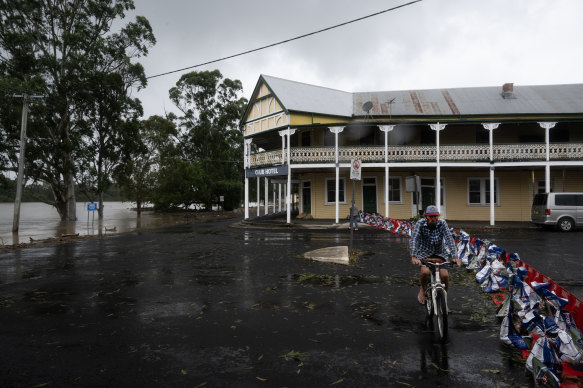
Sydney Morning Herald reporter Angus Dalton has been in Coraki in northern NSW, where the waters of the Richmond and Wilsons rivers meet, intensifying the threat of flood to this evacuated town of 1400.
There Strike Force Kilo, a Fire and Rescue NSW squad, has seized the rare opportunity this afternoon to conduct drills in natural floodwater as the situation stabilises.
The squad, which is poised for a real flood rescue in case someone is swept away, has been practising with drones which can drop lifejackets to people flailing in floodwater or trapped on roofs.
You can read the full story here.
The Gold Coast council has issued a watch and act warning to its residents, calling on the Currumbin Valley community to prepare now for moderate flooding from Currumbin Creek.
Gold Coast Mayor Tom Tate confirmed 102,000 homes remain without power – down from Saturday’s 140,000 – and 57 roads are closed.
Residents have also been warned they could expect prolonged power outages for the next five days, but Tate said the city’s experience during the heavy storms over Christmas in 2023 held them in good stead for the recovery phase. “Mother nature is very unpredictable. Where it goes, only Alfred knows,” he said.
Tate also confirmed state schools will not be open on the Gold Coast on Monday.
The number of properties experiencing power outages caused by Alfred has dropped, although more than a quarter of a million people in Queensland remain without power as crews respond to downed poles and live wires.
In Queensland, more than 268,000 people remain without power, far fewer than the 350,000 this morning.
Energex and Ergon crews have reconnected 40,000 homes and businesses so far today across the region and will continue working well into the night.
Energy Queensland CEO Peter Scott said there have been 1500 live wires on the ground across south-east Queensland this weekend as ex-tropical cyclone Alfred brought down trees and power poles.
“A big focus for today is to work on the restoration of power at Mount Nardi [which] is home to several transmission towers for FM radio, digital television, fixed wireless broadband and some mobile phone services,” he said in a statement.
Queensland Premier David Crisafulli, who in his update today that around 450,000 properties had experienced power losses since the start of Alfred, posted a video to social media of him thanking energy workers for their efforts.
In northern NSW, more than 12,500 homes and businesses were without power as of 4.30pm AEDT this afternoon, according to electricity distributor Essential Energy.
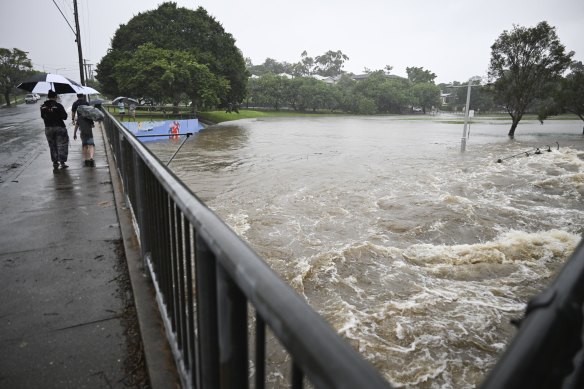
Residents near the Clarence River in Grafton have been warned that the area has now surpassed the threshold for major flooding, with water levels more than doubling in the past 24 hours.
River heights at Clarence River were just over 2.3 metres at 4.30pm on Saturday, but have since risen to 5.46 metres as of 4pm today.
This morning, residents were issued a “shelter now” warning by the NSW SES, and have been told it is too late to leave safely with evacuation routes cut off. Yesterday Grafton recorded about 50 millimetres of rainfall, while the area to the south of the city had 60–70 millimetres.
Major flood warnings remain in place for the Tweed River at Tumbulgum and the Richmond River at Wiangaree, Kyogle, Coraki, Bungawalbin and Woodburn. Grafton previously experienced record levels of flooding in 2013 when river heights peaked at over 8 metres.
Thousands of insurance claims have already been made across northern NSW and South East Queensland following damage from ex-tropical cyclone Alfred.
The Insurance Council of Australia (ICA) said today that insurers had received almost 3000 claims related to cyclone damage since the start of March, as the weather system has brought widespread power outages, heavy rain, flooding and falling debris. The peak body has declared an “insurance catastrophe” for the regions, under which claims from affected areas are given priority.
This comes as federal and state governments have announced relief funds for councils and residents. A combined $30 million in immediate assistance is available for councils and communities in both states.
Speaking earlier, Queensland Premier David Crisafulli confirmed state and federal governments were working together to offer financial assistance packages for residents.
“We’ll be outlining to eligible residents about those costs and what that covers,” Crisafulli said this afternoon.
“But I do want to communicate to people that we understand there’s been hardship as part of this, and we will be working with the Commonwealth government to make sure that flows quickly.”
Here are the latest updates in the aftermath of ex-tropical cyclone Alfred hitting the coast.
- Alfred made landfall at 9pm on Saturday, hitting the coast of Queensland between Brisbane and Maroochydore, according to the Bureau of Meteorology.
- In NSW, severe weather warnings remain in place for parts of the Northern Rivers, Northern Tablelands, Mid North Coast and North West Slopes and Plains. In QLD, warnings remain for the south-east Coast and parts of Wide Bay–Burnett and Darling Downs regions.
- In Queensland, major flood warnings remain in place for the Bremer River and Warrill Creek, and the Logan Albert River basin. In NSW, major flood warnings remain for the Clarence River at Grafton, the Orara River at Glenreagh and Coutts Crossing and the Richmond River at Coraki and Bungawalbin.
- More than 1800 emergency callouts have been made on Sunday across Queensland and New South Wales.
- Across both states, hundreds of schools will be closed on Monday – head here for a full list of NSW schools, and here for Queensland.
- A 61-year-old man who died after being swept into floodwaters in northern NSW on Friday has been identified as 61-year-old Tom Cook.
- Thirteen people who were injured in a crash involving two Australian Defence Force vehicles near Lismore are expected to make a full recovery. Two soldiers remain in a serious condition.
- Brisbane has been experiencing strong winds as the ex-cyclone approaches and more than 268,000 homes are without electricity across south-east Queensland, and 12,500 without in NSW.
Opposition Leader Peter Dutton has said there was “no perfect response” to the extreme weather conditions brought on by ex-cyclone Alfred, but praised the early action taken by local governments.
“People complained about the fact that we closed down too early, and the event didn’t take place until Friday, Saturday and today,” he said in a press conference given from the city of Moreton Bay in his electorate.
“But had the tropical cyclone sped up and people hadn’t been prepared or warned for it, then there would have been criticism on that basis,” he said.
“I just think we have to accept that it’s an imperfect science. The councils and the state governments will make the calls that they see fit and that they think are in the best interests of the community, and I think we should be grateful for that.”
Northern NSW can expect another day of heavy rainfall tomorrow as the remnants of ex-tropical cyclone Alfred turn south after moving into western Queensland.
The Bureau of Meteorology’s Sue Oates said the weather system was moving over the towns of Kingaroy and Miles, about three hours north of Brisbane.
“But then the system will shift south of the Queensland border, where … heavier rainfall will occur over NSW during Monday,” she said.
“For Queensland, today is the key day for heavy rainfall and where we’ll see the most significant 24-hour totals.”
Oates said the rain would ease in Brisbane from tomorrow. “But don’t expect that the skies will be clear on Monday. It will be unsettled, and we are expecting showers and potentially thunderstorms through our area,” she said.
“Finally, for eastern Australia, we should see an easing of the conditions on Tuesday.”
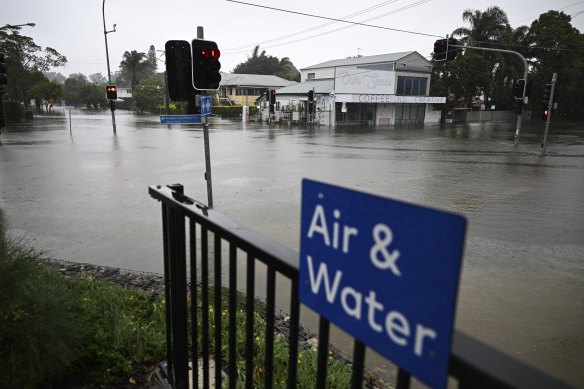
Ex-tropical cyclone Alfred has continued to bring heavy rains and winds to Brisbane, causing road closures and continued flood danger.
Since 9am Saturday the city has recorded over 150 millimetres of rain, and more than 100 roads have been closed in suburbs such as Carindale, Oxley and Stones Corner.
Acting Queensland Police Commissioner Shane Chelepy has urged to people to stay out of flooded areas in public parks and sporting grounds in these suburbs.
“We’re seeing young people wanting to go and play in these waters. Those drains in those areas are very dangerous, so please stay out.”
Meanwhile, the ABC was briefly reporting local radio 612AM had lost transmission, advising residents to tune into 106.1FM instead for emergency advice. The service has since been restored.
Discover more from World Byte News
Subscribe to get the latest posts sent to your email.
