





Donald Trump’s decision to impose tariffs on Australian steel and aluminium could be just the start as the US president also has plans to target other imports.
Donald Trump’s decision to impose tariffs on Australian steel and aluminium could be just the start as the US president also has plans to target other imports.
- Updated
- World
- North America
- Trade wars
By Matthew Knott, Shane Wright, Michael Koziol and Nick Toscano
Updated March 12, 2025 — 11.16amfirst published at 4.28am
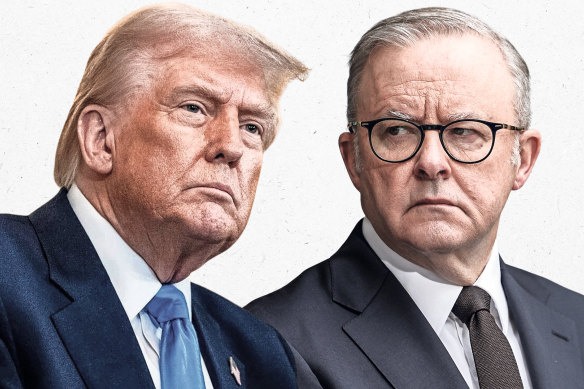
Prime Minister Anthony Albanese has accused Donald Trump of breaching the spirit of Australia’s close relationship with the United States by slapping a 25 per cent tariff on all US steel and aluminium imports, labelling the move an unjustified act of economic self-harm.
In an announcement that prompted accusations by the opposition that Albanese was responsible for the tariff increase, White House press secretary Karoline Leavitt told this masthead that Australia would not be granted an exemption from the imposts that will have increased fears of a global economic slowdown.
Asked why he had decided against the carve-out, she indicated there would be no exemptions across the board. “America first steel. If they want to move their steel manufacturers here, they’re welcome to do so,” she said.
The boss of one of the nation’s most powerful unions leapt upon the decision to demand quotas for Australian steel and aluminium in public infrastructure projects, saying it would be “sheer idiocy” to stick with a free market approach in the Trump era.
Australia, along with other major steel and aluminium exporters, has spent the past month pressing Trump to grant them an exemption on the tariffs that are due to start mid-afternoon Australian time on Wednesday.
“Such a decision by the Trump administration is entirely unjustified,” Albanese told reporters in Sydney.
“This is against the spirit of our two nations’ enduring friendship and fundamentally at odds with the benefit of our economic partnership that has delivered over more than 70 years.
“Australia has no tariffs on goods from the United States and, of course, we have [a free-trade] agreement with the United States.”
Advertisement
Labelling the tariff move as “not a friendly act”, Albanese said: “Quite clearly it is not a positive step in a relationship. It is as simple as that.
“I think Australians will look at this decision and will be concerned that our friends in the United States have chosen to impose these tariffs on Australia given that Australia does not impose tariffs on the United States.”
While saying the government would continue to lobby for an exemption, Albanese said Australian exporters would seek to diversify their markets and that the nation’s steel and aluminium products were in high demand around the world.
Asked whether he should have travelled to Washington to lobby Trump for an exemption, Albanese stressed that no nation had received a carve-out, including those whose leaders had held White House meetings with Trump.
Signalling plans to shore up Australian industry, Albanese said the Buy Australia campaign would get additional support in the budget on Tuesday, March 25: “All Australians, of course, can join this effort and support our [nation] by taking the opportunity to buy Australian.”
Deputy opposition leader Sussan Ley blamed Albanese for the tariffs, arguing he should have had a face-to-face meeting with Trump.
“This government just hasn’t done enough … it’s bad news for Australian jobs, Australian industry,” she told Sky News.
Loading
“All of the other leaders of the Quad and AUKUS, Japan, India, the UK, travelled to the US, and they had face-to-face meetings and they did what they needed to do. They advocated fiercely in their country’s interests … well, where has the prime minister been?
“We would expect a prime minister of Australia to advocate just as fiercely in our national interest, to travel to the US to have those face-to-face meetings.”
Foreign Minister Penny Wong disputed the accusation that Albanese did not make enough contact with Trump.
“I just would make the point that the prime minister has had two calls with the president. I would make the point that we have been engaging at every level,” she said.
Paul Farrow, the national secretary of the Australian Workers Union, which represents workers at some of the country’s biggest aluminium refineries, said: “What the government must do is simple. Australian steel and Australian aluminium must be mandated for use in all Australian infrastructure and government buildings from this point onward.
“Australia’s purist free-market approach on procurement was naive a decade ago, sticking to it now would be sheer idiocy … Australia is very good at making steel and aluminium. Trump knows it, and it’s about time we recognise it too.”
The Albanese government made a concerted attempt to avoid the tariffs, pursuing a carve-out similar to that granted to Malcolm Turnbull when he was prime minister during Trump’s first term.
Treasurer Jim Chalmers flew to Washington to meet his US counterpart, Scott Bessent, while Australian ambassador to the US Kevin Rudd met Commerce Secretary Howard Lutnick last Friday to plead Australia’s case.
Loading
The Australian embassy in Washington was contacted for comment.
While the tariff decision will be a feature of the coming Australian election campaign, it is already weighing on the global economy.
Business Council of Australia chief executive Bran Black said: “Australia should adopt a cool-headed response to this news and keep making the case for our interests through continued extensive engagement with the US Administration…My primary concern is with the broader trade picture and the risk that lies ahead for our economy if a global contest of reciprocal tariffs were to escalate.”
Confirmation of the tariffs roiled through world equity and foreign exchange markets. The Dow Jones Industrial Average shed another 1.1 per cent overnight and is now more than 10 per cent down from when Trump first announced his tariff plans in early February. The ASX is down 8 per cent over the same timeframe and had lost 1.5 per cent by lunchtime on Wednesday.
Most currencies increased in value against the US dollar on fears about the strength of the American economy. At one point, the Australian dollar pushed through US63¢ before edging below that mark early on Wednesday.
Economists with ANZ Sophia Angala and Adelaide Timbrell said the direct effects of the tariffs were likely to be small, noting South Korea was Australia’s largest steel and aluminium market, accounting for 19.4 per cent of total exports of the metals.
But they warned an escalation of trade tensions, including Trump’s plan for tariffs on more goods beginning next month, would be more challenging for the Australian and global economy.
“As a trade-exposed economy, the largest tariff-related risk for Australia arises from a potential escalation of trade tensions. On the more extreme end, a trade war could lead to supply chain disruptions that increase the price of goods imports, negatively impacting domestic incomes and offsetting disinflation momentum,” they said.
One of the affected Australian companies, BlueScope, said in a statement that it was disappointed that an exemption similar to that negotiated by the Turnbull government in 2018 had not been put in place.
“We are working closely with the Australian trade and diplomatic staff in Canberra and in Washington DC, and with a wide range of senior representatives in Congress to ensure the BlueScope investment proposition is fully understood,” a spokesperson said.
Loading
Australia’s largest aluminium manufacturer, Capral, has been in business for 80 years producing extruded aluminium for construction and window frames. Chief executive Tony Dragicevich said imports already supply about 30 per cent of the local aluminium extrusion market, and he expects Trump’s tariffs will increase competition.
“There is no doubt that tariffs will have an impact on the international trade flows, and some of that product will need to find a new home,” Dragicevich said.
Capral employs 1100 people across six manufacturing plants and 22 distribution centres, pulling in $650 million in annual revenue. He said the company struggles to compete with imports.
Get a note directly from our foreign correspondents on what’s making headlines around the world. Sign up for our weekly What in the World newsletter.
Matthew Knott is the foreign affairs and national security correspondent for The Sydney Morning Herald and The Age.Connect via Twitter or Facebook.
Shane Wright – Shane is a senior economics correspondent for The Age and The Sydney Morning Herald.Connect via Twitter or email.
Michael Koziol is the North America correspondent for The Age and Sydney Morning Herald. He is a former Sydney editor, Sun-Herald deputy editor and a federal political reporter in Canberra.Connect via Twitter.
Nick Toscano is a business reporter for The Age and Sydney Morning Herald.Connect via Twitter or email.
Loading
Discover more from World Byte News
Subscribe to get the latest posts sent to your email.
