



Marine leaders will decide this year whether to outfit each of their divisions with a maritime reconnaissance company and brand…
Browsing: Tech
tech news
Drilling Marine Corps reservists across the command’s components may see an increased emphasis on job proficiency and readiness as Marine…
Birmingham offers solid internet options, including blazing-fast multi-gig fiber. Here are CNET’s picks for the best home internet providers in…
The definition of preventive healthcare can be broad and confusing. To figure out what it actually is, we reached out…
CNET takes a look at this budget-friendly, pocket-sized computer.CNET takes a look at this budget-friendly, pocket-sized computer. CNET takes a look…
Oracle Cloud Infrastructure Deploys Thousands of NVIDIA Blackwell GPUs for Agentic AI and Reasoning Modelson April 28, 2025 at 1:00 pm
Oracle has stood up and optimized its first wave of liquid-cooled NVIDIA GB200 NVL72 racks in its data centers. Thousands of NVIDIA Blackwell GPUs are now being deployed and ready for customer use on NVIDIA DGX Cloud and Oracle Cloud Infrastructure (OCI) to develop and run next-generation reasoning models and AI agents. Oracle’s state-of-the-art GB200
Read ArticleOracle has stood up and optimized its first wave of liquid-cooled NVIDIA GB200 NVL72 racks in its data centers. Thousands of NVIDIA Blackwell GPUs are now being deployed and ready for customer use on NVIDIA DGX Cloud and Oracle Cloud Infrastructure (OCI) to develop and run next-generation reasoning models and AI agents. Oracle’s state-of-the-art GB200
Read Article
Oracle has stood up and optimized its first wave of liquid-cooled NVIDIA GB200 NVL72 racks in its data centers. Thousands of NVIDIA Blackwell GPUs are now being deployed and ready for customer use on NVIDIA DGX Cloud and Oracle Cloud Infrastructure (OCI) to develop and run next-generation reasoning models and AI agents.
Oracle’s state-of-the-art GB200 deployment includes high-speed NVIDIA Quantum-2 InfiniBand and NVIDIA Spectrum-X Ethernet networking to enable scalable, low-latency performance, as well as a full stack of software and database integrations from NVIDIA and OCI.
OCI, one of the world’s largest and fastest-growing cloud service providers, is among the first to deploy NVIDIA GB200 NVL72 systems. The company has ambitious plans to build one of the world’s largest Blackwell clusters. OCI Superclusters will scale beyond 100,000 NVIDIA Blackwell GPUs to meet the world’s skyrocketing need for inference tokens and accelerated computing. The torrid pace of AI innovation continues as several companies including OpenAI have released new reasoning models in the past few weeks.
OCI’s installation is the latest example of NVIDIA Grace Blackwell systems going online worldwide, transforming cloud data centers into AI factories that manufacture intelligence at scale. These new AI factories leverage the NVIDIA GB200 NVL72 platform, a rack-scale system that combines 36 NVIDIA Grace CPUs and 72 NVIDIA Blackwell GPUs, delivering exceptional performance and energy efficiency for agentic AI powered by advanced AI reasoning models.
OCI offers flexible deployment options to bring Blackwell to customers across public, government and sovereign clouds, as well as customer-owned data centers through OCI Dedicated Region and OCI Alloy at any scale.
A number of customers are planning to deploy workloads right away on the OCI GB200 systems including major technology companies, enterprise customers, government agencies and contractors, and regional cloud providers.
These new racks are the first systems available from NVIDIA DGX Cloud, an optimized platform with software, services and technical support to develop and deploy AI workloads on leading clouds such as OCI. NVIDIA will use the racks for a variety of projects including training reasoning models, autonomous vehicle development, accelerating chip design and manufacturing, and developing AI tools.
GB200 NVL72 racks are live and available now from DGX Cloud and OCI.
Oracle has stood up and optimized its first wave of liquid-cooled NVIDIA GB200 NVL72 racks in its data centers. Thousands of NVIDIA Blackwell GPUs are now being deployed and ready for customer use on NVIDIA DGX Cloud and Oracle Cloud Infrastructure (OCI) to develop and run next-generation reasoning models and AI agents. Oracle’s state-of-the-art GB200
Read Article
Travelers entering the US should consider a simple phone that doesn’t have all your personal information. Here’s how.Travelers entering the…
NVIDIA Brings Cybersecurity to Every AI Factoryon April 28, 2025 at 3:00 pm
As enterprises increasingly adopt AI, securing AI factories — where complex, agentic workflows are executed — has never been more critical. NVIDIA is bringing runtime cybersecurity to every AI factory with a new NVIDIA DOCA software framework, part of the NVIDIA cybersecurity AI platform. Running on the NVIDIA BlueField networking platform, NVIDIA DOCA Argus operates
Read ArticleAs enterprises increasingly adopt AI, securing AI factories — where complex, agentic workflows are executed — has never been more critical. NVIDIA is bringing runtime cybersecurity to every AI factory with a new NVIDIA DOCA software framework, part of the NVIDIA cybersecurity AI platform. Running on the NVIDIA BlueField networking platform, NVIDIA DOCA Argus operates
Read Article
As enterprises increasingly adopt AI, securing AI factories — where complex, agentic workflows are executed — has never been more critical.
NVIDIA is bringing runtime cybersecurity to every AI factory with a new NVIDIA DOCA software framework, part of the NVIDIA cybersecurity AI platform. Running on the NVIDIA BlueField networking platform, NVIDIA DOCA Argus operates on every node to immediately detect and respond to attacks on AI workloads, integrating seamlessly with enterprise security systems to deliver instant threat insights.
The DOCA Argus framework provides runtime threat detection by using advanced memory forensics to monitor threats in real time, delivering detection speeds up to 1,000x faster than existing agentless solutions — without impacting system performance.
Unlike conventional tools, Argus runs independently of the host, requiring no agents, integration or reliance on host-based resources. This agentless, zero-overhead design enhances system efficiency and ensures resilient security in any AI compute environment, including containerized and multi-tenant infrastructures. By operating outside the host, Argus remains invisible to attackers — even in the event of a system compromise.
Cybersecurity professionals can seamlessly integrate the framework with their SIEM, SOAR and XDR security platforms, enabling continuous monitoring and automated threat mitigation and extending their existing cybersecurity capabilities for AI infrastructure.
NVIDIA BlueField is a foundational security component for every AI factory, providing built-in, data-centric protection for AI workloads at scale. By combining BlueField’s acceleration capabilities with DOCA Argus’ proactive threat detection, enterprises can secure AI factories without compromising performance or efficiency.
Cisco is collaborating with NVIDIA to deliver a Secure AI Factory with NVIDIA architecture that simplifies how enterprises deploy and protect AI infrastructure at scale. The architecture embeds security into every layer of the AI factory, ensuring runtime protection is built in from the start rather than bolted on after deployment.
“Now is the time for enterprises to be driving forward with AI, but the key to unlocking innovative use cases and enabling broad adoption is safety and security,” said Jeetu Patel, executive vice president and chief product officer at Cisco. “NVIDIA and Cisco are providing enterprises with the infrastructure they need to confidently scale AI while safeguarding their most valuable data.”
DOCA Argus and BlueField are part of the NVIDIA cybersecurity AI platform — a full-stack, accelerated computing platform purpose-built for AI-driven protection. It combines BlueField’s data-centric security and Argus’ real-time threat detection with NVIDIA AI Enterprise software — including the NVIDIA Morpheus cybersecurity AI framework — to deliver visibility and control across an AI factory. It also taps into agentic AI to autonomously perceive, reason and respond to threats in real time.
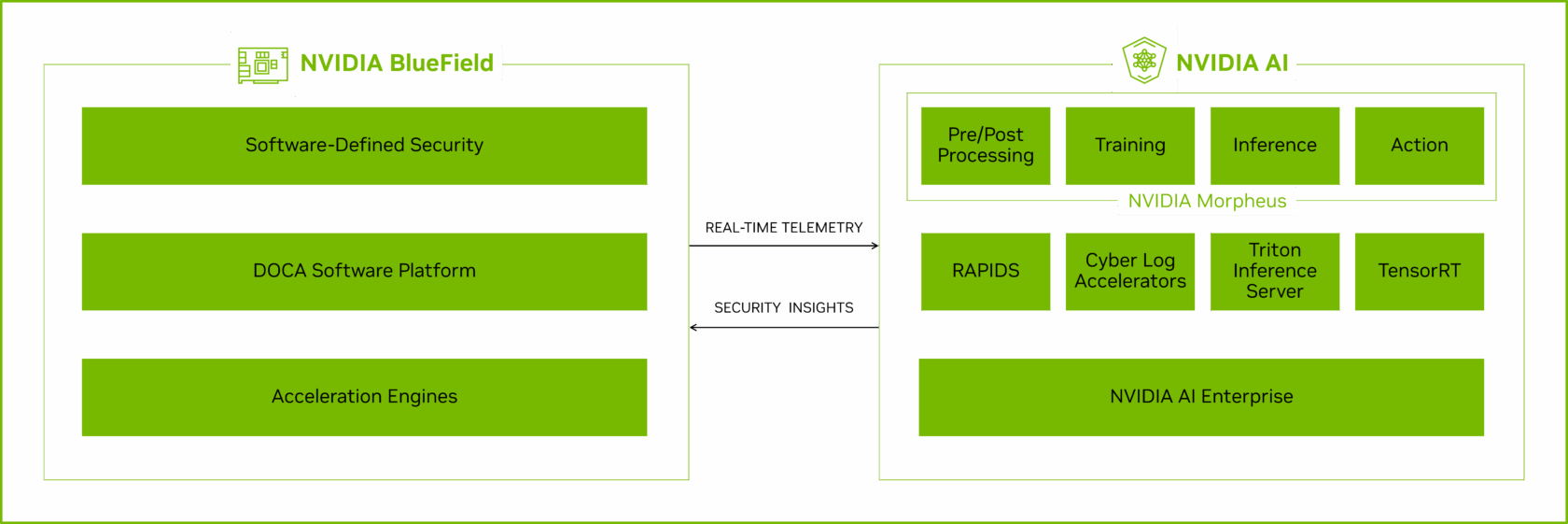
Optimized AI Workload Threat Detection
Enterprises are inundated with massive volumes of data, making it difficult to pinpoint real threats. The growing adoption of agentic AI, with AI models and autonomous agents operating at enterprise scale to seamlessly connect data, applications and users, brings unprecedented opportunities for gleaning insights from data — while introducing the need for advanced protection that can keep pace.
DOCA Argus is fine-tuned and optimized using insights from NVIDIA’s own security team, surfacing only real, validated threats. By focusing on well-known threat actors and eliminating false positives, the framework provides enterprises with actionable intelligence, reducing alert fatigue and streamlining security operations.
Argus is purpose-built to protect containerized workloads like NVIDIA NIM microservices, incorporating real-world threat intelligence and validation to secure every layer of the AI application stack.
“Cyber defenders need robust tools to effectively protect AI factories, which serve as the foundation for agentic reasoning,” said David Reber, chief security officer at NVIDIA. “The DOCA Argus framework delivers real-time security insights to enable autonomous detection and response — equipping defenders with a data advantage through actionable intelligence.”
Get started with DOCA Argus and meet NVIDIA at the RSA Conference in San Francisco, running through Thursday, May 1.
As enterprises increasingly adopt AI, securing AI factories — where complex, agentic workflows are executed — has never been more critical. NVIDIA is bringing runtime cybersecurity to every AI factory with a new NVIDIA DOCA software framework, part of the NVIDIA cybersecurity AI platform. Running on the NVIDIA BlueField networking platform, NVIDIA DOCA Argus operates
Read Article
The Gunners make their first appearance in the last four since 2009.The Gunners make their first appearance in the last…
How Agentic AI Enables the Next Leap in Cybersecurityon April 28, 2025 at 3:00 pm
Agentic AI is redefining the cybersecurity landscape — introducing new opportunities that demand rethinking how to secure AI while offering the keys to addressing those challenges. Unlike standard AI systems, AI agents can take autonomous actions — interacting with tools, environments, other agents and sensitive data. This provides new opportunities for defenders but also introduces
Read ArticleAgentic AI is redefining the cybersecurity landscape — introducing new opportunities that demand rethinking how to secure AI while offering the keys to addressing those challenges. Unlike standard AI systems, AI agents can take autonomous actions — interacting with tools, environments, other agents and sensitive data. This provides new opportunities for defenders but also introduces
Read Article
Agentic AI is redefining the cybersecurity landscape — introducing new opportunities that demand rethinking how to secure AI while offering the keys to addressing those challenges.
Unlike standard AI systems, AI agents can take autonomous actions — interacting with tools, environments, other agents and sensitive data. This provides new opportunities for defenders but also introduces new classes of risks. Enterprises must now take a dual approach: defend both with and against agentic AI.
Building Cybersecurity Defense With Agentic AI
Cybersecurity teams are increasingly overwhelmed by talent shortages and growing alert volume. Agentic AI offers new ways to bolster threat detection, response and AI security — and requires a fundamental pivot in the foundations of the cybersecurity ecosystem.
Agentic AI systems can perceive, reason and act autonomously to solve complex problems. They can also serve as intelligent collaborators for cyber experts to safeguard digital assets, mitigate risks in enterprise environments and boost efficiency in security operations centers. This frees up cybersecurity teams to focus on high-impact decisions, helping them scale their expertise while potentially reducing workforce burnout.
For example, AI agents can cut the time needed to respond to software security vulnerabilities by investigating the risk of a new common vulnerability or exposure in just seconds. They can search external resources, evaluate environments and summarize and prioritize findings so human analysts can take swift, informed action.
Leading organizations like Deloitte are using the NVIDIA AI Blueprint for vulnerability analysis, NVIDIA NIM and NVIDIA Morpheus to enable their customers to accelerate software patching and vulnerability management. AWS also collaborated with NVIDIA to build an open-source reference architecture using this NVIDIA AI Blueprint for software security patching on AWS cloud environments.
AI agents can also improve security alert triaging. Most security operations centers face an overwhelming number of alerts every day, and sorting critical signals from noise is slow, repetitive and dependent on institutional knowledge and experience.
Top security providers are using NVIDIA AI software to advance agentic AI in cybersecurity, including CrowdStrike and Trend Micro. CrowdStrike’s Charlotte AI Detection Triage delivers 2x faster detection triage with 50% less compute, cutting alert fatigue and optimizing security operation center efficiency.
Agentic systems can help accelerate the entire workflow, analyzing alerts, gathering context from tools, reasoning about root causes and acting on findings — all in real time. They can even help onboard new analysts by capturing expert knowledge from experienced analysts and turning it into action.
Enterprises can build alert triage agents using the NVIDIA AI-Q Blueprint for connecting AI agents to enterprise data and the NVIDIA Agent Intelligence toolkit — an open-source library that accelerates AI agent development and optimizes workflows.
Protecting Agentic AI Applications
Agentic AI systems don’t just analyze information — they reason and act on it. This introduces new security challenges: agents may access tools, generate outputs that trigger downstream effects or interact with sensitive data in real time. To ensure they behave safely and predictably, organizations need both pre-deployment testing and runtime controls.
Red teaming and testing help identify weaknesses in how agents interpret prompts, use tools or handle unexpected inputs — before they go into production. This also includes probing how well agents follow constraints, recover from failures and resist manipulative or adversarial attacks.
Garak, a large language model vulnerability scanner, enables automated testing of LLM-based agents by simulating adversarial behavior such as prompt injection, tool misuse and reasoning errors.
Runtime guardrails provide a way to enforce policy boundaries, limit unsafe behaviors and swiftly align agent outputs with enterprise goals. NVIDIA NeMo Guardrails software enables developers to easily define, deploy and rapidly update rules governing what AI agents can say and do. This low-cost, low-effort adaptability ensures quick and effective response when issues are detected, keeping agent behavior consistent and safe in production.
Leading companies such as Amdocs, Cerence AI and Palo Alto Networks are tapping into NeMo Guardrails to deliver trusted agentic experiences to their customers.
Runtime protections help safeguard sensitive data and agent actions during execution, ensuring secure and trustworthy operations. NVIDIA Confidential Computing helps protect data while it’s being processed at runtime, aka protecting data in use. This reduces the risk of exposure during training and inference for AI models of every size.
NVIDIA Confidential Computing is available from major service providers globally, including Google Cloud and Microsoft Azure, with availability from other cloud service providers to come.
The foundation for any agentic AI application is the set of software tools, libraries and services used to build the inferencing stack. The NVIDIA AI Enterprise software platform is produced using a software lifecycle process that maintains application programming interface stability while addressing vulnerabilities throughout the lifecycle of the software. This includes regular code scans and timely publication of security patches or mitigations.
Authenticity and integrity of AI components in the supply chain is critical for scaling trust across agentic AI systems. The NVIDIA AI Enterprise software stack includes container signatures, model signing and a software bill of materials to enable verification of these components.
Each of these technologies provides additional layers of security to protect critical data and valuable models across multiple deployment environments, from on premises to the cloud.
Securing Agentic Infrastructure
As agentic AI systems become more autonomous and integrated into enterprise workflows, the infrastructure they rely on becomes a critical part of the security equation. Whether deployed in a data center, at the edge or on a factory floor, agentic AI needs infrastructure that can enforce isolation, visibility and control — by design.
Agentic systems, by design, operate with significant autonomy, enabling them to perform impactful actions that can be both beneficial or potentially harmful. This inherent autonomy requires protecting runtime workloads, operational monitoring and strict enforcement of zero-trust principles to secure these systems effectively.
NVIDIA BlueField DPUs, combined with NVIDIA DOCA Argus, provides a framework that enables applications to access comprehensive, real-time visibility into agent workload behavior and accurately pinpoint threats through advanced memory forensics. Deploying security controls directly onto BlueField DPUs, rather than server CPUs, further isolates threats at the infrastructure level, substantially reducing the blast radius of potential compromises and reinforcing a comprehensive, security-everywhere architecture.
Integrators also use NVIDIA Confidential Computing to strengthen security foundations for agentic infrastructure. For example, EQTYLab developed a new cryptographic certificate system that provides the first on-silicon governance to ensure AI agents are compliant at runtime. It will be featured at RSA this week as a top 10 RSA Innovation Sandbox recipient.
NVIDIA Confidential Computing is supported on NVIDIA Hopper and NVIDIA Blackwell GPUs, so isolation technologies can now be extended to the confidential virtual machine when users are moving from a single GPU to multi-GPUs.
Secure AI is provided by Protected PCIe and builds upon NVIDIA Confidential Computing, allowing customers to scale workloads from a single GPU to eight GPUs. This lets companies adapt to their agentic AI needs while delivering security in the most performant way.
These infrastructure components support both local and remote attestation, enabling customers to verify the integrity of the platform before deploying sensitive workloads.
These security capabilities are especially important in environments like AI factories — where agentic systems are beginning to power automation, monitoring and real-world decision-making. Cisco is pioneering secure AI infrastructure by integrating NVIDIA BlueField DPUs, forming the foundation of the Cisco Secure AI Factory with NVIDIA to deliver scalable, secure and efficient AI deployments for enterprises.
Extending agentic AI to cyber-physical systems heightens the stakes, as compromises can directly impact uptime, safety and the integrity of physical operations. Leading partners like Armis, Check Point, CrowdStrike, Deloitte, Forescout, Nozomi Networks and World Wide Technology are integrating NVIDIA’s full-stack cybersecurity AI technologies to help customers bolster critical infrastructure against cyber threats across industries such as energy, utilities and manufacturing.
Building Trust as AI Takes Action
Every enterprise today must ensure their investments in cybersecurity are incorporating AI to protect the workflows of the future. Every workload must be accelerated to finally give defenders the tools to operate at the speed of AI.
NVIDIA is building AI and security capabilities into technological foundations for ecosystem partners to deliver AI-powered cybersecurity solutions. This new ecosystem will allow enterprises to build secure, scalable agentic AI systems.
Join NVIDIA at the RSA Conference to learn about its collaborations with industry leaders to advance cybersecurity.
Seenotice regarding software product information.
Agentic AI is redefining the cybersecurity landscape — introducing new opportunities that demand rethinking how to secure AI while offering the keys to addressing those challenges. Unlike standard AI systems, AI agents can take autonomous actions — interacting with tools, environments, other agents and sensitive data. This provides new opportunities for defenders but also introduces
Read Article
THE HAGUE, Netherlands — Global military spending surged to an unprecedented $2.72 trillion in 2024, jumping 9.4% from the previous…
The Gunners make their first appearance in the last four since 2009.The Gunners make their first appearance in the last…
Defense technology firm Anduril Industries on Tuesday rolled out a lighter, more mobile version of its Pulsar electronic warfighter system,…
All manner of seasonal street, trail and bike lane construction is busting out around Salt Lake City this spring, paid…
Saturday’s Nihon Matsuri festival turned the Japantown area of Salt Lake City into a lively gathering and celebration with martial…
A person on horseback found what appeared to be human bones in a park in Utah County on Friday night.…
Note to readers • This is the first of a two-part series from an interview with Ammon Bundy, who is…
The Salt Lake County Council will consider selling a large chunk of the Salt Palace Convention Center and the land…
When she was hired as president of Utah State University, Elizabeth “Betsy” Cantwell signed a contract to receive an annual…
Evacuation orders have been lifted with gas and power restored to an area of South Salt Lake where city officials…