




Fremantle declared itself a nuclear-free zone in 1980. The impending arrival of nuclear subs down the coast has residents painting signs and hitting the streets once again.
Fremantle declared itself a nuclear-free zone in 1980. The impending arrival of nuclear subs down the coast has residents painting signs and hitting the streets once again.
In 1978, a young and very pregnant school teacher named Jo Vallentine was listening to the radio while doing the dishes in her Mt Lawley home when Liberal WA premier Charles Court came on to announce he would build Australia’s first nuclear reactor.
Vallentine jumped on her scooter and rode to the Environment Centre in Wellington Street, kicking off a life-long battle against nuclear proliferation that saw her elected to the Australian Senate in 1985, first as a member of the Nuclear Disarmament Party, then an independent (1985-90) and then a Green (1990-92).
“I was a Quaker and had long been concerned about nuclear weapons. But when Charlie talked about nuclear power something clicked. I realised that nuclear energy was as big a threat to humanity as nuclear war,” she says.
Vallentine was not alone in her alarm at the prospect of WA joining the nuclear club.
When word of Court’s atomic ambitions spread activists got busy, most famously marching on Ledge Point, north of Perth, where the government had secured land for the nuclear power plant.
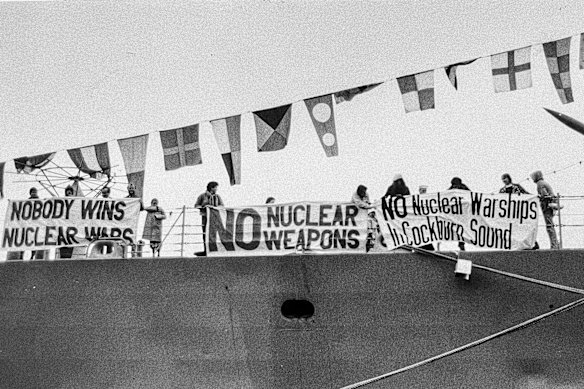
During the next decade, the fight shifted to Fremantle, where activists, jolted into action by rising tension between American and the Soviet Union, embarked on a decade-long battle against nuclear-powered and armed US warships arriving at Australian shores.
“The aircraft carriers were anchored in Gage Roads,” Vallentine remembers.
“But their support vessels were tied up on the harbour. So people were climbing on board with banners in our bags or under our shirts and unfurling them.”
While memories of the protests has faded from the memory, a significant legacy of the era — the declaration of Fremantle as a nuclear-free zone — has re-emerged in conversations along the Cappuccino Strip since it was announced the Henderson Defence Precinct to the city’s south would soon host nuclear-powered submarines as part of the $368 billion AUKUS pact.
The government last month pledged $12 billion to build up the precinct – which sits in the City of Cockburn, just to the south of Fremantle – including docks for nuclear submarine maintenance.
Defence Minister Richard Marles said at the time the US government would choose where its submarines were maintained – “but we absolutely anticipate that this will be a facility which is available for them”.
With its long history of anti-nuclear pushback, it was not surprising that representatives of the Australian Submarine Agency endured a hostile reception when they rocked up to Fremantle Town Hall for an AUKUS information session days after the government’s funding announcement.
Locals are concerned the presence of nuclear submarines would make Fremantle a target in any future conflict, are uneasy about the storage of nuclear waste and possible accidents, and worry a defence facility involving American warships would mean heightened levels of security and cut off access to areas along the coast that have been a part of their worlds for generations.
There is also a disquiet that such a large foreign military presence will change the laid-back, anti-establishment character of a city that was recently celebrated as Australia’s best tourist destination.
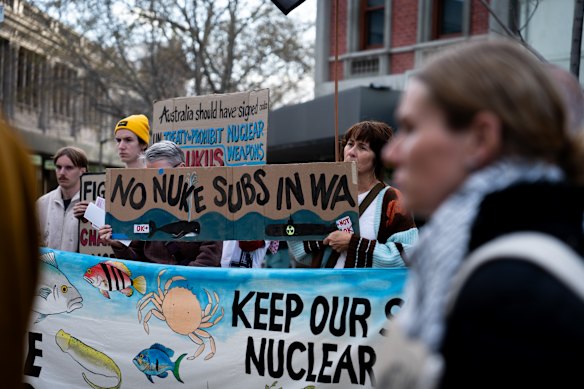
“I cannot believe we are doing this again,” long-time Fremantle resident Rosslyn De Souza says.
“We marched against the American warships coming in in the 1980s and now they are back again.
“Unfortunately, the generation who marched against the ships are older and don’t have the energy they once did.
“And the young ones are too consumed with their busy lives to do what we did.”
De Souza’s friend and fellow Fremantle resident Liesbeth Goedhart, 66, fears the US and UK military personnel and their families who will start arriving over the next few years will permanently alter the character of the area.
“I’m not worried about thousands of new people moving into the area, unless it happens the way it happened in Exmouth, which is a US enclave,” she said.
“If they are willing to lead a Fremantle lifestyle, then I will have no problems. But is that going to happen?”
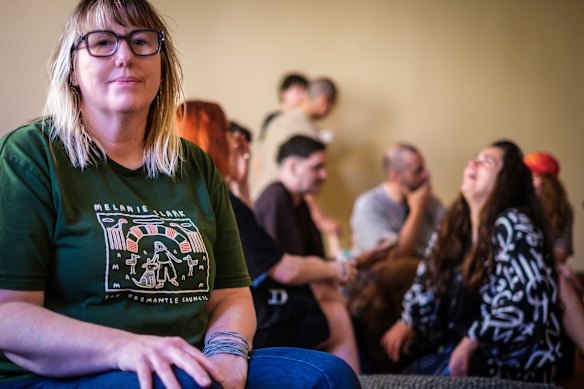
While AUKUS will not play a large part in the looming local council elections – despite the port city’s nuclear-free status – North Ward candidate Melanie Clark is one of the loudest voices in the pushback against the alliance, which will begin with nuclear submarines docking for maintenance from 2027 and eventually give Australia its own submarines.
“Submarines sitting in our backyard very much makes us a target in any future conflict,” Clark says.
“So let’s be honest about it and call it a military base.
“There are always accidents … we saw what happened when Rio Tinto lost that tiny capsule out in the middle of nowhere.
“Imagine that happening in a highly populated area.”
Clark also flagged concerns an influx of people moving to the region from the US and UK would exacerbate an already severe housing crisis.
For WA Greens MLC Sophie McNeill the issue of AUKUS is more pressing than future scenarios and projected changes to Fremantle.
McNeill, a Walkley Award-winning former Middle East correspondent, believes AUKUS will bind Australia into the US military empire, which she accuses of funding Israel’s war in Gaza.
“My boys want to be tradies. I don’t want them working for an American defence contractor,” McNeill says.
While the baton has been passed to a younger generation of anti-nuclear campaigners, elder statesperson Vallentine maintains the rage, using her stature to lean on the likes of federal Fremantle MP Josh Wilson, who she urged to resign from the ALP so he could act forcefully on his anti-AUKUS position.
“It can’t be easy for Josh because he knows his stuff, and he knows his electorate,” Vallentine says.
“I would love for him to go independent.”
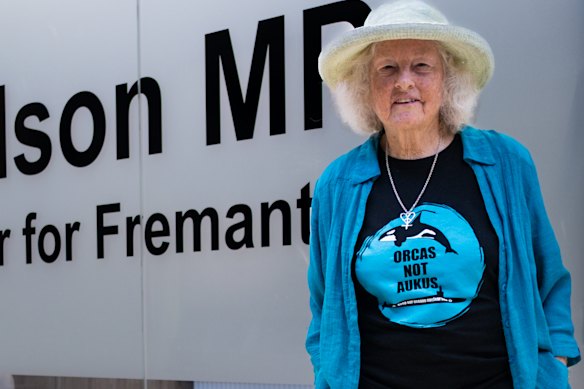
Vallentine believes AUKUS has nothing to do with a true US/Australia military alliance and the promised Australian subs will probably never be delivered.
She is convinced the Americans need a base in this part of the world to be closer to China.
“And it is all happening faster than people realise,” she says.
“The impact on Fremantle is going to be far bigger than most people imagine, and it is happening right now.”
Wilson denies Vallentine’s accusation that being the Federal member for Fremantle prevents him from voicing the concerns and aspirations of the port city community — that he has always embraced “Fremantle values” on such issues as the live sheep trade, greater protection for the oceans and AUKUS.
“I have consistently argued my position on the acquisition of nuclear-propelled submarines in the Parliament, at Labor’s National Conference, in the media, and in Australian Foreign Affairs magazine,” Wilson tells WAtoday.
“I’ve always undertaken my representative work on an open, principled, responsive, and constructive basis, and I accept that it’s in the nature of democracy that there will be many different views and that one’s view won’t always win the day.”
Start the day with a summary of the day’s most important and interesting stories, analysis and insights. Sign up for our Morning Edition newsletter.
Discover more from World Byte News
Subscribe to get the latest posts sent to your email.
