





The Australian sharemarket has edged higher on Friday despite another volatile US session overnight, with Wall Street’s benchmark S&P 500 index entering a correction after the latest chapter of President Donald Trump’s trade war.
The Australian sharemarket has edged higher on Friday despite another volatile US session overnight, with Wall Street’s benchmark S&P 500 index entering a correction after the latest chapter of President Donald Trump’s trade war.
- Updated
- Business
- Markets
- World markets
By Gemma Grant
Updated March 14, 2025 — 11.50amfirst published at 4.15am
The Australian sharemarket has advanced on Friday despite another volatile US session overnight, with Wall Street’s benchmark S&P 500 index entering a correction after the latest chapter of President Donald Trump’s trade war.
The ASX was 28 points or 0.4 per cent higher at 12:50pm AEDT, with five of 11 industry sectors in positive territory, but financial stocks retreated, led by CBA.
CBA dropped 0.8 per cent shortly after midday, while rivals Westpac (down 0.1 per cent), ANZ (down 0.4 per cent) also retreated. NAB was the best performer of the big four, lifting slightly by 0.9 per cent.
The big miners rose on the back of a rise in iron ore prices overnight with BHP adding 1.7 per cent and Rio Tinto advancing by 1.6 per cent shortly after lunch. Fortescue jumped by 2.4 per cent. Northern Star Resources (up 3.5 per cent) and Evolution Mining (up 4.6 per cent) surged after gold hit a record price overnight.
Department store Myer dipped 1.8 per cent shortly after lunch, after chief executive Olivia Wirth reshuffled the leadership ranks, which has resulted in chief financial officer Matt Jackman leaving the business. He will be replaced by former David Jones chief financial officer Kathy Karabatsas.
Loading
Myer’s current general merchandise manager of apparel, home and entertainment Belinda Slifkas has been promoted to chief merchandise officer, and Sportsbet’s current chief people officer Megan Collins is set to join Myer in the same role in late April. Meanwhile, a hunt is underway to fill the newly created role of chief product officer, who will have responsibility for Myer’s underperforming exclusive and private label brands including sass & bide, Marcs and David Lawrence.
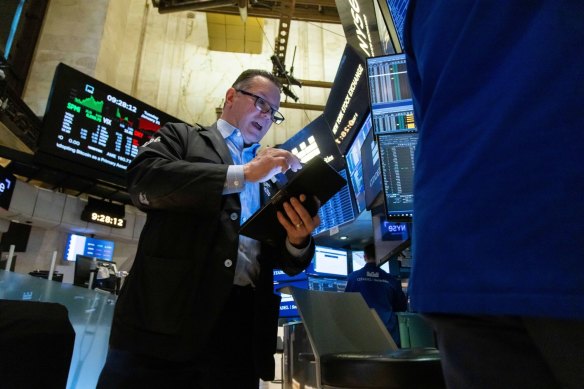
Overnight, Wall Street’s selloff hit a new low after Trump upped the stakes in his trade war by threatening huge taxes on European wines and alcohol. The S&P 500’s 1.4 per cent slide meant that it has slumped 10 per cent from its most recent high, the accepted definition of entering a correction. Not even a double shot of good news on the US economy could stop the bleeding.
The Dow Jones dropped 537 points, or 1.3 per cent, and the Nasdaq composite fell 2 per cent.
Advertisement
The dizzying, battering swings for stocks have been coming not just day to day but also hour to hour, and the Dow hurtled between a slight gain and a drop of 689 points through Thursday’s trading.
The turbulence is a result of uncertainty about how much pain Trump will let the economy endure through tariffs and other policies in order to reshape the country and world as he wants. The president has said he wants manufacturing jobs back in the United States, along with a smaller US government workforce and other fundamental changes.
Trump’s latest escalation came on Thursday when he threatened 200 per cent tariffs on champagne and other European wines unless the European Union rolled back a “nasty” tariff announced on US whiskey. The EU unveiled that move on Wednesday in response to US tariffs on European steel and aluminium.
US households and businesses have already reported drops in confidence because of all the uncertainty about which tariffs will stick from Trump’s barrage of on- and off-again announcements. That’s raised fears about a pullback in spending that could sap energy from the economy. Some US businesses say they’ve already begun to see a change in their customers’ behaviour because of the uncertainty.
A particularly feared scenario for the economy is one where its growth stagnates, but inflation stays high because of tariffs. Few tools are available in Washington to fix what’s called “stagflation.” If the Federal Reserve were to cut interest rates to boost the economy, for example, that could also push inflation higher.
Good news came on both those economic fronts on Thursday.
One report showed inflation at the wholesale level last month was milder than economists expected. It followed a similarly encouraging report from the prior day on inflation that US consumers are feeling.
Loading
But “the question for markets is whether good news on the inflation front can make itself heard above the noise of the ever-changing tariff story,” said Chris Larkin, managing director, trading and investing, at E-Trade from Morgan Stanley.
A separate report, meanwhile, said fewer US workers applied for unemployment benefits last week than economists expected. It’s the latest signal that the job market remains relatively solid overall. If that can continue, it could allow US consumers to keep spending, and that’s the main engine of the economy.
Elon Musk’s Tesla fell 3 per cent following a rare back-to-back gain, and it’s down more than 40 per cent so far in 2025.
On the winning side of Wall Street was Intel, which jumped 14.6 per cent after naming former board member and semiconductor industry veteran Lip-Bu Tan as its chief executive.
In stock markets abroad, indexes fell across much of Europe and Asia, but the moves were relatively modest.
with AP
The Market Recap newsletter is a wrap of the day’s trading. Get it each weekday afternoon.
Discover more from World Byte News
Subscribe to get the latest posts sent to your email.
