





Our reviewers took a look at all the latest shows around town.
Our reviewers took a look at all the latest shows around town.
By Michael Ruffles, Peter McCallum, Millie Muroi and Cassie Tongue
February 15, 2025 — 11.32am
MUSICAL THEATRE
Hadestown
Theatre Royal, February 14
By CASSIE TONGUE
★★★★½
The myth of Orpheus and Eurydice is one of the oldest stories we know: all gods and men, love and death, fear and faith. But in Hadestown, the eight-time Tony-award-winning musical now at the Theatre Royal, the story has a new life that’s both timeless and also perfect for these times.
Written by singer-songwriter Anaïs Mitchell and directed by Rachel Chavkin (Darren Yap is making it sing in Sydney), Hadestown is a gutsy folk opera turned genuine Broadway hit. It’s a show that dares you to listen to its songs – little gifts of poetry, folk and jazz – and believe that an ancient story still has something to say.
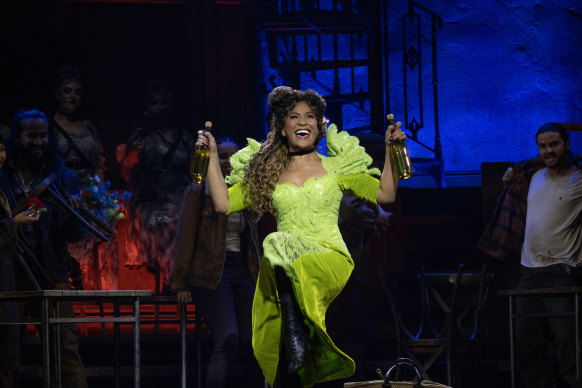
Hermes (Christine Anu), a warm and knowing emcee, introduces us to Orpheus (Noah Mullins, angelic), the Fates (Sarah Murr, Jennifer Trijo, and Imani Williams) who lurk in the back of our minds, and Eurydice (Abigail Adriano, luminous). The band (under the lively music direction of Laura Tipoki) are onstage with the chorus, feeling the story of these lovers and sharing it with us.
As soon as Orpheus sees her, he’s in love; Eurydice, more grounded in reality, is cautious. We watch them fall in love as the world turns and Persephone (Elenoa Rokobaro, electric) returns to her husband Hades (Adrian Tamburini, striking), leaving behind a harsh winter. It ends badly – but if you know the myth, that’s no spoiler. Eurydice is bound for Hades’ domain of the dead, and Orpheus is bound to try to bring her back.
The hopeful and heartbreaking journey plays out on an early 20th century New Orleans-inspired stage, all speakeasies and balconies and depression-era struggle. In a stunning journey lit by lamps and lanterns (The Tony Award-winning lighting is recreated wonderfully here by Trudy Dalgleish), Orpheus descends.
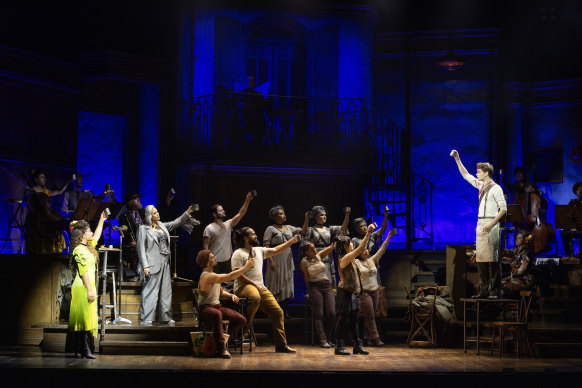
When Orpheus appeals to Hades for the chance to love to flourish again – not just for himself and Eurydice, but also Hades and his resentfully too-caged wife, whose journey is just as compelling as that of the young lovers – you feel something like hope flutter in your chest. And when Orpheus appeals to the lost souls of Hades’ foundries and urges them to rise up against a boss who steals their joy, their freedom, and their identities, it’s a reminder of the strength that lies in the collective.
After just a few previews, the production is still settling into itself – a brief show stop for technical difficulties early into opening night gave its first act a stuttered, hesitant start – but as the show warmed up, so did the cast, and by the second act everything was expressive, expansive and deeply touching. This will only grow over the season.
Advertisement
You shouldn’t miss it. We know how it all ends, of course – or do we? Hermes and her players have a lot to tell us about that, and it’s a powerful narrative well worth hearing. Hadestown is extraordinary, and this production is gorgeous, deeply felt, and full of the ghosts we need.
MUSIC
Tim Minchin
The Foundry, February 12
Reviewed by MICHAEL RUFFLES
★★★★
Barefoot, with wine glass in hand, the bedraggled Matilda mastermind walks onto the new Foundry stage and feigns (we hope) disgust.
The house lights are still on and Tim Minchin can see us as clearly as we can his leonine visage.
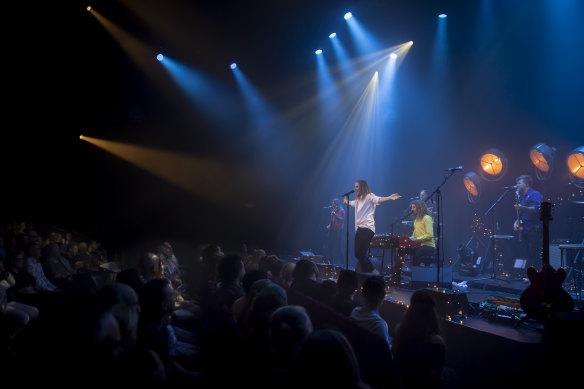
“They are f—ing beautiful but please make them go away,” he chides as someone finds the switch, before launching into a power ballad about the importance of turning mobile phones off.
Welcome to The Foundry, a new theatre dusted off and polished up in the loading dock at the back of the Lyric.
They have booked a fitting opening act; Minchin is mining songs 20 years or more old that have never been committed to posterity in a studio recording. These have been reimagined for a rock band and will grace record stores and streaming services later this year as his second album proper, Time Machine. They show his precocious songwriting talent of decades ago, honed with the benefit of experience and hindsight.
By turns rambunctious and rambling, Minchin mixes in favourites for the rusted-on crowd in the front rows (Rock and Roll Nerd, Not Perfect), and the odd newer composition (the mischievous Play It Safe, for the 50th anniversary of the Sydney Opera House). For this neophyte, almost everything was a revelation. The most familiar, his anthem about taking canvas bags to the supermarket, was a rousing end to the first act.
Minchin describes one of the late ’90s songs as a mix of the Whitlams and the Pixies. Others bring to mind a mutant sharing the DNA of Ben Folds and Bill Bailey; there is poignancy leavened with absurdity, seedy temptations weighed down with love’s mundane gravity, and lullabies that careen into carnival nightmares that cut close to the bone. I can’t remember a better time watching a man sit at a keyboard.
Other than being hard to get out of in a hurry, the venue itself is a gem and Minchin is pleased to have been asked to “christen it, or defile it”. He did both, and in fine style.
Tim Minchin has further shows at The Foundry, Feb 13-15.
MUSIC
Singapore Symphony Orchestra
Opera House Concert Hall
February 12
Reviewed by PETER McCALLUM
★★★½
The Singapore Symphony Orchestra began its first Australian tour under conductor Hans Graf with a darting flash on the clarinet, followed by haunting whispers on strings like strange sounds in the night.
The piece was Luciola singapura for orchestra with yangqin obbligato by Singaporean composer Cheng Jin Koh and it takes its name from a new species of luminous firefly, discovered in a freshwater swamp in Singapore in 2021.
The first section involved a series of fleeting moments with strange shrieks, shivers from the yangqin (a Chinese zither) and lonely sustained notes, drawing in gestures from Chinese musical traditions and creating an atmosphere of mysterious quivering activity.
The yangqin combined with rippling patterns on the piano to create a texture that flowed, bristled and splashed, leading to a final section in which a hyperactive melody grew more and more frenetic, with the eponymous firefly apparently in a state of great excitement. The orchestration was imaginative, if occasionally awkward, and the performance was brightly coloured though occasionally struggled to achieve full cohesion.
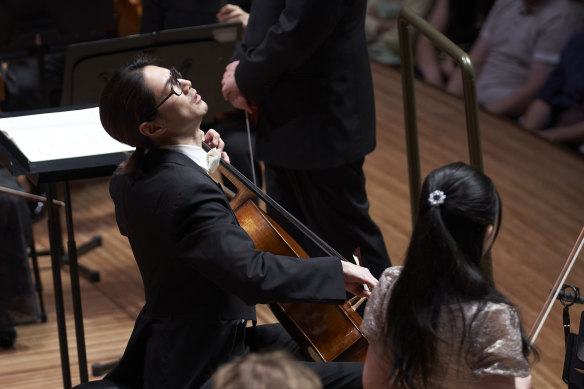
After the arresting, carefully chiselled motive from the full orchestra at the start of Brahms’ Concerto for Violin and Cello, Sydney-born Singaporean cellist Pei-Sian Ng began the cadenza-like opening with a reflective dreamy mood, without quite establishing a sense of pulse. Eighteen-year-old violinist Chloe Chua joined with a fresh, natural sense of melodic shape.
Her playing is undistorted by mannerism, with strong technical and tonal control, and shows great potential. The formal two-bar patterns of the second movement were shaped with good musical intent and would benefit from more refined control of rhythm and phrase to avoid stagnation. This is a challenging work for any players and thrived best in moments like the tripping melody of the third movement, where expressive freedom was underpinned with an intuitive rhythmic pulse.
Tchaikovsky’s Symphony No. 5 in E minor after the interval began in brooding, carefully shaped phrases to create a sense of shaded ominousness that Tchaikovsky maintained throughout the work until resolving it with blazing affirmation in the finale. The second movement started with warm quiet strings as a downy bed for the famous horn solo, played with a restrained, distant tone.
The movement rose to forceful intensity as this idea and its partner were transferred to the strings. After the graceful opening and serene close of the Valse in the third movement, strings and wind created nimble passagework in the central section before the brass barked a stern rebuke in the return of the symphony’s opening idea.
In the finale, Graf emphasised magisterial breadth, showcasing the orchestra’s potential when unleashed. This was a welcome visit by a near neighbour and attracted an enthusiastic near-capacity crowd.
MUSIC
Bryan Adams
February 12, Qudos Bank Arena
Reviewed by MILLIE MUROI
★★★★
For most artists, the backing band is just that: they unassumingly support the main act, throwing in the odd solo to remind the audience they’re there. Bryan Adams’ band struck the elusive balance – neither overpowering him nor shying away from the kind of dexterity and power that leaves you breathless.
The production, likewise, was bold, quirky and dynamic; at one point, a car-sized boxing glove floated through the air during Roll with the Punches, the title track of Adams’ coming album.
As a result of all this and more, the Canadian rocker’s So Happy It Hurts tour left moments imprinted on the mind from opener Kick Ass onwards.
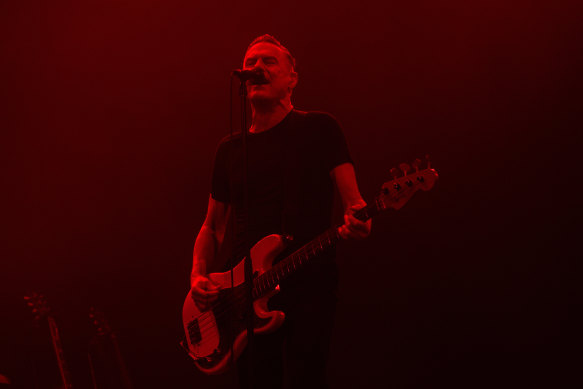
Adams and his band displayed passion and impressive artistry, with an especially palpable connection between the main man and long-time (since 1976) lead guitarist Keith Scott. Adams paid tribute to the late Tina Turner, performing their 1985 collaboration It’s Only Love, and brought back support act James Arthur for a rendition of Rewrite the Stars that, while beautifully showcasing Arthur’s voice, was a little clunky as a duet.
While the final segment of the concert was less powerful, it was intimate and refreshing to see Adams perform it at the back of the stadium, including a piece he wrote when he was 18 called Straight from the Heart.
Forty years of touring has clearly failed to slow down the 65-year-old. Adams’ stage presence, playfulness and energy befit a singer who still unashamedly belts out songs with titles like 18 ’Til I Die.
His most familiar tunes are still Summer of ’69 and Heaven from 1985 breakthrough album Reckless, on which his sandy, powerful vocals strike a nostalgic chord. But he proves just as good crooning poignant numbers such as Please Forgive Me.
When Adams quit school at 15, his mum said that was OK, under one condition: “Just do a good job.” Safe to say Bryan Adams has done more than just that.
Michael Ruffles is the deputy state topic editor of The Sydney Morning Herald.Connect via email.
Millie Muroi is the economics writer at The Sydney Morning Herald and The Age, based in Canberra. She was formerly the banking writer based in Sydney.Connect via Twitter or email.
Loading
Discover more from World Byte News
Subscribe to get the latest posts sent to your email.
