





Billions were wiped from the Australian sharemarket after US stocks took a hammering overnight, amid rising anxiety that Trump’s tariffs will start a recession in the US.
Billions were wiped from the Australian sharemarket after US stocks took a hammering overnight, amid rising anxiety that Trump’s tariffs will start a recession in the US.
- Updated
- Business
- Markets
- World markets
By Cindy Yin
Updated March 11, 2025 — 1.46pmfirst published at 5.13am
The Australian sharemarket is still stuck in the red, despite recovering a bit off ground, after a horror start to the day amid rising anxiety that the Trump administration’s tariffs could spark a recession in the world’s largest economy.
The S&P/ASX 200 traded 74.6 points, or 0.94 per cent lower, at 7887.70 points as of 2pm AEDT, with tech stocks tumbling 4.7 per cent and nine of the 11 industry sectors in the red. Wall Street plunged overnight as volatility across global markets triggered by US President Donald Trump’s tariffs on major trading partners extended into its third week.
The big four banks slumped in early trade, but recovered some ground by lunchtime. Commonwealth Bank – the nation’s biggest lender and the biggest stock on the ASX – was down 0.5 per cent after slumping more than 2 per cent in early trade. Consumer discretionary retailers also suffered, with Bunnings, Kmart and Officeworks owner Wesfarmers down 1.7 per cent and electronics retailer JB Hi-Fi losing 2.6 per cent, while consumer staples such as the big supermarkets fared better – Coles’ share price rose 0.5 per cent.
The Australian dollar traded at 62.88 US cents after its fall overnight.
The mining heavyweights were mixed, with the world’s biggest and lowest-cost miner BHP and iron ore rival Rio Tinto up 0.7 and 0.6 per cent respectively, while Fortescue extended its losses, down 1.3 per cent.
Loading
The market sell-down continued even after data showed Australia’s consumer confidence picked up in March as inflation pressures eased, which had led the Reserve Bank to cut interest rates for the first time in four years last month. Sentiment jumped 4 per cent to 95.9 points – the highest level in three years according to figures from a Westpac survey released Tuesday morning.
Tech stocks were leading the market’s losses, as embattled software giant WiseTech Global (down 3.4 per cent), Xero (down 5.2 per cent), TechnologyOne (down 6.3 per cent), and NextDC (down 2.8 per cent) all recorded sharp falls.
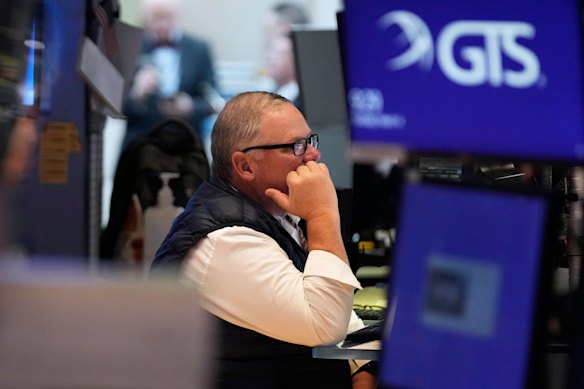
The tech plunge mirrors the big tech sell-off on Wall Street amid a rotation into defensive shares, which sent the S&P 500 down 2.7 per cent and had the tech-heavy Nasdaq 100 plummeting 4 per cent, wiping out more than $US1 trillion ($1.6 trillion) in its worst session in 2½ years.
Advertisement
In the US, Tesla tumbled 15.4 per cent, widening its loss this year to 41 per cent. AI chip giant Nvidia lost 5.1 per cent and has erased more than $US1 trillion in market value in two months. Bloomberg’s index of the Magnificent Seven tech stocks – which also includes Google’s parent Alphabet, Amazon, Apple, Meta and Microsoft — tumbled 5.4 per cent and is now down more than 15 per cent in 2025.
‘We’ve gone from animal spirits to what are the odds of a recession.This is a headline-driven market; one that could change in an hour. Sit tight. Buckle up.’
Gina Bolvin, president of Bolvin Wealth Management Group
The Dow Jones Industrial Average lost 2.1 per cent. Wall Street’s closely watched volatility gauge – the VIX – hit the highest this year. US Treasury yields slid on bets that an economic slowdown would force the Federal Reserve to slash interest rates. Bitcoin slipped below $US80,000 ($128,000).
Loading
The market wreckage comes after a weekend that saw Trump himself suggest that the American economy is set to slow after he sidestepped a question in a Fox News interview on Sunday. Asked on Fox News’ Sunday Morning Futures program whether he’s expecting a recession, he said: “I hate to predict things like that. There is a period of transition because what we’re doing is very big.” The change in language from the campaign trail – when he promised tariffs on Day One that would pay for tax cuts without disrupting the growth – has sparked a frenzied repricing of risk assets.
“Sell your winners, embrace the bear case and duck and cover,” said Michael Bailey, director of research at Fulton Breakefield Broenniman.
“We’ve gone from animal spirits to ‘What are the odds of a recession?’,” said Gina Bolvin, president of Bolvin Wealth Management Group. “This is a headline-driven market; one that could change in an hour. Sit tight. Buckle up. We finally have the correction we were waiting for.”
Speculation is intensifying that Trump is willing to tolerate hardship in the US economy and markets in pursuit of long-term goals involving tariffs and smaller government.
“President Trump doubled down on the current policy path and acknowledged the chance of a slowdown, and that’s weighing on sentiment,” said Tom Essaye at The Sevens Report.
Traders also kept a close eye on something that hasn’t happened with the US equity benchmark since November 2023 – a close below the key 200-day moving average.
Loading
“There’s a saying on Wall Street about how nothing good happens below the 200-day moving average,” said Callie Cox at Ritholtz Wealth Management. “Honestly, out of all the crazy sayings that come out of this industry, it’s one you should take seriously. Selloffs accelerate and swings get dramatically bigger in the danger zone – or the space below the 200-day moving average.”
Meanwhile, demand for recession havens boosted sovereign bonds. The yield on 10-year US Treasuries slid nine basis points to 4.21 per cent. West Texas Intermediate dipped to trade below $US66 a barrel, down more than 15 per cent from its mid-January peak.
The latest moves mark an abrupt about-face for markets, where the dominant driver of the last few years had been the surprising resilience of the US economy, even as growth weakened overseas. That’s shaking the aura of economic and market exceptionalism that has dominated for more than a decade.
The talk of tariffs is in many ways worse than the implementation, according to David Bahnsen, chief investment officer at The Bahnsen Group.
Loading
“I do not believe the administration knows how the tariff situation will play out, but if I were a betting man, I would say that it will persist long enough to do damage to economic activity for at least a quarter or two, and ultimately result in a deal with different countries that will make everyone wonder why we went through all the fuss,” Bahnsen said.
He also noted that if a tax cut extension and further tax reform bill is passed through budget reconciliation sooner rather than later, that will help “offset the damage.”
A chorus of Wall Street strategists is warning about higher stock volatility, with Morgan Stanley’s Michael Wilson the latest to sound the alarm on economic growth worries. Other market forecasters, including at JPMorgan and RBC Capital Markets, have also tempered bullish calls for 2025 as Trump’s tariffs stoke fears of slowing economic growth.
“There are always multiple forces at work in the market, but right now, almost all of them are taking a back seat to tariffs,” said Chris Larkin at E*Trade from Morgan Stanley. “Until there’s more clarity on trade policy, traders and investors should anticipate continued volatility.”
Loading
For Sam Stovall at CFRA, how long this period of investor caution will persist depends on how quickly it will take the global trade clouds – and the resulting threat of recession – to dissipate.
From rookie retail traders to hedge fund pros, no one knows what the eventual cost of Trump’s sweeping policies will be. His pro-growth plans were tax cuts, deregulation and energy dominance. Tariffs were supposed to bring manufacturing back to the US and create jobs. But so far, there’s little evidence of that.
All of this has retail investors spooked. For the first time since 2022, the majority of individual investors say they believe stock prices will drop over the next six months, according to a survey by the American Association of Individual Investors.
Mark Hackett at Nationwide says he has greater confidence that we are near a bottom rather than on the cusp of a new wave of selling.
“If key risks like the debt ceiling, government shutdown, and tariffs resolve in a better-than-worst-case scenario, and economic data remains stable, we could see a recovery follow this selln-off,” he noted, though investors do need to “keep an eye on the pessimistic scenario”.
With Bloomberg, staff writers
The Business Briefing newsletter delivers major stories, exclusive coverage and expert opinion. Sign up to get it every weekday morning.
Loading
Discover more from World Byte News
Subscribe to get the latest posts sent to your email.
