





Australia has argued it should avoid planned US tariffs because of our long-running trade deficit with America. But that argument has disappeared in a sea of gold.
Australia has argued it should avoid planned US tariffs because of our long-running trade deficit with America. But that argument has disappeared in a sea of gold.
By Shane Wright and Matthew Knott
March 11, 2025 — 2.26pm
Australia has run its first-ever monthly trade surplus with the United States, undermining its key argument with US President Donald Trump that it should avoid being slapped with tariffs on steel and aluminium exports.
Data from the Australian Bureau of Statistics show that in January, America imported more than $6 billion worth of goods from Australia. The previous monthly record, of almost $3 billion, was set in December.

Offsetting the exports were $4.3 billion of imports, leaving Australia with a $1.7 billion trade surplus. It is the first time since the bureau started collating monthly trade data in January 1988 that Australia has run a surplus with the United States, due almost entirely to a 92-fold increase in the amount of gold US importers bought between November and January.
Trump has regularly argued that one of the reasons for his tariff agenda is because of America’s large trade deficits with nations such as China. In its bid to avoid planned steel and aluminium tariffs, due to start later this week, the federal government has repeatedly pointed out that in the case of Australia, the US runs a rare trade surplus.
As recently as Monday, Prime Minister Anthony Albanese noted the traditional trade imbalance between the two nations.
“The United States enjoys a trade surplus with Australia, and has done so since the Truman presidency,” he said.
But JP Morgan senior economist Tom Kennedy said the most recent data did not help Australia’s cause.
“The timing of this sudden shift is interesting given the global mood music, with the Trump administration’s tariff policies targeted towards trading partners that maintain structural surpluses versus the US,” he said.
Advertisement
Traditionally, Australia’s trade deficit with the US is built on imports of American planes, heavy construction equipment and computers. They are partly offset by Australian exports of beef and pharmaceuticals.
Loading
Trump cited the US trade surplus with Australia last month when he said he was considering an exemption. “We have a surplus with Australia, one of the few,” Trump told reporters in the White House following a phone call with Albanese.
“And the reason is they buy a lot of airplanes. They’re rather far away, and they need lots of airplanes.”
But the January surplus was driven by a surge of gold and silver imports.
Non-monetary gold exports to the US from Australia increased to a record $4.6 billion in January. In November, gold exports were worth about $50 million. In Australian dollar terms, the gold price has climbed by 10 per cent to more than $4613 an ounce since the start of the year, with most of that jump occurring in January.
American imports of gold have soared since the start of the year. The average monthly value in 2022 and 2023 was about $US1.7 billion. In January, it soared to $US30.8 billion.
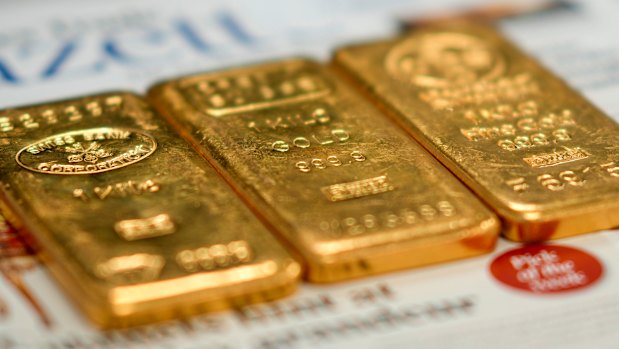
It is being driven by concerns over the state of the US economy under Trump’s tariff agenda and its impact on American inflation. Investors traditionally consider gold a haven from inflation.
Kennedy cautioned the January surplus was likely to recede, returning to a trade deficit in coming months.
On Tuesday, the ASX200 shed another 1 per cent in value, following a deep fall on US equities markets which have been spooked by growing signs America could suffer a recession this year.
Since Trump announced his first tariff plans in early February, the ASX200 has lost 8 per cent of its value.
The revelation came as Opposition Leader Peter Dutton said Albanese would be to blame if Australia failed to secure an exemption from Trump’s steel and aluminium steel tariffs rather than Malcolm Turnbull.
The former prime minister has been engaging in a stoush with Trump ahead of the deadline for the tariffs to come into effect, raising the possibility this could create a negative perception of Australia in Trump’s mind at a crucial moment.
“The prime minister has the responsibility – as Malcolm Turnbull did when he was prime minister – to negotiate with the then Trump administration for an exemption to the tariffs,” Dutton told Channel Seven on Tuesday.
Loading
“Instead of squibbing it, the PM has got to step up to the plate and start dealing with the realities, and make sure that Australia is exempt from this tariff.”
Dutton said he did not agree with Trump’s claim that Turnbull was a “weak and ineffective” leader with a poor understanding of China.
Other nations have been aggressively lobbying for an exemption from the tariffs, so far unsuccessfully. Japanese Trade Minister Yoji Muto said he had emerged from meetings with Trump’s key economic advisers in Washington on Tuesday without any assurances of a carve-out.
Cut through the noise of federal politics with news, views and expert analysis. Subscribers can sign up to our weekly Inside Politics newsletter.
Shane Wright – Shane is a senior economics correspondent for The Age and The Sydney Morning Herald.Connect via Twitter or email.
Matthew Knott is the foreign affairs and national security correspondent for The Sydney Morning Herald and The Age.Connect via Twitter or Facebook.
Loading
Discover more from World Byte News
Subscribe to get the latest posts sent to your email.
