



ATHENS, Greece — Greece will spend 25 billion euros ($27 billion) over the next decade to adapt its military to evolving high-tech…
Browsing: Tech
tech news
MANILA, Philippines — Japan’s Mitsubishi Heavy Industries has clinched a deal to develop new long-range, precision-guided missiles in a 32…
MELBOURNE, Australia — Australian military leaders are scrambling to cobble together fresh air defense capabilities, as China’s missile arsenal is…
The Pentagon’s top watchdog has begun an investigation into Defense Secretary Pete Hegseth’s use of Signal, a commercial messaging app,…
The Defense Innovation Unit on Thursday launched a new marketplace designed to connect technology firms with vetted advanced manufacturing companies…
THE HAGUE, Netherlands — For generations, the blast furnaces of the Ruhr Valley, Silesia and Lorraine have formed the backbone…
President Donald Trump said Thursday that he’s fired “some” White House National Security Council officials, a move that comes a…
Editor’s note: This story has been updated. President Donald Trump has abruptly fired the director of the National Security Agency,…
PARIS — Norway plans to nearly double its fleet of self-propelled artillery, proposing to buy an additional 24 K9 Thunder…
Defense Secretary Pete Hegseth will travel to Panama next week, the second senior U.S. official to visit the country in…
The U.S. Space Force announced more than $13.5 billion in launch contracts Friday to SpaceX, United Launch Alliance and Blue…
NVIDIA Blackwell Powers Real-Time AI for Entertainment Workflowson March 19, 2025 at 3:00 pm
AI has been shaping the media and entertainment industry for decades, from early recommendation engines to AI-driven editing and visual effects automation. Real-time AI — which lets companies actively drive content creation, personalize viewing experiences and rapidly deliver data insights — marks the next wave of that transformation. With the NVIDIA RTX PRO Blackwell GPU
Read ArticleAI has been shaping the media and entertainment industry for decades, from early recommendation engines to AI-driven editing and visual effects automation. Real-time AI — which lets companies actively drive content creation, personalize viewing experiences and rapidly deliver data insights — marks the next wave of that transformation. With the NVIDIA RTX PRO Blackwell GPU
Read Article
AI has been shaping the media and entertainment industry for decades, from early recommendation engines to AI-driven editing and visual effects automation. Real-time AI — which lets companies actively drive content creation, personalize viewing experiences and rapidly deliver data insights — marks the next wave of that transformation.
With the NVIDIA RTX PRO Blackwell GPU series, announced yesterday at the NVIDIA GTC global AI conference, media companies can now harness real-time AI for media workflows with unprecedented speed, efficiency and creative potential.
NVIDIA Blackwell serves as the foundation of NVIDIA Media2, an initiative that enables real-time AI by bringing together NVIDIA technologies — including NVIDIA NIM microservices, NVIDIA AI Blueprints, accelerated computing platforms and generative AI software — to transform all aspects of production workflows and experiences, starting with content creation, streaming and live media.
Powering Intelligent Content Creation
Accelerated computing enables AI-driven workflows to process massive datasets in real time, unlocking faster rendering, simulation and content generation.
NVIDIA RTX PRO Blackwell GPUs series include new features that enable unprecedented graphics and AI performance. The NVIDIA Streaming Multiprocessor offers up to 1.5x faster throughput over the NVIDIA Ada generation, and new neural shaders that integrate AI inside of programmable shaders for advanced content creation.
Fourth-generation RT Cores deliver up to 2x the performance of the previous generation, enabling the creation of massive photoreal and physically accurate animated scenes. Fifth-generation Tensor Cores deliver up to 4,000 AI trillion operations per second and add support for FP4 precision. And up to 96GB of GDDR7 memory boosts GPU bandwidth and capacity, allowing applications to run faster and work with larger, more complex datasets for massive 3D and AI projects, large-scale virtual-reality environments and more.

“One of the most exciting aspects of new technology is how it empowers our artists with tools to enhance their creative workflows,” said Steve May, chief technology officer of Pixar Animation Studios. “With Pixar’s next-generation renderer, RenderMan XPU — optimized for the NVIDIA Blackwell platform — 99% of Pixar shots can now fit within the 96GB of memory on the NVIDIA RTX PRO 6000 Blackwell GPUs. This breakthrough will fundamentally improve the way we make movies.”

“Our artists were frequently maxing out our 48GB cards with ILM StageCraft environments and having to battle performance issues on set for 6K and 8K real-time renders,” said Stephen Hill, principal rendering engineer at Lucasfilm. “The new NVIDIA RTX PRO 6000 Blackwell Max-Q Workstation Edition GPU lifts these limitations — we’re seeing upwards of a 2.5x performance increase over our current production GPUs, and with 96GB of VRAM we now have twice as much memory to play with.”
In addition, neural rendering with NVIDIA RTX Kit brings cinematic-quality ray tracing and AI-enhanced graphics to real-time engines, elevating visual fidelity in film, TV and interactive media. Including neural texture compression, neural shaders, RTX Global Illumination and Mega Geometry, RTX Kit is a suite of neural rendering technologies that enhance graphics for games, animation, virtual production scenes and immersive experiences.
Fueling the Future of Streaming and Data Analytics
Data analytics is transforming raw audience insights into actionable intelligence faster than ever. NVIDIA accelerated computing and AI-powered frameworks enable studios to analyze viewer behavior, predict engagement patterns and optimize content in real time, driving hyper-personalized experiences and smarter creative decisions.
With the new GPUs, users can achieve real-time ingestion and data transformation with GPU-accelerated data loading and cleansing at scale.
The NVIDIA technologies accelerating streaming and data analytics include a suite of NVIDIA CUDA-X data processing libraries that enable immediate insights from continuous data streams and reduce latency, such as:
- NVIDIA cuML: Enables GPU-accelerated training and inference for recommendation models using scikit-learn algorithms, providing real-time personalization capabilities and up-to-date relevant content recommendations that boost viewer engagement while reducing churn.
- NVIDIA cuDF: Offers pandas DataFrame operations on GPUs, enabling faster and more efficient NVIDIA-accelerated extract, transform and load operations and analytics. cuDF helps optimize content delivery by analyzing user data to predict demand and adjust content distribution in real time, improving overall user experiences.
Along with cuML and cuDF, accelerated data science libraries provide seamless integration with the open-source Dask library for multi-GPU or multi-node clusters. NVIDIA RTX Blackwell PRO GPUs’ large GPU memory can further assist with handling massive datasets and spikes in usage without sacrificing performance.
And, the video search and summarization blueprint integrates vision language models and large language models and provides cloud-native building blocks to build video analytics, search and summarization applications.
Breathing Life Into Live Media
With NVIDIA RTX PRO Blackwell GPUs, broadcasters can achieve higher performance than ever in high-resolution video processing, real-time augmented reality and AI-driven content production and video analytics.
New features include:
- Ninth-Generation NVIDIA NVENC: Adds support for 4:2:2 encoding, accelerating video encoding speed and improving quality for broadcast and live media applications while reducing costs of storing uncompressed video.
- Sixth-Generation NVIDIA NVDEC: Provides up to double H.264 decoding throughput and offers support for 4:2:2 H.264 and HEVC decode. Professionals can benefit from high-quality video playback, accelerate video data ingestion and use advanced AI-powered video editing features.
- Fifth-Generation PCIe: Provides double the bandwidth over the previous generation, improving data transfer speeds from CPU memory and unlocking faster performance for data-intensive tasks.
- DisplayPort 2.1: Drives high-resolution displays at up to 8K at 240Hz and 16K at 60Hz. Increased bandwidth enables seamless multi-monitor setups, while high dynamic range and higher color depth support deliver more precise color accuracy for tasks like video editing and live broadcasting.
“The NVIDIA RTX PRO 6000 Blackwell Max-Q Workstation Edition GPU is a transformative force in Cosm’s mission to redefine immersive entertainment,” said Devin Poolman, chief product and technology officer at Cosm, a global immersive technology, media and entertainment company. “With its unparalleled performance, we can push the boundaries of real-time rendering, unlocking the ultra-high resolution and fluid frame rates needed to make our live, immersive experiences feel nearly indistinguishable from reality.”
As a key component of Cosm’s CX System 12K LED dome displays, RTX PRO 6000 Max-Q enables seamless merging of the physical and digital worlds to deliver shared reality experiences, enabling audiences to engage with sports, live events and cinematic content in entirely new ways.

To learn more about NVIDIA Media2, watch the GTC keynote and register to attend sessions from NVIDIA and industry leaders at the show, which runs through Friday, March 21.
Try NVIDIA NIM microservices and AI Blueprints on build.nvidia.com.
AI has been shaping the media and entertainment industry for decades, from early recommendation engines to AI-driven editing and visual effects automation. Real-time AI — which lets companies actively drive content creation, personalize viewing experiences and rapidly deliver data insights — marks the next wave of that transformation. With the NVIDIA RTX PRO Blackwell GPU
Read Article
“Stay the course.” “Tune out the noise.” “Focus on the long term.” If you’re within five years of retiring, either…
Utah’s fertility rate has dropped again, according to federal data. Utah’s fertility rate has dropped again, according to federal data.…
NVIDIA Honors Americas Partners Advancing Agentic and Physical AIon March 19, 2025 at 3:00 pm
NVIDIA this week recognized 14 partners leading the way across the Americas for their work advancing agentic and physical AI across industries. The 2025 Americas NVIDIA Partner Network awards — announced at the GTC 2025 global AI conference — represent key efforts by industry leaders to help customers become experts in using AI to solve
Read ArticleNVIDIA this week recognized 14 partners leading the way across the Americas for their work advancing agentic and physical AI across industries. The 2025 Americas NVIDIA Partner Network awards — announced at the GTC 2025 global AI conference — represent key efforts by industry leaders to help customers become experts in using AI to solve
Read Article
NVIDIA this week recognized 14 partners leading the way across the Americas for their work advancing agentic and physical AI across industries.
The 2025 Americas NVIDIA Partner Network awards — announced at the GTC 2025 global AI conference — represent key efforts by industry leaders to help customers become experts in using AI to solve many of today’s greatest challenges. The awards honor the diverse contributions of NPN members fostering AI-driven innovation and growth.
This year, NPN introduced three new award categories that reflect how AI is driving economic growth and opportunities, including:
- Trailblazer, which honors a visionary partner spearheading AI adoption and setting new industry standards.
- Rising Star, which celebrates an emerging talent helping industries harness AI to drive transformation.
- Innovation, which recognizes a partner that’s demonstrated exceptional creativity and forward thinking.
This year’s NPN ecosystem winners have helped companies across industries use AI to adapt to new challenges and prioritize energy-efficient accelerated computing. NPN partners help customers implement a broad range of AI technologies, including NVIDIA-accelerated AI factories, as well as large language models and generative AI chatbots, to transform business operations.
The 2025 NPN award winners for the Americas are:
- Global Consulting Partner of the Year — Accenture is recognized for its impact and depth of engineering with its AI Refinery platform for industries, simulation and robotics, marketing and sovereignty, which helps organizations enhance innovation and growth with custom-built approaches to AI-driven enterprise reinvention.
- Trailblazer Partner of the Year — Advizex is recognized for its commitment to driving innovation in AI and high-performance computing, helping industries like healthcare, manufacturing, retail and government seamlessly integrate advanced AI technologies into existing business frameworks. This enables organizations to achieve significant operations efficiencies, enhanced decision-making, and accelerated digital transformation.
- Rising Star Partner of the Year — AHEAD is recognized for its leadership, technical expertise and deployment of NVIDIA software, NVIDIA DGX systems, NVIDIA HGX and networking technologies to advance AI, benefitting customers across healthcare, financial services, life sciences and higher education.
- Networking Partner of the Year — Computacenter is recognized for advancing high-performance computing and data centers with NVIDIA networking technologies. The company achieved this by using the NVIDIA AI Enterprise software platform, DGX platforms and NVIDIA networking to drive innovation and growth throughout industries with efficient, accelerated data centers.
- Solution Integration Partner of the Year — EXXACT is recognized for its efforts in helping research institutions and businesses tap into generative AI, large language models and high-performance computing. The company harnesses NVIDIA GPUs and networking technologies to deliver powerful computing platforms that accelerate innovation and tackle complex computational challenges across various industries.
- Enterprise Partner of the Year — World Wide Technology (WWT) is recognized for its leadership in advancing AI adoption of customers across industry verticals worldwide. The company expanded its end-to-end AI capabilities by integrating NVIDIA Blueprints into its AI Proving Ground and has made a $500 million commitment to AI development over three years to help speed enterprise generative AI deployments.
- Software Partner of the Year — Mark III is recognized for the work of its cross-functional team spanning data scientists, developers, 3D artists, systems engineers, and HPC and AI architects, as well as its close collaborations with enterprises and institutions, to deploy NVIDIA software, including NVIDIA AI Enterprise and NVIDIA Omniverse, across industries. These efforts have helped many customers build software-powered pipelines and data flywheels with machine learning, generative AI, high-performance computing and digital twins.
- Higher Education Research Partner of the Year — Mark III is recognized for its close engagement with universities, academic institutions and research organizations to cultivate the next generation of leaders across AI, machine learning, generative AI, high-performance computing and digital twins.
- Healthcare Partner of the Year — Lambda is recognized for empowering healthcare and biotech organizations with AI training, fine-tuning and inferencing solutions to speed innovation and drive breakthroughs in AI-driven drug discovery. The company provides AI training, fine-tuning and inferencing solutions at every scale — from individual workstations to comprehensive AI factories — that help healthcare providers seamlessly integrate NVIDIA accelerated computing and software into their infrastructure.
- Financial Services Partner of the Year — WWT is recognized for driving the digital transformation of the world’s largest banks and financial institutions. The company harnesses NVIDIA AI technologies to optimize data management, enhance cybersecurity and deliver transformative generative AI solutions, helping financial services clients navigate rapid technological changes and evolving customer expectations.
- Innovation Partner of the Year — Cambridge Computer is recognized for supporting customers deploying transformative technologies, including NVIDIA Grace Hopper, NVIDIA Blackwell and the NVIDIA Omniverse platform for physical AI.
- Service Delivery Partner of the Year — SoftServe is recognized for its impact in driving enterprise adoption of NVIDIA AI and Omniverse with custom NVIDIA Blueprints that tap into NVIDIA NIM microservices and NVIDIA NeMo and Riva software. SoftServe helps customers create generative AI services for industries spanning manufacturing, retail, financial services, auto, healthcare and life sciences.
- Distribution Partner of the Year — TD SYNNEX has been recognized for the second consecutive year for supporting customers in accelerating AI growth through rapid delivery of NVIDIA accelerated computing and software, as part of its Destination AI initiative.
- Rising Star Consulting Partner of the Year — Tata Consultancy Services (TCS) is recognized for its growth and commitment to providing industry-specific solutions that help customers adopt AI faster and at scale. Through its recently launched business unit and center of excellence built on NVIDIA AI Enterprise and Omniverse, TCS is poised to accelerate adoption of agentic AI and physical AI solutions to speed innovation for customers worldwide.
- Canadian Partner of the Year — Hypertec is recognized for its advancement of high-performance computing and generative AI across Canada. The company has employed the full-stack NVIDIA platform to accelerate AI for financial services, higher education and research.
- Public Sector Partner of the Year — Government Acquisitions (GAI) is recognized for its rapid AI deployment and robust customer relationships, helping serve the unique needs of the federal government by adding AI to operations to improve public safety and efficiency.
Learn more about the NPN program.
NVIDIA this week recognized 14 partners leading the way across the Americas for their work advancing agentic and physical AI across industries. The 2025 Americas NVIDIA Partner Network awards — announced at the GTC 2025 global AI conference — represent key efforts by industry leaders to help customers become experts in using AI to solve
Read Article
A white supremacist gang member was shot and killed by police early Friday after task force officers attempted to arrest…
Catholic Community Services of Utah says it may be forced to close its refugee resettlement program next year after it…
It was an announcement that stunned the world. How much will new Trump tariffs added this week cost Utah businesses…
Innovation to Impact: How NVIDIA Research Fuels Transformative Work in AI, Graphics and Beyondon March 20, 2025 at 12:00 am
The roots of many of NVIDIA’s landmark innovations — the foundational technology that powers AI, accelerated computing, real-time ray tracing and seamlessly connected data centers — can be found in the company’s research organization, a global team of around 400 experts in fields including computer architecture, generative AI, graphics and robotics. Established in 2006 and
Read ArticleThe roots of many of NVIDIA’s landmark innovations — the foundational technology that powers AI, accelerated computing, real-time ray tracing and seamlessly connected data centers — can be found in the company’s research organization, a global team of around 400 experts in fields including computer architecture, generative AI, graphics and robotics. Established in 2006 and
Read Article
The roots of many of NVIDIA’s landmark innovations — the foundational technology that powers AI, accelerated computing, real-time ray tracing and seamlessly connected data centers — can be found in the company’s research organization, a global team of around 400 experts in fields including computer architecture, generative AI, graphics and robotics.
Established in 2006 and led since 2009 by Bill Dally, former chair of Stanford University’s computer science department, NVIDIA Research is unique among corporate research organizations — set up with a mission to pursue complex technological challenges while having a profound impact on the company and the world.
“We make a deliberate effort to do great research while being relevant to the company,” said Dally, chief scientist and senior vice president of NVIDIA Research. “It’s easy to do one or the other. It’s hard to do both.”
Dally is among NVIDIA Research leaders sharing the group’s innovations at NVIDIA GTC, the premier developer conference at the heart of AI, taking place this week in San Jose, California.
“We make a deliberate effort to do great research while being relevant to the company.” — Bill Dally, chief scientist and senior vice president
While many research organizations may describe their mission as pursuing projects with a longer time horizon than those of a product team, NVIDIA researchers seek out projects with a larger “risk horizon” — and a huge potential payoff if they succeed.
“Our mission is to do the right thing for the company. It’s not about building a trophy case of best paper awards or a museum of famous researchers,” said David Luebke, vice president of graphics research and NVIDIA’s first researcher. “We are a small group of people who are privileged to be able to work on ideas that could fail. And so it is incumbent upon us to not waste that opportunity and to do our best on projects that, if they succeed, will make a big difference.”
Innovating as One Team
One of NVIDIA’s core values is “one team” — a deep commitment to collaboration that helps researchers work closely with product teams and industry stakeholders to transform their ideas into real-world impact.
“Everybody at NVIDIA is incentivized to figure out how to work together because the accelerated computing work that NVIDIA does requires full-stack optimization,” said Bryan Catanzaro, vice president of applied deep learning research at NVIDIA. “You can’t do that if each piece of technology exists in isolation and everybody’s staying in silos. You have to work together as one team to achieve acceleration.”
When evaluating potential projects, NVIDIA researchers consider whether the challenge is a better fit for a research or product team, whether the work merits publication at a top conference, and whether there’s a clear potential benefit to NVIDIA. If they decide to pursue the project, they do so while engaging with key stakeholders.
“We are a small group of people who are privileged to be able to work on ideas that could fail. And so it is incumbent upon us to not waste that opportunity.” — David Luebke, vice president of graphics research
“We work with people to make something real, and often, in the process, we discover that the great ideas we had in the lab don’t actually work in the real world,” Catanzaro said. “It’s a tight collaboration where the research team needs to be humble enough to learn from the rest of the company what they need to do to make their ideas work.”
The team shares much of its work through papers, technical conferences and open-source platforms like GitHub and Hugging Face. But its focus remains on industry impact.
“We think of publishing as a really important side effect of what we do, but it’s not the point of what we do,” Luebke said.
NVIDIA Research’s first effort was focused on ray tracing, which after a decade of sustained work led directly to the launch of NVIDIA RTX and redefined real-time computer graphics. The organization now includes teams specializing in chip design, networking, programming systems, large language models, physics-based simulation, climate science, humanoid robotics and self-driving cars — and continues expanding to tackle additional areas of study and tap expertise across the globe.
“You have to work together as one team to achieve acceleration.” — Bryan Catanzaro, vice president of applied deep learning research
Transforming NVIDIA — and the Industry
NVIDIA Research didn’t just lay the groundwork for some of the company’s most well-known products — its innovations have propelled and enabled today’s era of AI and accelerated computing.
It began with CUDA, a parallel computing software platform and programming model that enables researchers to tap GPU acceleration for myriad applications. Launched in 2006, CUDA made it easy for developers to harness the parallel processing power of GPUs to speed up scientific simulations, gaming applications and the creation of AI models.
“Developing CUDA was the single most transformative thing for NVIDIA,” Luebke said. “It happened before we had a formal research group, but it happened because we hired top researchers and had them work with top architects.”
Making Ray Tracing a Reality
Once NVIDIA Research was founded, its members began working on GPU-accelerated ray tracing, spending years developing the algorithms and the hardware to make it possible. In 2009, the project — led by the late Steven Parker, a real-time ray tracing pioneer who was vice president of professional graphics at NVIDIA — reached the product stage with the NVIDIA OptiX application framework, detailed in a 2010 SIGGRAPH paper.
The researchers’ work expanded and, in collaboration with NVIDIA’s architecture group, eventually led to the development of NVIDIA RTX ray-tracing technology, including RT Cores that enabled real-time ray tracing for gamers and professional creators.
Unveiled in 2018, NVIDIA RTX also marked the launch of another NVIDIA Research innovation: NVIDIA DLSS, or Deep Learning Super Sampling. With DLSS, the graphics pipeline no longer needs to draw all the pixels in a video. Instead, it draws a fraction of the pixels and gives an AI pipeline the information needed to create the image in crisp, high resolution.
Accelerating AI for Virtually Any Application
NVIDIA’s research contributions in AI software kicked off with the NVIDIA cuDNN library for GPU-accelerated neural networks, which was developed as a research project when the deep learning field was still in its initial stages — then released as a product in 2014.
As deep learning soared in popularity and evolved into generative AI, NVIDIA Research was at the forefront — exemplified by NVIDIA StyleGAN, a groundbreaking visual generative AI model that demonstrated how neural networks could rapidly generate photorealistic imagery.
While generative adversarial networks, or GANs, were first introduced in 2014, “StyleGAN was the first model to generate visuals that could completely pass muster as a photograph,” Luebke said. “It was a watershed moment.”
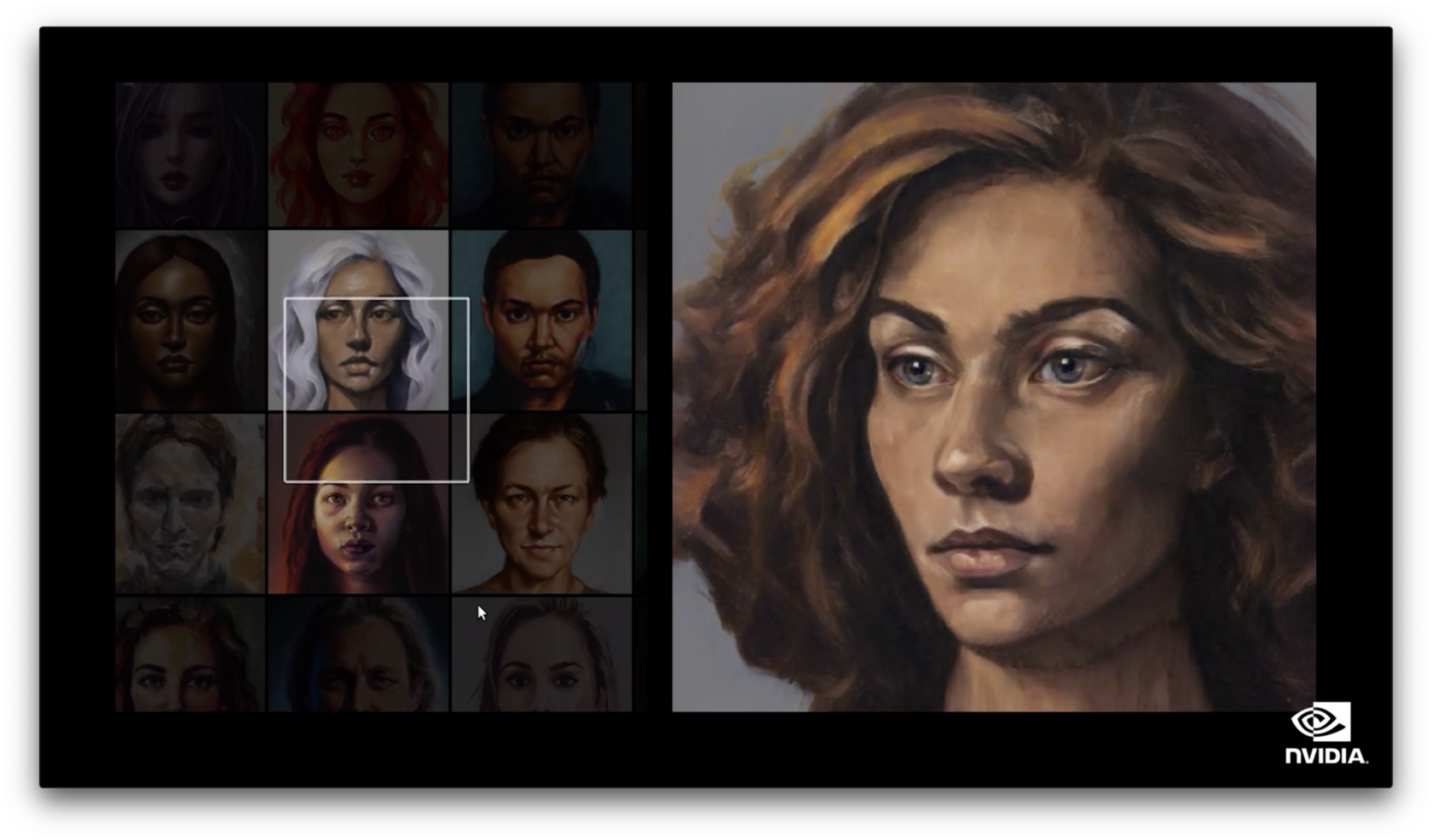
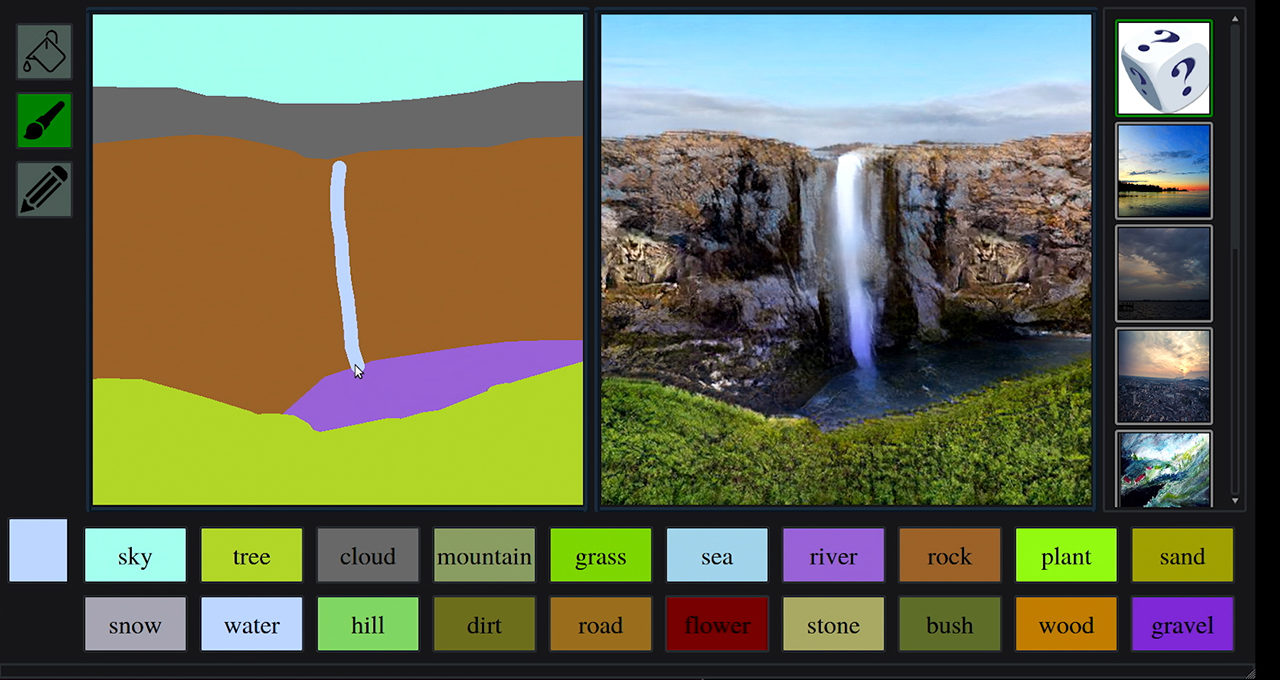
NVIDIA researchers introduced a slew of popular GAN models such as the AI painting tool GauGAN, which later developed into the NVIDIA Canvas application. And with the rise of diffusion models, neural radiance fields and Gaussian splatting, they’re still advancing visual generative AI — including in 3D with recent models like Edify 3D and 3DGUT.
In the field of large language models, Megatron-LM was an applied research initiative that enabled the efficient training and inference of massive LLMs for language-based tasks such as content generation, translation and conversational AI. It’s integrated into the NVIDIA NeMo platform for developing custom generative AI, which also features speech recognition and speech synthesis models that originated in NVIDIA Research.
Achieving Breakthroughs in Chip Design, Networking, Quantum and More
AI and graphics are only some of the fields NVIDIA Research tackles — several teams are achieving breakthroughs in chip architecture, electronic design automation, programming systems, quantum computing and more.
In 2012, Dally submitted a research proposal to the U.S. Department of Energy for a project that would become NVIDIA NVLink and NVSwitch, the high-speed interconnect that enables rapid communication between GPU and CPU processors in accelerated computing systems.
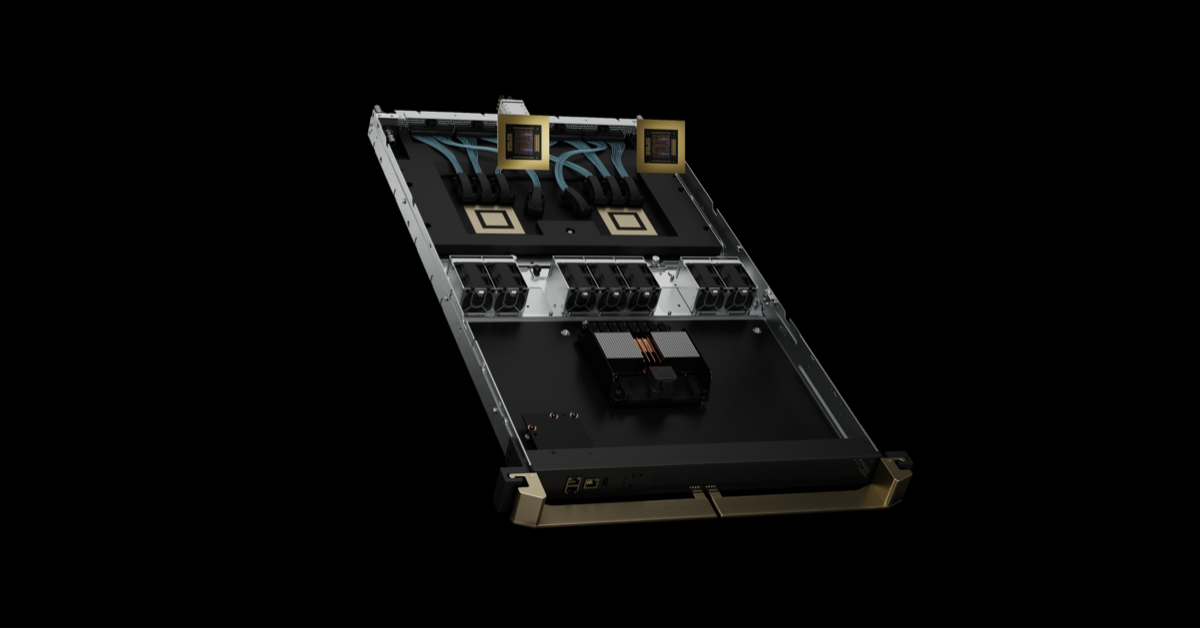
In 2013, the circuit research team published work on chip-to-chip links that introduced a signaling system co-designed with the interconnect to enable a high-speed, low-area and low-power link between dies. The project eventually became the link between the NVIDIA Grace CPU and NVIDIA Hopper GPU.
In 2021, the ASIC and VLSI Research group developed a software-hardware codesign technique for AI accelerators called VS-Quant that enabled many machine learning models to run with 4-bit weights and 4-bit activations at high accuracy. Their work influenced the development of FP4 precision support in the NVIDIA Blackwell architecture.
And unveiled this year at the CES trade show was NVIDIA Cosmos, a platform created by NVIDIA Research to accelerate the development of physical AI for next-generation robots and autonomous vehicles. Read the research paper and check out the AI Podcast episode on Cosmos for details.
Learn more about NVIDIA Research at GTC. Watch the keynote by NVIDIA founder and CEO Jensen Huang below:
See notice regarding software product information.
The roots of many of NVIDIA’s landmark innovations — the foundational technology that powers AI, accelerated computing, real-time ray tracing and seamlessly connected data centers — can be found in the company’s research organization, a global team of around 400 experts in fields including computer architecture, generative AI, graphics and robotics. Established in 2006 and
Read Article
Riverton • Four presidents reside, in some form or fashion, in this Utah mayor’s office. Riverton Mayor Trent Staggs won’t…