





The ex-tropical cyclone made landfall at 9pm on Saturday, but heavy rain and flooding is forecast to continue through Sunday.
The ex-tropical cyclone made landfall at 9pm on Saturday, but heavy rain and flooding is forecast to continue through Sunday.
Here are the latest updates in the aftermath of ex-Tropical Cyclone Alfred hitting the coast.
- Alfred made landfall at 9pm on Saturday, hitting the coast of Queensland between Brisbane and Maroochydore, according to the Bureau of Meteorology.
- In NSW, severe weather warnings remain in place for parts of the Northern Rivers, Northern Tablelands, Mid North Coast and North West Slopes and Plains. In Qld, warnings remain for the south-east coast and parts of Wide Bay–Burnett and Darling Downs regions.
- In Queensland, major flood warnings remain in place for the Bremer River and Warrill Creek, and the Logan Albert River basin. In NSW, major flood warnings remain for the Clarence River at Grafton, the Orara River at Glenreagh and Coutts Crossing and the Richmond River at Coraki and Bungawalbin.
- More than 1800 emergency callouts have been made on Sunday across Queensland and NSW.
- Across both states, hundreds of schools will be closed on Monday – head here for a full list of NSW schools, and here for Queensland.
- A 61-year-old man who died after being swept into floodwaters in northern NSW on Friday has been identified as 61-year-old Tom Cook.
- Thirteen people who were injured in a crash involving two Australian Defence Force vehicles near Lismore are expected to make a full recovery. Two soldiers remain in a serious condition.
- Brisbane has been experiencing strong winds as the ex-cyclone approaches and more than 268,000 homes are without electricity across South East Queensland, and 12,500 without in NSW.
Here’s a quick summary of Queensland Premier David Crisafulli’s press conference earlier this afternoon.
In it, he talks about the next steps for Queenslanders affected by Alfred.
Some public transport services are set to resume across northern NSW and South East Queensland tomorrow even as ex-Tropical Cyclone Alfred continues to bring major flood warnings to other areas.
In Brisbane, where public transport began operating again this morning before drivers were stood down before midday following flash flooding, some bus services will run on a reduced timetable on Monday. All bus services in the Gold Coast have been cancelled. Buses in Logan and Redlands will run according to a Saturday timetable.
In northern NSW, communities in Mid North Coast in towns including Coffs Harbour, Kempsey and Port Macquarie will see a return of some services, while NSW TrainLink will recommence limited coach operations through to Grafton.
But in the Northern Rivers areas such as Tweed, Grafton, Yamba, Kyogle, Ballina and Byron will have over 1000 school services cancelled, as well as 109 regular routes.
Travellers in both states have been advised to continue to check the relevant transport apps.
Queensland police are ramping up patrols after a 26-year-old man allegedly broke into a car in a flooded car park on the Gold Coast and stole items.
More than 110 extra police from north Queensland will join officers in Brisbane and on the Gold Coast under anti-looting Operation Xray Secure.
Deputy Commissioner Cheryl Scanlon said police were committed to keeping Queenslanders safe throughout the extreme weather.
“Whether it’s responding to calls for assistance, disrupting opportunistic thieves targeting innocent Queenslanders’ properties or providing a helping hand where it’s needed most,” she said.
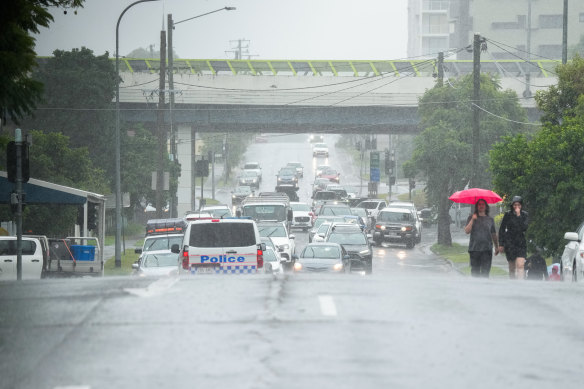
The NSW government has confirmed it will consider delaying the start of NAPLAN tests for public schools in areas affected by ex-Tropical Cyclone Alfred.
The NSW Education Standards Authority (NESA) will work with affected schools to start NAPLAN testing later if needed, to be determined on a case-by-case basis.
The NAPLAN testing window takes place across nine school days, and is scheduled to take place from Wednesday, March 12 to Monday, March 24. NESA and the Queensland Curriculum and Assessment Authority (QCAA) will provide advice to schools as they become operational.
The NSW Education Department will provide an update on Monday to advise school communities on any remaining school closures for Tuesday. You can find the full list of the 255 schools in NSW that will be closed on Monday here.
Education Minister Prue Car said in a statement on Sunday night that while there were no reports so far of major damages to schools in affected areas, it did not mean it was safe for staff and students to travel to and from schools on Monday.
“As the full impact of ex-Tropical Cyclone Alfred continues to unfold and clean-up efforts begin to get under way, our priority is ensuring the safety of students and staff,” she said.
Brisbane has continued to experience some of the worst flash flooding today as the remnants of ex-Tropical Cyclone Alfred have lingered over the city.
Homes in Tingalpa in Brisbane’s south side flooded, and water rose in garages at Nundah on the north side, after 100 millimetres of rain – almost the average monthly rainfall for December – was dumped over the city within two hours this morning.
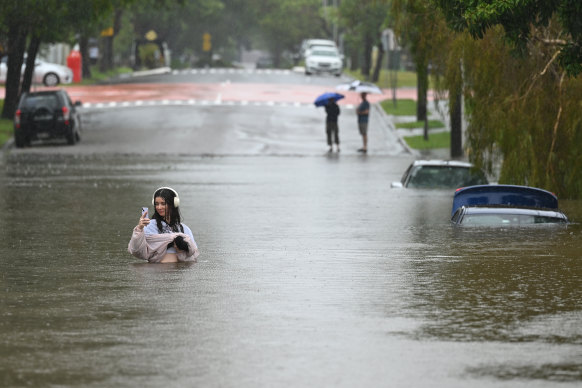
Heavy rain caused flash flooding in parts of Brisbane today, inundating homes on Boundary Street and Wynnum Road in Tingalpa, swamping cars in Newmarket and Stones Corner, and inundating garages in Nundah.
More than 100 roads were closed, with low-lying areas in Windsor some of the first to go under. The Coles at Morningside on the city’s south side was evacuated after its car park flooded.
Woolloongabba, Coorparoo, Carina, Carindale, Richlands, Oxley and Greenslopes have also been affected.

Gold Coast council has issued an emergency warning for major flooding for several suburbs, advising some residents it is too late to evacuate.
Residents in Currumbin, Currumbin Valley, Tallebudgera, Tallebudgera Valley and Elanora have been advised to take action now, by going inside and getting up high. People have been told not to try to drive.
Earlier, City of Gold Coast Mayor Tom Tate warned the council was preparing for the largest disaster recovery in its history.
Queensland Education Minister John-Paul Langbroek has offered cyclone-affected schools the option of pushing back NAPLAN tests a week.
“Schools will communicate directly with their communities to outline their decision concerning NAPLAN,” Langbroek said on Sunday night.
More than 1000 state, Catholic and independent schools were closed across South East Queensland as Cyclone Alfred approached.
As of 5pm on Sunday, 237 of 661 state schools were due to reopen on Monday, with mandatory closures across only the Gold Coast Council area due to ongoing severe weather.
Safety assessments have been done for the Moreton Bay, Brisbane, Redlands, Ipswich, Logan and Scenic Rim regions, allowing some schools to advise of their reopening, while the majority of schools in the Sunshine Coast, Noosa and Darling Downs areas will reopen.
The Bureau of Meteorology’s updated flood warning advice shows the extent to which ex-ex-Tropical Cyclone Alfred is continuing to threaten northern NSW and South East Queensland into this evening.
Major flood warnings are in place for the Clarence River and Richmond River regions in NSW, and for the Bremer River and Warrill Creek area, and Logan and Albert rivers in Queensland.
More residents on the Clarence River have been ordered to evacuate as it continues to rise above safe levels. The NSW SES have directed people in Brushgrove Village to evacuate before 9pm AEDT this evening.
The river at is currently at 5.55 metres and rising at Grafton, above the major flood level of 5.4 metres, and is predicted to reach around 5.8 metres overnight Sunday into Monday.
Queensland, over which the remnants of Alfred have hovered today as they pushed westward, has not received a reprieve this evening. Earlier this afternoon, a severe thunderstorm warning for intense rain and damaging winds was issued for Logan, the Gold Coast, Brisbane, Redland City and the Ipswich council area.
The number of NBN internet services taken out by wild weather has continued to rise today, with South East Queensland still the worst affected.
In a statement this afternoon, the NBN said the number of impacted services in South East Queensland had risen during the day to around 239,000, while the number in northern NSW had also risen to 13,000.
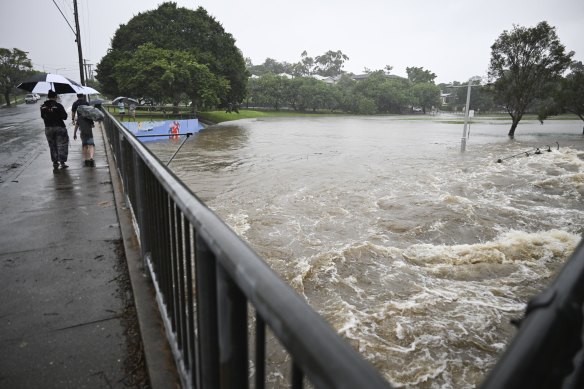
“Many of our sites remain operating on backup power sources and where possible, we are deploying generators to support connectivity and will continue to work with the emergency authorities to deploy more generators today.
“We are continuing to monitor conditions closely so that we can begin deploying our on-the-ground teams as soon as it is safe to do so. Once conditions allow, our crews will assess any damage to network infrastructure and commence repairs.”
Telstra, meanwhile, continued to reconnect customers, but late this afternoon still had disruptions at 164 mobile sites, 7268 landline services, and 1849 ADSL services.
Sydney Morning Herald reporter Angus Dalton has been in Coraki in northern NSW, where the waters of the Richmond and Wilsons rivers meet, intensifying the threat of flood to this evacuated town of 1400.
There Strike Force Kilo, a Fire and Rescue NSW squad, has seized the rare opportunity this afternoon to conduct drills in natural floodwater as the situation stabilises.
The squad, which is poised for a real flood rescue in case someone is swept away, has been practising with drones which can drop lifejackets to people flailing in floodwater or trapped on roofs.
You can read the full story here.
Discover more from World Byte News
Subscribe to get the latest posts sent to your email.
