




Sydney’s education thought leaders have gathered at ICC Sydney for The Sydney Morning Herald School Summit.
Sydney’s education thought leaders have gathered at ICC Sydney for The Sydney Morning Herald School Summit.
The recent establishment of a quality assurance oversight board has provided the NSW Education Standard Authority (NESA) with “a little bit more teeth” to manage the initial teacher education programs provided by universities, chief executive Paul Martin said at today’s summit.
The comments came after a question regarding the criticism of initial teacher education programs in relation to explicit teaching.
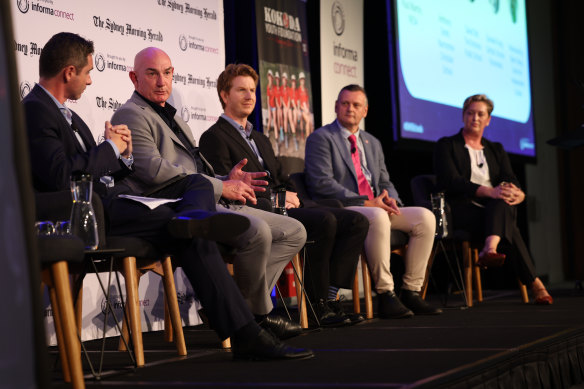
Martin said that criticism of the teacher education system had “occurred for pretty much every year of the last 50 years”, but that that didn’t mean “there aren’t legitimate critiques” of divergent pedagogical approaches taught in universities.
He said there were 109 separate education courses in the state and, while NESA requires those programs to meet syllabus requirements and to undergo assessment, Martin acknowledged that his team were “not sitting in every lecture”.
“There is a balance between the individual university having its own views academically expressed, and the expectations of the teachers of the schools and the children and the systems that they are going to be employed [in].”
Following remarks from Jenny Donovan, chief executive of the Australian Education Research Organisation, a panel is discussing how best to embrace explicit teaching methods in NSW schools.
David Stitt, principal of The Entrance Public School advocated for the methodology, saying that he had observed the change within his own school. Stitt said his school was “underperforming five years ago” but the school was now “significantly” overperforming.
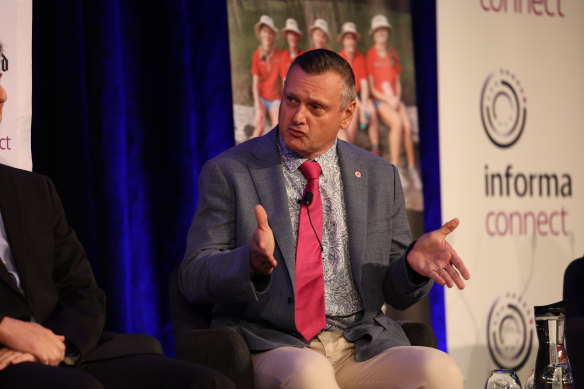
“That just shows that, through this instruction, you can actually meet the needs of the diverse population within your classroom.”
Anthony Smith, teaching and learning co-ordinator at Narromine Christian School, said that “walking into a classroom that is showcasing a high quality, explicit instruction lesson it just has a buzz about it, and I get excited just talking about it”.
The chief executive of the Australian Education Research Organisation, Jenny Donovan, has advocated for explicit teaching at the Sydney Morning Herald’s Schools Summit, as the government and department continue to reinforce the technique.
Donovan said that students learn best from teacher-led education that ensures they have understood a concept before taking on the next step, and that learning in this manner triggers “reward structures” that encourage future growth.

“We talk so much about student engagement in their learning, we try all sorts of extracurricular activities and try and trick them into liking school, but evolution has given our brains a truly wondrous feature when we learn something and can show what we’ve learnt; our reward structure is activated in the brain,” she said.
“Teaching sets students up to experience successful learning, and successful learning fosters a sense of self-efficacy and a further willingness to engage in learning. This is the reason why things like our concerns about wellbeing, our anxiety around attendance, so many things can be addressed when our focus is on the teaching.”
Donovan said that public perceptions of explicit teaching as a “back-to-basics” approach in which a teacher stood at the front of a classroom and talked at students failed to grasp how engaging and effective the technique could be.
Throughout today’s summit a number of speakers, including the Minister for Education and Early Learning Prue Car, and NSW Department of Education Secretary Murat Dizdar, have advocated for the application of research based explicit teaching methods.
Generative AI deployed in the classroom and at home has the ability to “erode effort” and work against student learning, says Anthony England, director of innovative learning technologies at Pymble Ladies College.
Speaking on an AI panel at the Schools Summit, England said “learning is not a fast track thing. You struggle, you fail, you try again and you don’t get a quick answer. AI is so shiny, bright at giving a quick answer, that we might, through the pursuit of efficiency, short-change our students’ growth.”
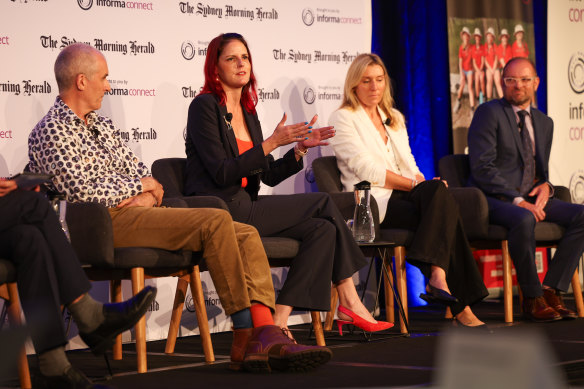
The technology, however, also has “many different opportunities” in teaching, said Miriam Scott, from the Association of Independent Schools of NSW, who also noted that schools, like all workplaces, were “really overwhelmed” with their application of the technology.
“We have schools who are early adopters … and these are the schools who are actually leading the way for all of us, because they’re actually making the mistakes … AI literacy is digital literacy, and digital literacy is everybody’s responsibility.”
Alongside Scott, Paul Wood of the NSW Department of Education said that strong communication between staff, students and parents on the way AI can be used in assessments was integral to managing its use in schooling.
Lee Barrett, from CEnet, said that “teachers, admin staff, students: they need a seat at the table to ensure that AI tools aren’t just gimmicks, but that we are using [them] in the most fundamental, profound ways to benefit student growth.”
Following Michele Bruniges’ presentation on disadvantage in public schools, a panel is discussing how best to support students. Doug Taylor, chief executive of The Smith Family, said his charity worked extensively with students facing disadvantage, including Indigenous students and children from single-parent households, and a holistic approach needed to be taken to tackle the issue.
“We can’t teach our way out of poverty, teaching is necessary, but it’s not sufficient for the sort of challenges [disadvantaged students are facing],” he said. “What we really focus on is how incredibly important partnerships are to enable our schools to do the work that they need to do, to get the sort of outcomes that are necessary.”
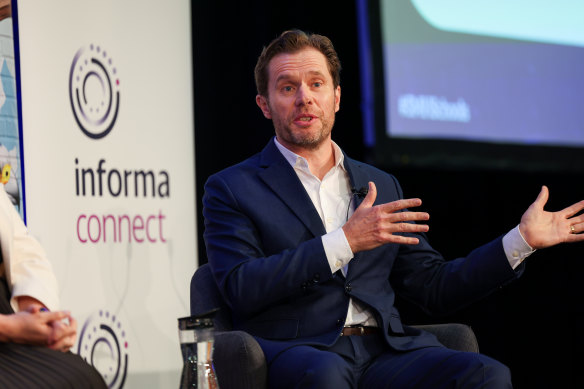
Taylor said the cost-of-living crisis was exacerbating disadvantage, and more attention needed to be paid to the way students accessed technology.
Jeanette Holland, the principal of St Agnes Catholic High School in Rooty Hill, said teaching staff were “swamped with [student] data”, and it was important to humanise that data by connecting to families and fostering a sense of belonging among students who feel distant from the school environment.
“Building relationships with families is really important,” said Holland, who has staff at her school specialised to liaise with families from diverse backgrounds.
“They work closely with our families, reach out and connect them. Sometimes there is a language barrier, so we try to break down those barriers. Any way that we can engage and support our students and our families is really important.”
In her keynote address to the Schools Summit, former secretary of the federal Department of Education and Training Michele Bruniges, has spoken about the impact of a “cycle of negative perceptions” caused by the concentration of disadvantage in public schools.
“The reality is our education system does not deliver the same educational opportunities and support for every child. Sadly, today more children are experiencing socio-educational disadvantage than ever before … children who need the most support are being clustered in the same schools.”
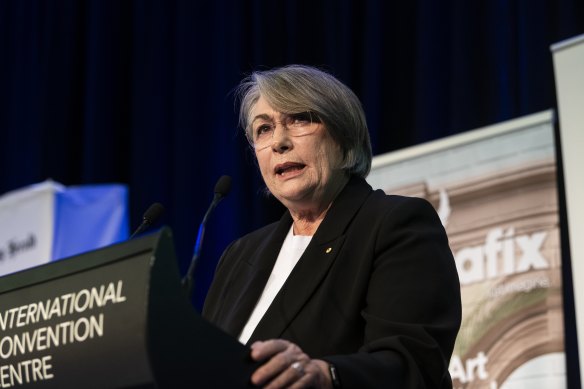
Bruniges said that there was no single solution to the issue, but suggested changes including providing access to meals for students, involving families in the schooling process, and offering more resources to teaching staff. She also called for a “default setting” of registering all new schools as comprehensive, rather than specialist or selective.
“This is a challenging conversation because it lays bare the disparities, but until we find ways to connect different school communities, we will condemn our children and young people to far less,” she said.
“The good news is that there are many opportunities for us to turn this around, for the benefit of our children and our communities.”
Education secretary Murat Dizdar tells Herald education editor Lucy Carroll he believes tutoring is unnecessary and that parents should “back-in their teachers”.
His comments came after a speech in which he said NSW “should not grow more selective [school] provision”.
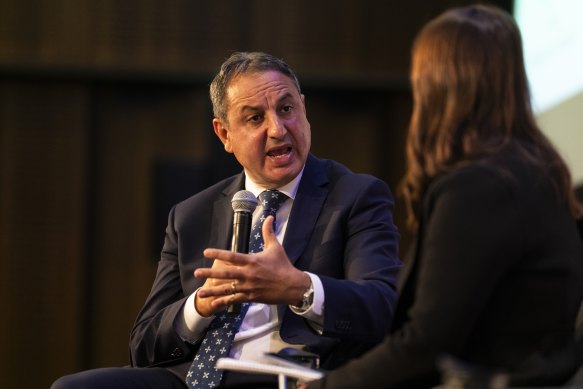
“I think we could do better by way of reporting, explaining to parents what we’re delivering in the curriculum daily … I think the reality is there’ll always be some [students attending tutoring outside of school], but I’d like to minimise what that looks like.”
Dizdar said he believed parents wanted “to do what they think is right for their child” when sending children to tutoring but that the financial costs did not add up.
“We should have these opportunities in every location, in every part of the state, and we need to double down on high potential and gifted schools, no ceilings, no limitations”, Dizdar told the summit.
In conversation with Herald education editor Lucy Carroll, NSW Education Secretary Murat Dizdar has said that he wants teachers to “teach controversial issues” without fear of aligning with the curriculum, despite concerns of politicised learning environments in the lead-up to the federal election.
“We’re not cut off from society,” said Dizdar, who said controversial topics should be taught “as long as we also give balance beyond perspective on all sides”.
Dizdar said when he was teaching high school economics he would have received feedback from parents if he had taught only one side of the debate.
“If I only delivered the Keynesian theory, I would have had parents writing to me saying, ‘You’re ignoring the Marxists’ … the controversial issues are not new, and I give a lot of credit to the workforce.”
NSW Department of Education secretary Murat Dizdar says that the education system must embrace a range of options as students leave high school, citing the skills shortages across the country as a sign that “pushing” tertiary university education may not be an “optimal outcome” for all.
In a wide-ranging speech, Dizdar said the “best measure” would be for every child to end up “after 13 years of schooling in a combination that might be tertiary, that might be TAFE, that might be work”.
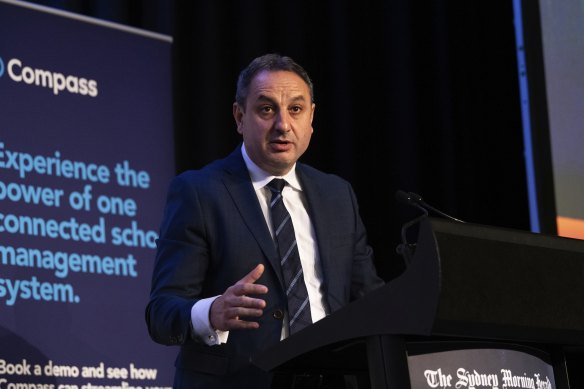
“Every student’s pathway’s got to matter,” said Dizdar.
The secretary also said positivity had returned to the teaching practice, pointing to rising satisfaction results in employee surveys.
“I think our workforce are feeling a little more valued, a little more recognised, a little more satisfied and enriched. And I think that’s really good foundations to build from. More teachers … in front of more classrooms, backing their practice.”
Dizdar also backed explicit teaching practices in the state, saying that he “wished” he had been trained in “that clear, evidence-based road map because my lessons would have been better”.
Following her address, Prue Car spoke to the Herald’s state political editor, Alexandra Smith, about combating antisemitism in public schools.
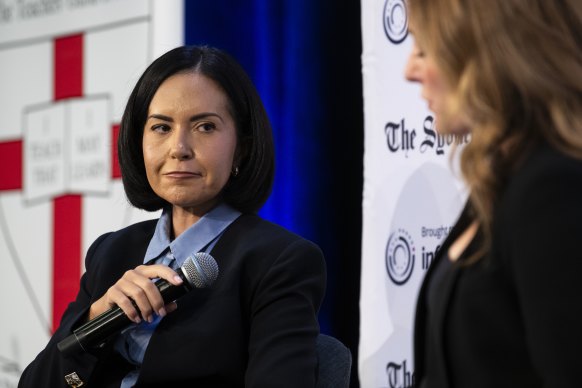
Car said the government “make[s] it really clear that every public school is a place where everyone can belong, no matter where you came from, where your parents or grandparents came from”.
The minister said she had engaged additional security in public schools that were at risk of antisemitic incidents.
“We make sure that we do not tolerate any sort of intolerance, any racism, any antisemitism, any Islamophobia, anything of the sort,” said Car.
“We have very strong systems and processes in place. Everyone’s held accountable. We work through those issues, and unfortunately, things sometimes happen in our schools.”
Discover more from World Byte News
Subscribe to get the latest posts sent to your email.
