





Donald Trump said the two men had a lengthy and productive phone call and agreed to visit each other’s countries, while praising the Russian leader for his “common sense”.
Donald Trump said the two men had a lengthy and productive phone call and agreed to visit each other’s countries, while praising the Russian leader for his “common sense”.
By Michael Koziol
February 13, 2025 — 4.16am
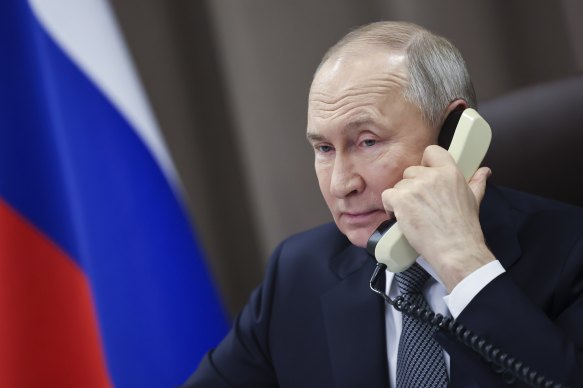
Washington: US President Donald Trump says negotiations to end the war in Ukraine will begin immediately following a “lengthy and highly productive” phone call with his Russian counterpart Vladimir Putin, as the US laid out its blunt vision for a peace deal at a high-level defence meeting in Europe.
Trump said he spoke with Putin on Wednesday morning (Thursday AEDT) and would shortly contact Ukraine’s President Volodymyr Zelensky about peace talks. Trump said Putin, like himself, believed “very strongly” in common sense, and the two agreed to “work together very closely, including visiting each other’s nations”.
Meanwhile, in his first overseas trip as US Defence Secretary, Pete Hegseth laid out the new administration’s blunt approach to resolving the three-year-old conflict at a meeting of the Ukraine Defence Contact Group in Brussels, dismissing many Ukrainian goals as unrealistic.
Ukraine could not return to its pre-2014 borders with Russia, nor could it join the North Atlantic Alliance (NATO), and the US would not deploy troops there in any peacekeeping mission, Hegseth said.
Trump – who, during the campaign, vowed to end of the conflict “in 24 hours” if elected – had been expected to depart from his predecessor Joe Biden’s approach and urge greater concessions to Putin, with whom Trump enjoys a good relationship.
Hegseth confirmed the new administration’s position in emphatic terms, while also stressing the US was too busy staving off China’s aggression in the Pacific to prioritise European matters.
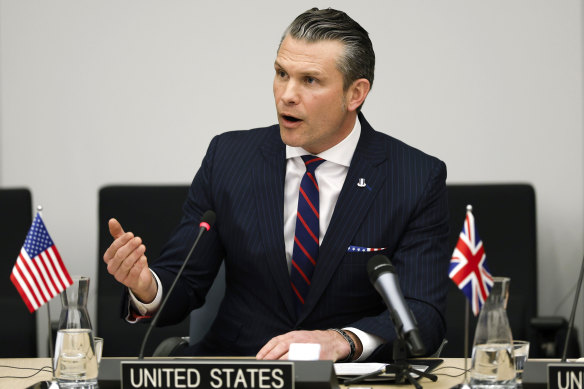
“We want, like you, a sovereign and prosperous Ukraine. But we must start by recognising that returning to Ukraine’s pre-2014 borders is an unrealistic objective,” he said. “Chasing this illusory goal will only prolong the war and cause more suffering.”
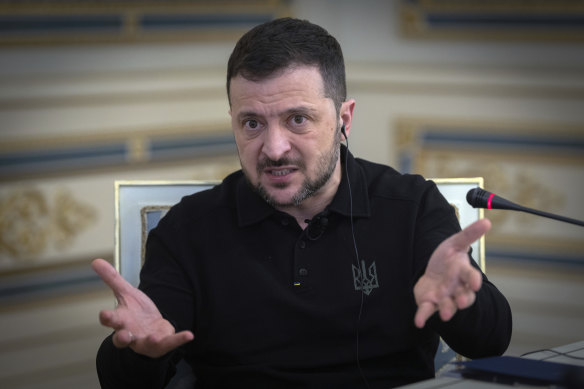
Zelensky has already said he is willing to cede some territory to Russia, but indicated this would need to be accompanied by NATO membership and a NATO military presence in Ukraine to fend off any future Russian aggression.
Advertisement
In 2014, Putin began backing separatists in the eastern part of the country and annexed the Crimea peninsula, although it is still recognised by most countries as part of Ukraine. Zelensky has said Ukraine will not take back the territory militarily, but hopes to regain it by diplomatic means.
While the Trump administration wanted robust security guarantees for Ukraine, “the United States does not believe that NATO membership for Ukraine is a realistic outcome of a negotiated settlement”, Hegseth said.
“Instead, any security guarantee must be backed by capable European and non-European troops. If these troops are deployed as peacekeepers to Ukraine at any point, they should be deployed as part of a non-NATO mission, and they should not be not covered under Article 5.”
That article, a core tenet of the treaty, states that an attack on any member state is considered an attack on all, compelling assistance from all members. “To be clear, as part of any security guarantee, there will not be US troops deployed to Ukraine,” Hegseth said.
Wednesday’s phone call between Trump and Putin was the first official exchange between the two men that Trump has confirmed since returning to the White House, but he has hinted at other calls.
On the weekend, he told The New York Post’s Miranda Devine he had spoken with the Russian President but would not confirm how many times. “I’d better not say,” he reportedly said.

The US also secured the release of an American schoolteacher, Marc Fogel, who had been imprisoned in Russia for four years. Fogel flew home to the US on Tuesday and met Trump and other dignitaries at the White House that evening. Trump was coy about what the deal involved, but the Kremlin since said a Russian prisoner was being released from the US.
On the US side, the Ukraine negotiations will be led by Secretary of State Marco Rubio, CIA director John Ratcliffe, National Security Adviser Michael Waltz and Trump’s special envoy Steve Witkoff.
In Brussels, Hegseth also reiterated Trump’s insistence that NATO members spend 5 per cent of their gross domestic product on defence, something only Poland comes close to doing. Spending more on defence was “a down-payment on peace through strength”, he said.
“Stark strategic realities” prevented the US from focusing on the security of Europe, Hegseth told the meeting, and said China had the capability and intent to threaten the US at home and its core interests in the Indo-Pacific.
“The US is prioritising deterring war with China in the Pacific, recognising the reality of scarcity and making the resourcing tradeoffs to ensure deterrence does not fail,” he said. “As the United States prioritises its attention to these threats, European allies must lead from the front.”
While the US remained committed to the NATO alliance, it “will no longer tolerate an imbalanced relationship which encourages dependency”, Hegseth said. He did not take questions.
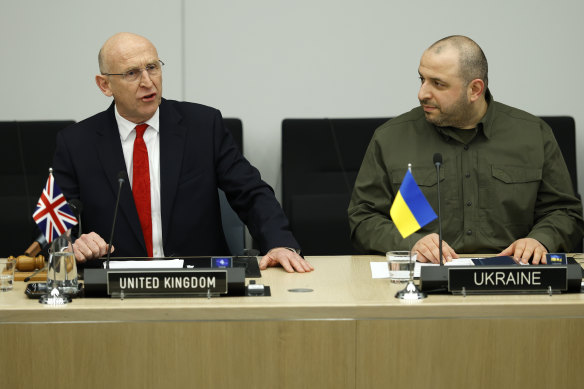
Speaking directly afterwards, UK Defence Secretary John Healey said members of the Ukraine Defence Contact Group heard his message clearly and were determined to end Putin’s war.
“On stepping up for Ukraine, we are and we will. On stepping up for European security, we are and we will,” he said.
Get a note directly from our foreign correspondents on what’s making headlines around the world. Sign up for the weekly What in the World newsletter here.
Michael Koziol is the North America correspondent for The Age and Sydney Morning Herald. He is a former Sydney editor, Sun-Herald deputy editor and a federal political reporter in Canberra.Connect via Twitter.
Loading
Discover more from World Byte News
Subscribe to get the latest posts sent to your email.
